Crystallization, recrystallization, melting point analysis and TLC.
Crystallization
- Crystallization is the formation of a solid in crystalline form from the gas or melt phase.
- The process occurs by either supersaturating a concentrated solution, lowering the temperature, or evaporating the solvent.
- In this method, most contaminants usually remain in the solution.
- Crystallization is often used as a purification step, e.g. in sugar production.
Recrystallization
- Cleansing of crystalline matter.
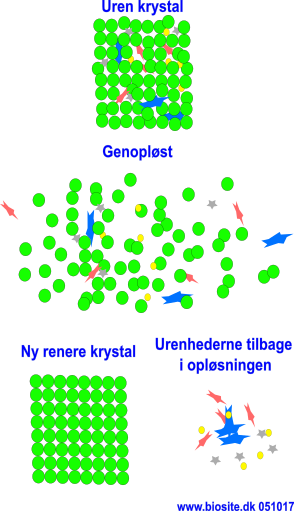
- Redissolution and recrystallization.
- The purpose is to increase the purity of an already crystallized substance.
- Increasing the purity, the impurities remain in the mother liquor (i.e. the remaining solution).
- Redissolve crystal by heating and subsequently restore by cooling.
- The yield percentage decreases, as the mother liquor has a higher saturation of the desired substance.
- Evaporation and cooling can crystallize out if recrystallization, i.e. that more of the desired substance comes in, but the impurity increases.
- The crystals from the recrystallization can be dissolved again and returned to the primary crystallization.
Melting point analysis
- Melting point analysis is a method of determining the temperature point at which a substance changes from solid to liquid.
- The analysis is used to determine the purity of a sample.
- Impurities in the molecular lattice lower the melting point.
Thin Layer Chromatography (TLC)
Stationary: Stationary plate/paper
Mobile phase: movement running fluid
- TLC can be used on many different substance mixtures such as colour mixtures, amino acids, lipids, alkaloids and mycotoxins.
- Chromatographic separation technique where a plate is used either of glass or strong aluminium foil.
- The plate on one side is covered with a powder which has different properties in relation to which substance classes you want to separate.
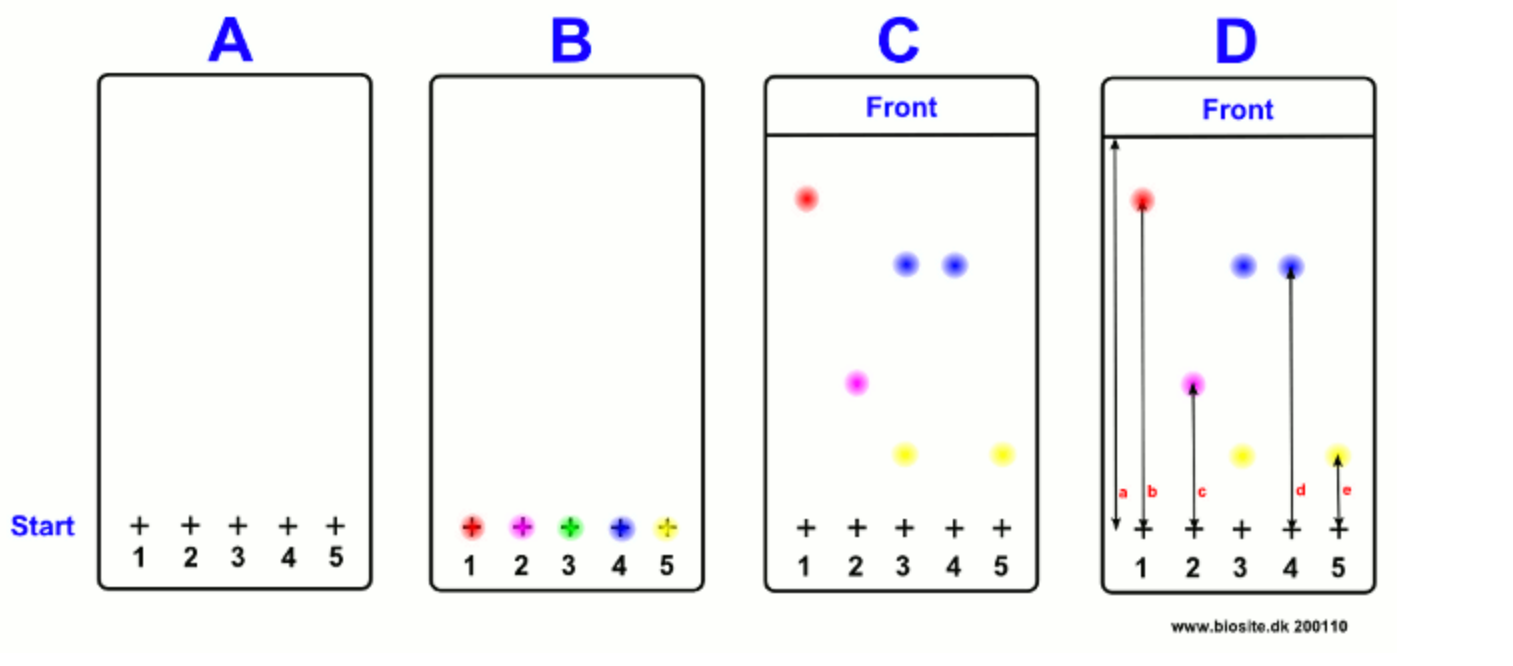
- On the lower part of the plate, attachment points are marked, usually with a soft pencil, where a few drops of the substance mixtures are then placed with a micropipette.
TLC method (simplified).
- Apply a solution of the substances to be separated into the lower part of a plate.
- Also, apply standard solutions of known substances.
- Place the plate upside down in a beaker with a suitable solvent at the bottom.
- Wait for the solvent to move up the plate.
- Remove the plate when the solvent is approximately 1 cm from the top edge of the plate.
- Mark the position of the liquid front with a pencil.
- Use a beaker with a lid and filter paper to saturate the air with the solvent vapours.
- Analyze the coloured spots that have moved differently up the plate.
- Identify the different dyes in the mixture using the location of the standard solutions on the plate.
Result processing of TLC.
- To compare the running length of the spots, RF values are used. (Relative to Front or retardation factor).
- The RF value is determined by measuring the running distance of the spots.
- The running distance is measured by measuring from the individual spot to the centre and then dividing this length by the length of the liquid front.
- 2D-TLC is used for more complex mixture systems.
- First, the TLC plate is developed in a solvent mixture which separates the polar components, and then the plate is dried.
- The plate is then turned 90 degrees and developed in a solvent mixture which separates the non-polar components of the mixture.