Chemical Reactions + Quantities
Chemical v Physical Changes
Chemical changes require a change in atomic composition.
Physical changes allow alterations of form and state
Stoichiometry
The study of numerical relations
Balancing Rules
Balance the most complex molecule first
Do pure substances last
If using fractions, multiply til whole
Count em up!
Stoichiometry
Stoichiometric ratios take the amount of molecules needed to balance an equation and put them in mole form, and relate them in a product:ratio way. These ratios help in mole-mass and mass-mass conversions.
Mass of A → Moles of A → Stoichiometric ratios B:A → Moles of B → Mass of B
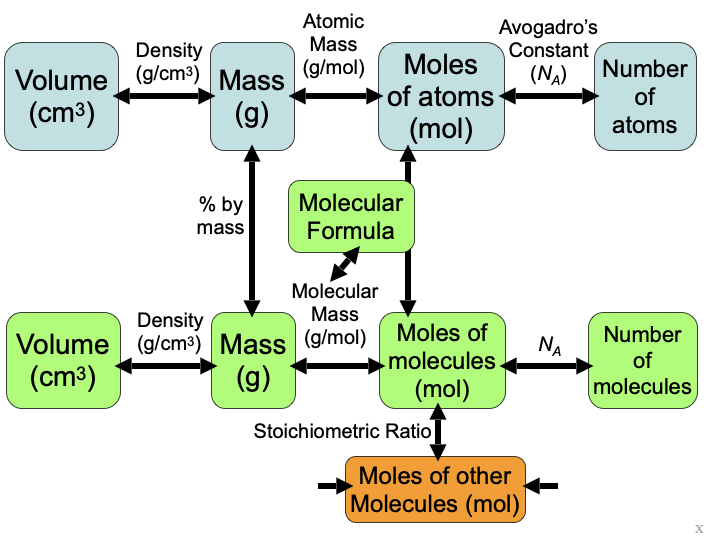 Limiting reagent - reagent that is consumed first
Reagent in excess -
Theoretical yield - how much of a product should be made based of limiting reagent
Actual yield - amount actually produced by a chemical reaction
Combustion
Oxygen in 2 forms in the product.
Solutions
dilute- small amount of solute to solvent
concentrated - large amount of solute to solvent
saturated - maximum concentration
ion concentration-
Molarity - amount of solute (mol) / volume of solution (L)
The molarity of a solution in a conversion factor between moles and volume. When diluting solutions to lower concentrations, more solvent is added, amount of solute stays the same. Concentration and volume inversely proportional.
M₁ × V₁ = M₂ × V₂
Aqueous
Salt and sugar water dissolve in water because they are similar. Substances are soluble if they dissolve in water. CHO is covered in OH- groups, salt . Attractive forces between solute and solvent are made when they are mixed together. Attractive forces between the compound and the solvent are competing. Solute only dissolves if the attractive forces are strong enough. When NaCl is mixed w water, h2o surrounds each cation and anion.
Electrolytes are substances that disassociate in water (at different levels). They also allow electricity to conduct through water. Strong electrolyte dissociate completely, weak electrolyte dissociate only somewhat.
When a compound has more ions in it, it has the ability to dissociate more. This makes a stronger electrolyte.
Conducting electricity required charged particles than can move
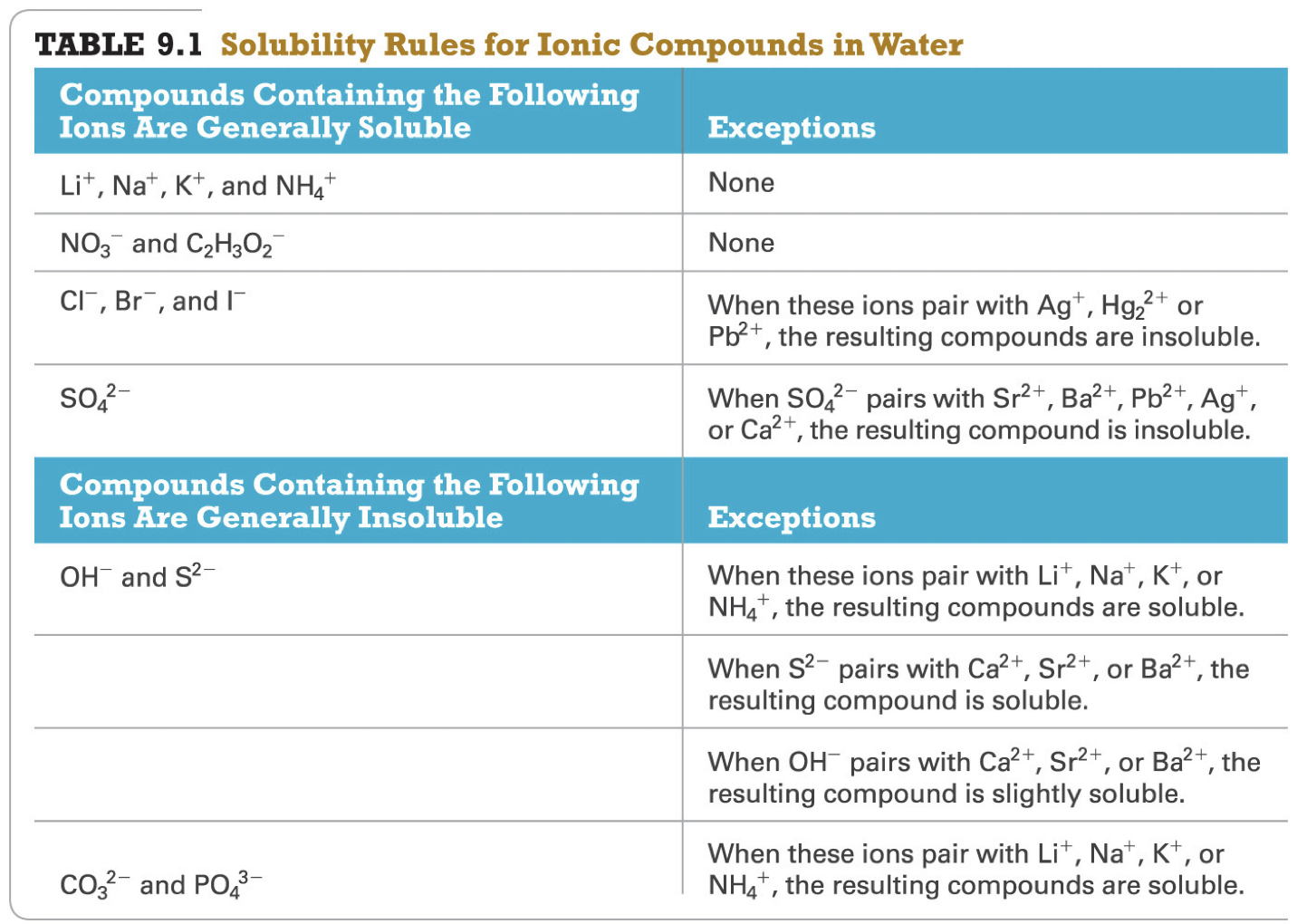
2 aqueous solutions the form a solid when mixed is a precipitation rxn. The product is insoluble in water, thus does not dissolve upon the chemical change. If the product IS water soluble, solution stays liquid. ALL AQUEOUS MEANS NO RXN.
Predicting precipitate
What ions are here?
What products could form?
Exchange ions
Balance charges
Find solubility
Use chart above
If neither forms precipitate, say no reaction after the arrow
XXX + XX → no reaction
If product is insoluble, write (s), if soluble (aq)
Balance equation
Polyatomic ions do not break apart
A complete ionic equation
Aqueous,s trong electrolytes are written as ions
Gaseous

spectator ions - don’t really do anything, help balance out charges sometimes
net ionic equation - written w/out spectator ions, the isolated equation for the precipitate