3.3, 3.4, 3.5
Mandate: backed by threats of penalties for non-compliance & provide little to no compensation for the costs of implementation
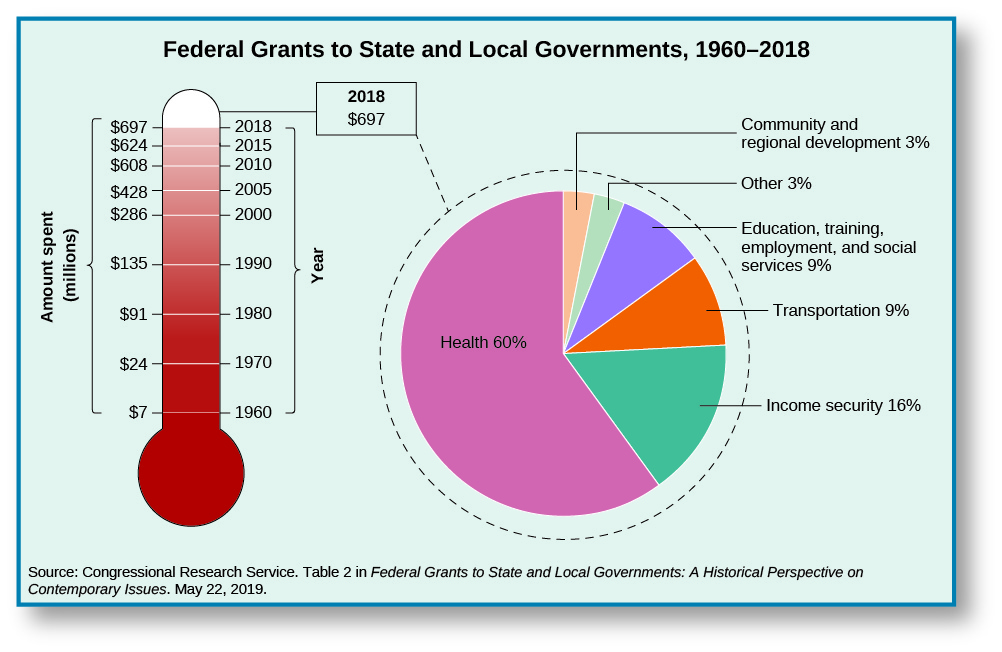
Grant: financial inducements to get states to work toward selected national goals
Land grants: in the first 1/2 of the 1800s, land grants were the main way the fed gov supported states, millions of acres of fed land were donated to support infrastructure. many universities are land-grant institutions
Categorical grants: federal transfers formulated to limit recipients’ discretion in the use of funds and subject them to strict criteria that guide project selection, performance, and financial oversight, among other things. Often require a commitment of matching funds from the state.
- ex. Medicare & Food Stamp program
Block grants: less stringent federal administrative conditions & greater flexibility
- ex. Workforce Investment Act program provides state and local agencies money to help youths and adults obtain skill sets that will lead to better-paying jobs
Venu shopping: the government has multiple access points, if people want to make change happen they can choose to rally at different levels and even branches of government
Pros of Federalism:
- Venu shopping: our system creates 2 levels of gov with the capacity to take action, failure to attain a desired policy goal at one level can be offset by successfully securing the support of elected reps at another level
- Promotes policy innovation & political participation and accommodates diverse opinions
Cons of Federalism:
- Race to the bottom dynamic: states compete to attract businesses by lowering taxes and regulations, and worker rights often suffer due to this as regulations are loosened. The reduction of payroll taxes leads to underfunding of the unemployment insurance programs
- The difficulty of taking action on issues of national importance
- Economic differences between states have a large impact on citizens well being.
- ex. example, in 2017, Maryland had the highest median household income ($80,776), while West Virginia had the lowest ($43,469).There are also huge disparities in school funding across states. In 2016, New York spent $22,366 per student for elementary and secondary education, while Utah spent $6,953. Furthermore, healthcare access, costs, and quality vary greatly across states. Proponents of social justice contend that federalism has tended to obstruct national efforts to effectively even out these disparities. When