Chronology of the Big Bang
13.7 Ga
(Ga = Billion years ago)
Singularity → The Big Bang
1 second after BB
Quarks
3 minutes after BB
nuclei formed
of hydrogen and Helium
Roughly ¾ and ¼ respectively
300k years after BB
electrons can form bc the earth cooled off enough to form atoms
1 Ga after BB
molecular clouds
hydrogen burning
doesn’t blow up because gravity won’t let it
First stars form
Iron kills a star
it doesn’t compress
When an element doesn’t compress the only thing a star can do is blow up
Nucleosynthesis - Stars making bigger elements
Supernova - Releases more energy than our sun will in our entire lifetime (bigger than big bang)
Shockwave from a Supernova
Terrestrial Planets → Gas Giants. (Jovian Planets)
Mercury, Venus, Earth, Mars - terrestrial Planets
Their interiors
they have a core of different compositions
Early on the terrestrials melting - as they cooled, they became less and less geologically active
Radiation is what runs our internal heat
Earth - only one that has a true satellite (the moon)
Mars has 2 moons - they’re not real moons
it was clickbait
it was stolen meteors from the asteroid belt
Stolen badly so it will collide into mars
Moon stabilizes the axis
provides tides
cool gravitational pull
yadda yadda
Mars
no air to breath
freeze to death at equator
Jovians (Gas Planets)
Bodies at least 10x the size of the earth
They’re rock and Gases
The rock being heavier sunk to the core
no actual crust
the gas surrounds/hugs the core
The Jupiter System
have small icier bodies circling them
They all have rings
The gravity of the giant Jovians suck in the rings
Small Solar System Bodies
Asteroids and Comets
the little scraps that never got together
most asteroids aren’t big enough (typically) to be spherical
Meteors - if it burns up in the atmosphere (shooting star)
Meteorites - if some of it hits the ground (now it’s a rock)
Meteroid - bad space puppy that doesn’t stay in the asteroid belt
Asteroid - good puppy in the asteroid belt
Past Neptune is what’s called- the Kuiper Belt
lots of ice
Keiper Belt Ice object - Pluto, Eris, Ceres
IAU - International Astronomy Union
namers of space stuff
Planet
hydrostatic equilibrium
be a ball
orbit the sun
cleared its path of all other major bodies
Oort Cloud
over a lightyear in diameter
completely surrounds our solar system
Problem with Comets
we can only see them when they get close
You see them too late to run, hide, migrate to mars, etc
Walk through the history of the Earth
History of the Earth
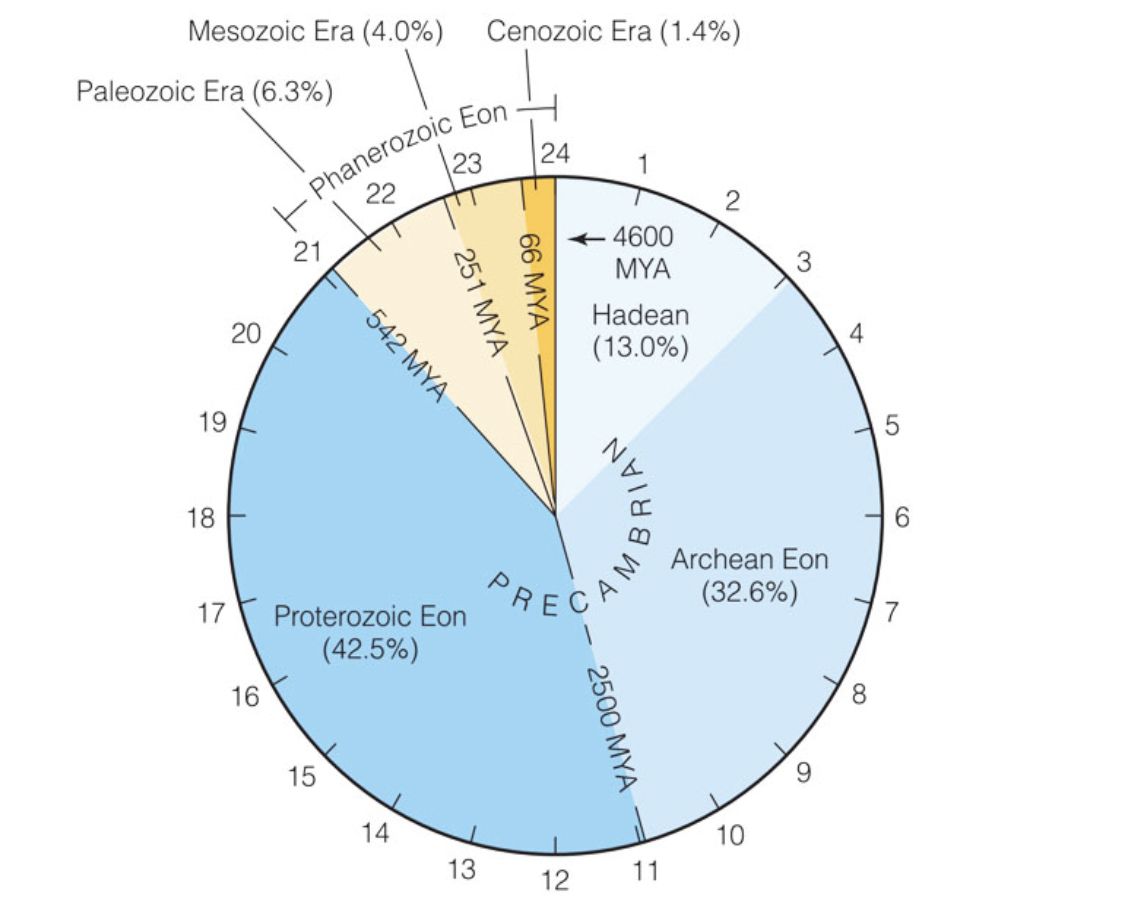
The solar nebula hypothesis is the most widely accepted explanation for how the solar system, including the sun, planets, and other celestial bodies, formed. It proposes that the solar system originated from a large cloud of gas and dust called the solar nebula, which collapsed under its own gravity.
Hadean Eon - accretion and differentiation
no solid rocks
hot as FUCKKK
Theia - the mars-sized impactor
it’s not mars
Archean Eon
continental crust building