Waves
4.1 Waves and Vibrations
Longitudinal and transverse waves (GCSE)
Polarisation
Longitudinal waves cannot be polarised since the oscillation occurs only along the line of propagation; there’s no perpendicular component that could have different orientations.
Transverse waves CAN be plane-polarised if the vibrations stay in one plane only. Light from a candle is unpolarised, but if it is passed through two polaroid filters, the transmitted light changes intensity if one polaroid is turned relative to the other.
4.2 Measuring waves
Phase difference: the phase difference of a vibrating particles at a certain time is the fraction of a cycle it has completed since the start of the cycle.
4.3 Wave properties 1
A ripple tank may be used to study wave properties, such as reflection, refraction, and diffraction.
Reflection: the bouncing back of a wave when it encounters a boundary/surface. Reflects occurs at interfaces where the wave speed changes, leading to a change in direction while maintaining the wave’s energy.
Refraction: the bending of a wave as it passes from one medium to another, resulting in a change in speed and direction.
Diffraction: the spreading out of waves when they encounter an obstacle or slit that is comparable in size to their wavelength. This phenomenon leads to the formation of interference patterns and is most noticeable with waves such as sound and light.
—> the longer the wavelength and the narrower the gap, the more the waves spread out (diffract).
Wave properties 2
Superposition
Definition: when waves meet, they pass through each other, but at the instant they meet, they combine.
The principles of superposition states that when two or more waves overlap in space, the resulting wave displacement at any point is equal to the sum of the displacements from each individual wave.
Supercrests and supertroughs are created (constructive interference).
Destructive interference is when a crest meets a trough of the same amplitude — they cancel out - displacement of 0.
Progressive wave: travels through space, transferring energy from one point to another. Can be either longitudinal or transverse.
Stationary wave: results from the interference of two waves moving in opposite directions (e.g. guitar string, or two people shaking a rope). It doesn’t travel through space, but rather oscillates in place. The points of maximum amplitude (antinodes) and 0 amplitude (nodes are formed due to interference.
Coherent sources of waves: produce an interference pattern where they overlap, because they vibrate at the same frequency with a constant phase difference.
4.6 More about waves on a string
First harmonic: in a stationary wave, the first harmonic has one antinode and two nodes at either end. In a string, this corresponds to the string vibrating in its simplest form.
Second harmonic: the first overtone and occurs at twice the frequency of the first harmonic. In a stationary wave on a string, the second harmonic has two antinodes and three nodes.
Explanation of the stationary wave patterns on a vibrating string: The crest reverses its phase when it reflects at the fixed end and travels back along the string as a trough. When it reaches the vibrator, it reflects and reverses again, travelling away from the vibrator once more as a crest. If the crest is reinforced by a crest created by the vibrator, the amplitude of the wave is increased. This is how a stationary wave is formed.
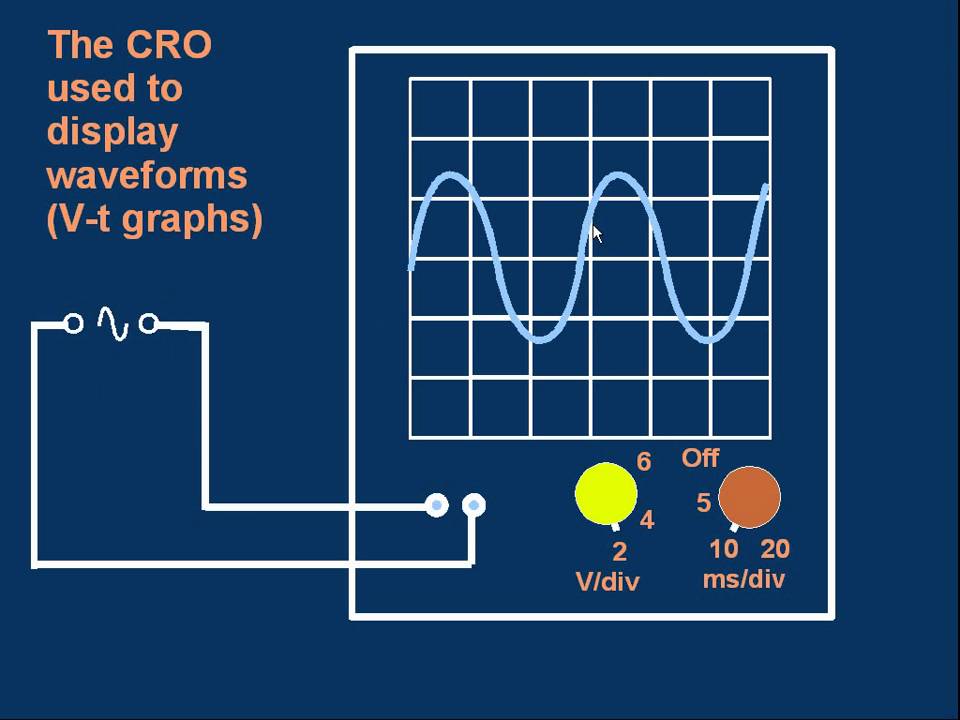
4.7 Using an oscilloscope
A device used to visualise and analyse the waveform of electrical signals. Allows users to observe the shape, frequency, amplitude, and other characteristics of the signal.
The displacement of the spot on the screen is proportional to the applied pd.