Humanities Exam Revision
World war 1 history and Civics and citizenships
WORLD WAR 1 HISTORY
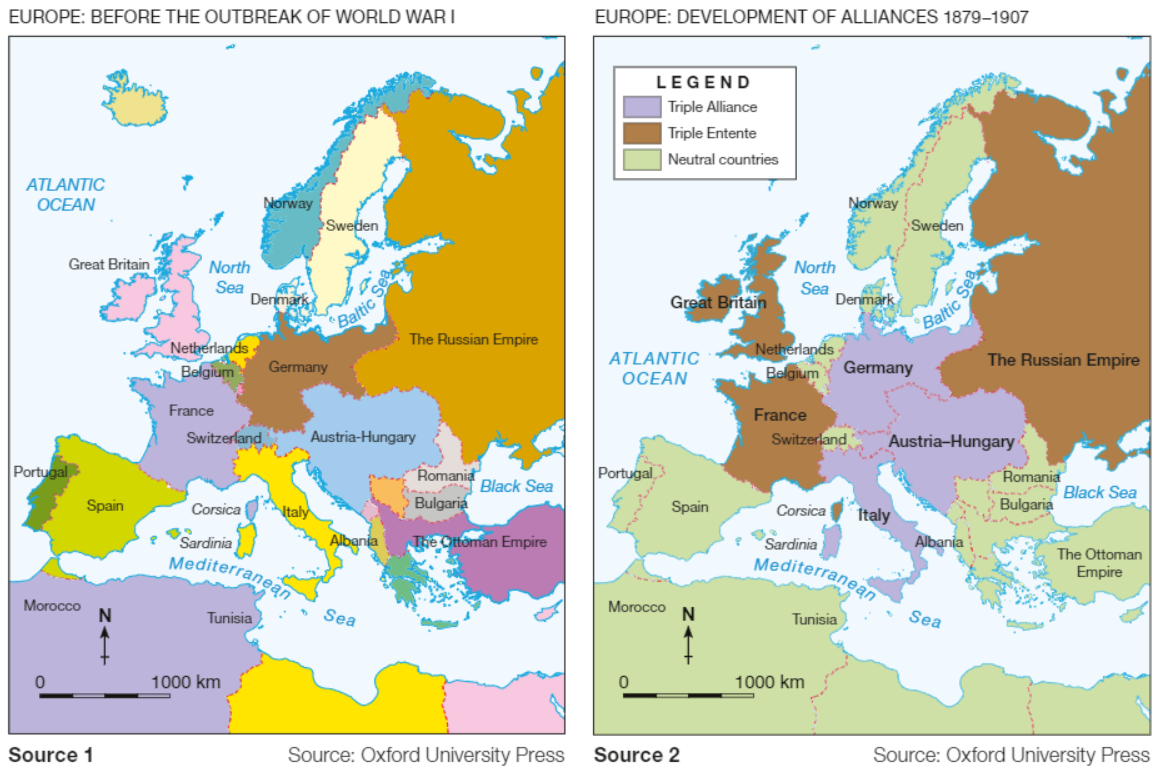
World War I was between two groups of countries — the Allies and the Central Powers
How did they form?
@@Triple Entente:@@
- The Russian Empire
- Great Britain
- France
==Triple Alliance:==
- Germany
- Austria-Hungary
- Italy
%%Neutral Countries:%%
- Switzerland
- Belgium
- Romania
- Bulgaria
- The Ottoman Empire
- Denmark
The 'spark' was the of of the @@Austria-Hungarian empire i@@n @@Sarajevo, Bosnia,@@ on @@28th June 191@@4, by a man named @@Gavrilo Princip.@@
%%Trench warfare:%% a type of combat in which opposing troops fight from trenches facing each other.
Conditions: The conditions in the trenches were horrible. The living conditions were harsh, stagnant and extremely dangerous. Lice, fleas and rats were everywhere. Many men suffered from in
==Battlefronts in Europe: (The Western Front)==
- The Gallipoli Campaign - Location, rationale and dates (start and end)
- The make-up of the Australian armed forces - reasons for enlistment
- ^^The Treaty of Versailles - What is this?^^
A signed by the Allied in the outside of is in
Took force on Jan 10th, 1920. 23 countries signed to promote peace. Germany was forced to sign.
- The impact of WWI on the Homefront (in Australia)
More control was taken over people’s lives by the Australian Government.
The issue of conscription divided Australian society.
Participation of women in the workforce increased. Women volunteered as nurses in the Red Cross, and often did men’s jobs.
Australia developed a strong sense of identity based on the ANZAC legend. Naïve attitudes about the war were gone forever.
\n
Definitions
- %%MAIN%%-
- ==ANZAC==- Australian and New Zealand Army Corps
- @@Conscription@@-Compulsory enlistment of citizens to serve in the armed forces
- -Distortion of the truth to persuade people to support an action or point of view
\n
Dates
- WWI Started on the ^^28th June 1914- 1918 11th November^^
- Withdrawal of Australian armed forces from Gallipoli- @@25th April 1915-15th December 1915@@
- @@June 28th 1919- Treaty of Versailles signed@@
- @@Peace armstice signed to end WWI November 11th 1918@@
\
*Note:History section of exam will be a combination of multiple choice and an extended response using source material. \n
Civics & Citizenship \n
General knowledge
- Another term for the Australian government \n %%The Federal parliament%%
- The type of voting used to determine the seats in the House of Representatives
%%Preferential voting-%% results in the election of candidates supported by the majority(76 or more) of voters
- The term used to describe the political party that has the second most seats in the House of Representatives
%%Liberal party%%
- Australia’s system of government
==Democracy- a way of governing in which depends on the will of the people==
- The term used to describe the leader of the political party with the most seats on the House of Representatives
@@Labor party@@
- Supreme court jurisdiction
- The highest court in Australia
@@The High Court@@
- The arms that make-up the Separation of Powers and its importance in Australia’s legal system
@@Judiciary- power to make judgements on the law (Courts, judges & magistrates)@@
@@Executive- power to put laws into action@@
@@Legislative- power to make and change laws@@
It is important because
- The claim value of the Magistrates’ Court
@@Nothing exceeding $100K@@
- Seats in the House of Representatives
@@151@@
- An example of a lower court
@@County court- n@@o monetary limit on the jurisdiction
- The process by which the Australian Constitution can be changed
@@A referendum.@@ Electorates vote for a proposed change to the Australian Constitution.
- The difference between civil and criminal law
^^Civil law- Civil law deals with non-criminal disputes between individuals or groups. These can arise in matters related to business dealings, or when a person is harmed by the careless actions of another.^^ Civil cases also operate under the adversarial system, with each side presenting their arguments before an independent judge or magistrate. Person making the complaint - plaintiff
- Person accused of doing harm - defendant. If the plaintiff is successful, the defendant can be required to provide compensation for the harm done.
- %%Criminal law%% %%protects the community from the harmful actions of others. When a person commits a crime, the state%% %%prosecutes%% %%that person by having them taken before a court.%%
- Courts operate under adversary system- two opposing sides present their arguments to a judge or magistrate. The prosecuting side (the prosecution) is required to prove the guilt of the person accused of the crime. The accused person has a right to present his or her side of the argument (known as the defence). %%In criminal cases, a person found to be guilty will be sentenced to receive a punishment, such as imprisonment or a fine.%%
An area of law for which a court has responsibility is known as its jurisdiction. In criminal cases the higher courts have jurisdiction over the most serious crimes. In civil cases the higher courts have jurisdiction over matters that will affect many people, involve complex legal issues or large sums of money.
- Cases in higher courts are more expensive. If an individual is unhappy with the ruling in a lower court, he or she can apply to have the case heard in a higher court. This process is referred to as ‘making an appeal against a court decision’.
- Court hierarchy- ==Magistrates’ court== → @@County Court@@ →
- @@The County Court hears more serious criminal cases such as armed robbery, serious drug-related offences and serious assaults. Murder-related cases are heard in the highest state court, the Supreme Court.@@
- ==Magistrates’ court hears matters relating to family law and child support, copyright, human rights. Monetary claim cannot exceed $100k.==
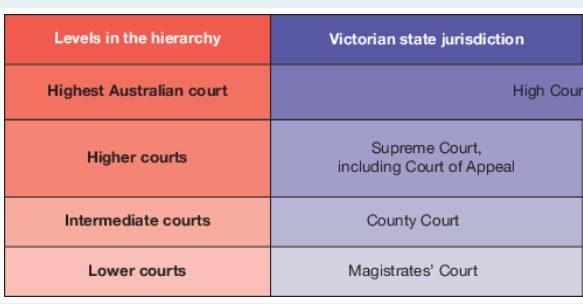 Highest court in Australia- The High Court. %%It has the power to interpret the Australian Constitution.%% The court reads, interprets and applies the words of the Constitution in disputes when they arise. \n
Definitions
- The aim of each political party is to win a majority in the House of Representatives and form government, so their ideas can affect the way Australia is governed.
- Judges are bound to follow interpretations of the law made by judges in higher courts, in cases with similar facts or involving similar legal principles.
- A vote used to approve a change to the Australian Constitution.
- -The individual, organisation or corporation against whom/which legal proceedings are commenced. Also known as a
- @@Representative Democracy-Australia’s form of government. People elect representatives to sit in Parliament to make laws on their behalf.@@
\n \n
*Note: Civics & Citizenship section of exam will be a combination of multiple choice, short answer and case study response.
\n \n