Biological Molecules: Carbohydrate Classification, Nutrition, and Food Testing Protocols
Foundations of Biological Molecules
Molecular Basis of Life:
Understanding biological molecules enables the investigation of living organisms at the cellular and molecular levels.
Knowledge of biological macromolecules informs dietary decisions to maintain physiological homeostasis and construct balanced diets.
Major Classes of Biological Nutrients:
Carbohydrates: Main source of energy for your body
Proteins and Enzymes: Polypeptides essential for enzymatic catalysis, cellular structure, transport, and immune defense.
Proteins: Composed of amino acids, proteins are crucial for growth, repair, and maintenance of body tissues.
Enzymes: Biological catalysts that accelerate chemical reactions in the body, enzymes are typically proteins that lower the activation energy required for reactions, thus playing a vital role in metabolism and various biochemical processes.
Lipids: Fats and oils that serve as energy stores in the body (found in foods like butter and olive oil).
Macronutrient Classification of Dietary Staples:
Carbohydrate-Dense Sources: Starchy staples and grains including sliced bread, processed pasta, milled rice, and whole cereals.
Protein-Dense Sources: Animal muscle tissues (beef steaks, chicken drumsticks, spare ribs, sausages), fish (salmon), and mammalian milk.
Lipid-Dense Sources: Pure fats and oils, including emulsified butter and cold-pressed extra virgin olive oil.
Fibre and Micronutrient Sources: Plant vegetative structures such as dark leafy greens (chard, bok choy, spinach), vine fruits (tomatoes), and whole fresh fruits (pineapples, melons).

Carbohydrate Structure and Chemical Classification
Hierarchical Classification of Carbohydrates:
Carbohydrates are grouped into three primary structural classes based on their degree of polymerisation:
Monosaccharides
Disaccharides
Polysaccharides

Monosaccharides and Disaccharides
Characteristics of Monosaccharides:
Monosaccharides: The simplest form of carbohydrates, consisting of a single sugar molecule (monomer). They cannot be broken down into simpler sugars.
simplest form
taste sweet
soluble in water
examples:
glucose
fructose
galactose
Characteristics of Disaccharides:
Disaccharides: Formed when two monosaccharide molecules chemically bond together, through glycosidic bonds
properties similar to monosaccharides: sweet, soluble in water
all disaccharides are reducing sugars (except for sucrose)
examples:
sucrose (e.g. sugar cane): Formed from glucose bonded to fructose; abundant in commercial sugar cane and sugar beet; structurally distinct as a non-reducing sugar.
maltose (e.g. barley): Formed from two linked glucose units; found predominantly in germinating grains such as barley.
lactose (e.g. milk): Formed from glucose bonded to galactose; the characteristic carbohydrate found in mammalian milk.

Primary Biological Function of Monosaccharides and Disaccharides:
Monosaccharides and disaccharides serve as the main energy source for your body
Glucose → provides energy for body
Polysaccharides: Structure and Physiological Roles
Characteristics of Polysaccharides:
Polysaccharides: Large polymers made of hundreds or thousands of monosaccharide units linked in long, straight, or branched chains.
long chains of monosaccharides
not sweet
not water soluble
examples:
cellulose (e.g. leafy green vegetables): a source of dietary fibre (prevents constipation)
starch (e.g. potato, wheat grains, maize, rice seeds): the primary carbohydrate storage of energy (in plants)
excess glucose made during photosynthesis is converted into starch
glycogen (e.g.): the primary carbohydrate storage of energy (in animals and fungi)
excess carbohydrates are converted into glycogen in the liver

Principles and Quality Assurance in Food Testing
Significance of Food Tests:
Identifying and verifying the specific nutrients present in different food products
Ensure quality control and food safety
Help people to plan healthy, balanced diets
Experimental Design and Scientific Controls:
Controlled Experiment: A scientific procedure designed to test a hypothesis by isolating a single independent variable while keeping all other conditions and variables strictly constant.
Control Group: A baseline group that is identical to the experimental group in all ways except for the difference in the experimental condition.
Controlled Variables: All other physical, environmental, procedural factors that are kept strictly constant throughout all setups (e.g., temperature, reagent volume, reaction duration).
this prevents those factors from affecting the results of the experiment
Control Group ≠ Controlled Variables
EXAMPLE — Bio-Fertilizer Experiment:
Experimental Group: Plant sprayed with bio-fertilizer 'x'.
Control Group: Another plant of the same type sprayed with an identical volume of plain water.
bio-fertilizer “x” vs. water: effect of bio-fertilizer “x” on plant growth

Laboratory Protocol: Iodine Test for Starch
Biochemical Basis of the Assay:
Iodine solution (iodine dissolved in aqueous potassium iodide, I2/KII2/KI) interacts physically with the helical coiled amylose core of starch macromolecules, creating a charge-transfer complex that alters light absorption.
Apparatus and Reagents:
Spotting tile / well plate.
Dropper pipettes.
Iodine reagent solution (initial colour: yellow-brown).
Liquid starch suspension, test extracts, and distilled water.
Step-by-Step Experimental Procedure:
Step 1: Add 1 drop of starch solution to the well on the spot plate
Step 2: Add a drop of iodine solution to the sample well and observe any colour change.
should have a positive result: blue-black colour appears (starch is present)
Step 3: Repeat steps 1 and 2 with distilled water as a control.
should have a negative result: solution remains yellow-brown (starch is absent)
Observations and Diagnostic Interpretation:
Initial Reagent Colour: Yellow-brown.
Positive Result: Shift from yellow-brown colour to blue-black colour, confirming the presence of starch.
Negative Result: The solution remains yellow-brown with no precipitate or dark coloration, confirming the absence of starch.

Laboratory Protocol: Benedict's Test for Reducing Sugars
Reducing Sugars:
All monosaccharides (glucose, fructose, galactose)
Certain disaccharides (maltose, lactose)
Non-Reducing Sugars:
Sucrose
Step-by-Step Experimental Procedure: Test for reducing sugars using Benedict’s test
Step 1: Mix 2 cm³ of glucose solution and 2 cm³ of Benedict’s solution.
Step 2: Boil the mixture for 5 minutes and observe any change in it.
use a water bath
mixture = glucose solution + Benedict’s solution
positive result: brick-red precipitate forms
Step 3: Repeant steps one and 2 with distilled water as a control.
negative result: mixture remains clear blue
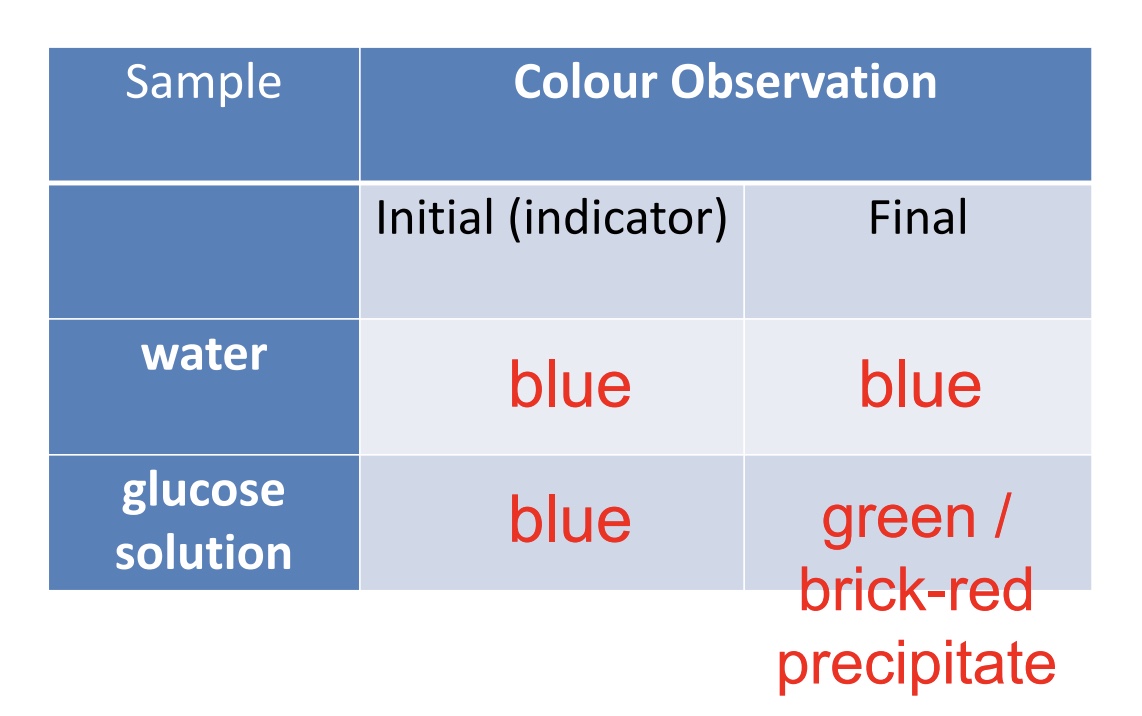
Colour Observations:
Clear Blue Solution: Negative result; no reducing sugar present.
Green/Yellow Precipitate: Traces of reducing sugar/Low concentration of reducing sugar present.
Orange-Red Precipitate: Moderate concentration of reducing sugar is present.
Brick-Red Precipitate: Large, high concentration of reducing sugar is present.