Unit 7 Study Guide: The Latin American Boom and 20th Century Narrative
Unit 7: The Latin American Boom and 20th Century Narrative
Introduction to El Boom Latinoamericano
El Boom was not just a literary movement; it was a publishing phenomenon and a cultural explosion that occurred in Latin America during the 1960s and 1970s. For the first time, Latin American authors achieved worldwide fame, seeing their works translated into multiple languages and embraced by European and North American audiences.
At its core, the Boom rejected the static, chronological realism of the 19th century in favor of structural experimentation, linguistic innovation, and the blending of reality with myth.
Historical Context: The Soil of the Boom
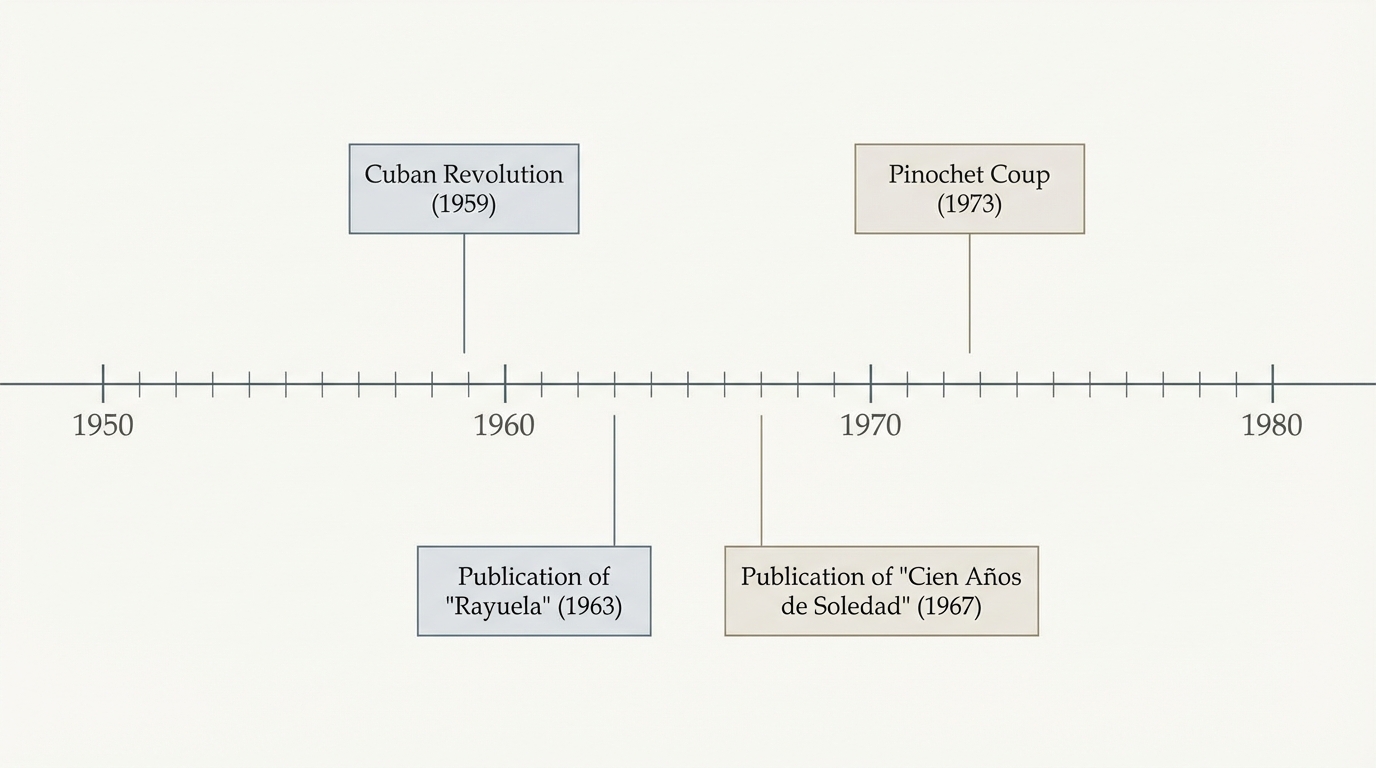
Literature does not exist in a vacuum. The Boom emerged during a period of intense political volatility:
- The Cuban Revolution (1959): This was the catalyst. It initially provided a sense of unity and hope for a leftist, anti-imperialist Latin American identity, though many authors later became disillusioned with the Castro regime.
- The Cold War: Latin American nations became proxies in the struggle between the US and the USSR, leading to political instability.
- Dictatorships (The Dirty Wars): Many countries (Argentina, Chile, Uruguay) fell under military regimes known as juntas. Literature became a tool for coded social critique and resistance.
- U.S. Intervention (Imperialism): The involvement of the U.S. in Latin American politics (e.g., Operation Condor) fueled a desire for a distinct, sovereign cultural identity.
Key Literary Techniques and Characteristics
The Boom is defined by how the story is told as much as what the story is about.
1. Realismo Mágico (Magical Realism)
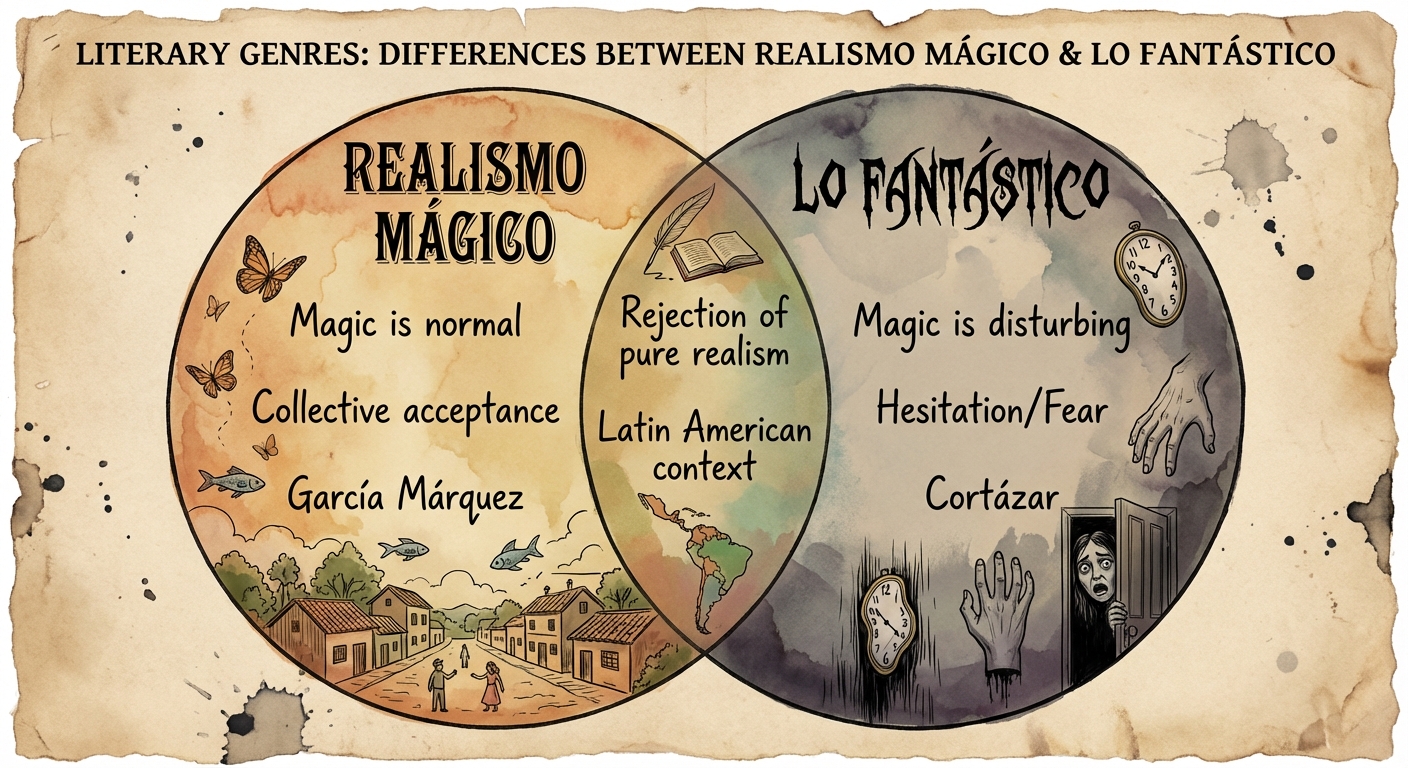
Often confused with fantasy, Realismo Mágico is a specific mode where the supernatural is treated as mundane, and the mundane is treated as supernatural.
- Definition: A literary style where magical elements appear in an otherwise realistic setting. The characters do not question these events; they accept them as part of reality.
- Key Effect: It validates the Latin American worldview, which often blends indigenous/African conceptualizations of the world (myth, superstition) with Western rationality.
- Example: In El ahogado más hermoso del mundo, the village creates a mythology around a dead body, and the corpse itself seems to grow and possess a presence that changes the town's reality.
2. Lo Fantástico (The Fantastic)
Distinct from Magical Realism, The Fantastic (championed by Cortázar) creates a rupture in reality.
- Mechanism: The story begins in a realistic world, but a sudden, inexplicable event occurs that causes hesitation or fear in the reader and the protagonist.
- Key Difference: In Magical Realism, the magic is normal. In The Fantastic, the magic is a disturbing intrusion.
- Example: In La noche boca arriba, the protagonist oscillates between two realities (modern hospital vs. Aztec sacrifice), leaving the reader unsure of which is the dream and which is reality until the horrifying end.
3. Structural Experimentation
Boom authors viewed the reader not as a passive consumer, but as an active participant (Cortázar called this the lector cómplice).
- Nonlinear Time: Narratives often use circular time (tiempo circular) or fragmented timelines, mimicking the way memory works rather than a clock.
- Fluir de la Conciencia (Stream of Consciousness): Inspired by James Joyce and William Faulkner, this technique captures a character's unedited, chaotic thought process.
- Polyphony: The use of multiple voices or perspectives within a single text.
AP Required Authors and Texts: Deep Dive
While general knowledge of novels like Cien años de soledad (García Márquez) and Rayuela (Cortázar) is useful for context, the AP exam focuses on the following required short stories. You must master the themes and techniques of these specific texts.
Gabriel García Márquez (Colombia)
The Father of Magical Realism.
Text 1: "La siesta del martes"
- Plot: A stoic mother and her daughter travel by train to a remote town during the stifling heat of the siesta to visit the grave of the son/brother, who was killed while robbing a house.
- Themes:
- Class Relations: The dignity of the poor vs. the hypocrisy of the church/authority.
- The Heat (El calor): Acts as an oppressive force, symbolizing the suffocating social environment.
- Technique: Hyper-realism. Unlike his magical works, this story is stark and realistic, focusing on sensory details (heat, dust) and silence.
Text 2: "El ahogado más hermoso del mundo"
- Plot: A colossal, beautiful drowned man washes ashore. The village women clean him, name him Esteban, and invent a life history for him, leading the village to undergo a permanent transformation to be worthy of his memory.
- Themes:
- Transformation through Imagination: How a collective myth shapes reality.
- The "Other": The stranger brings unity to the community.
- Technique: Hyperbole (exaggeration) and gradual transition into Magical Realism.
Julio Cortázar (Argentina)
The Master of the Fantastic and Experimental Form.
Text: "La noche boca arriba"
- Plot: A man crashes his motorcycle and is taken to a hospital. In his drug-induced sleep, he dreams he is a Moteca fleeing Aztecs in a "war of the blossom." He wakes up in the hospital, then falls back into the "dream."
- The Twist: In the end, he realizes the hospital/modern world was the dream, and his reality is that he is about to be sacrificed on the Aztec altar.
- Themes:
- The ambiguity of reality: The thin line between dream and waking life.
- The inescapability of destiny.
- Technique: Parallelism (sensory links between the two worlds: the hospital smell vs. the swamp smell; the arm restraint vs. the ropes).
Juan Rulfo (Mexico)
Precursor to the Boom (Contextually Unit 6/7 link).
Text: "No oyes ladrar los perros"
- Plot: A father carries his wounded criminal son, Ignacio, on his back across a moonlit landscape to find a doctor. The father berates the son for his life choices but continues out of loyalty to the dead mother.
- Themes:
- Generational Conflict: The disconnect between the traditional father and the lost son.
- Desolation: The landscape mirrors the emotional emptiness.
- Technique: In media res (starts in the middle of action) and dialogue without narratorial tags.
Carlos Fuentes (Mexico)
The Intellectual Investigator of Identity.
Text: "Chac Mool"
- Plot: Filiberto buys a statue of the rain god Chac Mool. The statue slowly comes to life, dominates Filiberto, floods the house, and eventually kills him (or drives him to death).
- Themes:
- Indigenous past vs. Modern present: Mexico cannot escape its heritage; the ancient gods are still powerful.
- Decadence of the Middle Class.
- Technique: Metafiction (the story is told through Filiberto's diary read by his friend) and Magical Realism/Fantastic Elements.
Jorge Luis Borges (Argentina)
The Intellectual Architect (Technically Vanguardism, but essential for Boom).
Text: "El Sur"
- Plot: Dahlmann, a librarian, hits his head and gets septicemia. He travels to his ancestral south to recover. He enters a knife fight in a store. It is implied the trip and the fight may be a hallucination as he dies in the hospital.
- Themes: National Identity (European vs. Gaucho) and the Symmetry of Time.
Comparison: Boom vs. Other Movements
| Feature | Realism/Regionalism (Pre-Boom) | El Boom (1960s-70s) | Post-Boom (e.g., Isabel Allende) |
|---|---|---|---|
| Focus | Local landscapes (La tierra), social protest, nature. | Universal themes, psychology, linguistic experimentation. | Return to simpler narratives, pop culture, sentimentality. |
| Narrative | Chronological, linear, objective omniscience. | Fragmented, circular, stream of consciousness, unreliable narrators. | Accessible, linear but maintaining some magical realism. |
| Reality | Objective, photographic. | Subjective, Magical Realism, The Fantastic. | Often uses "McOndo" realism (urban, gritty) or light magical realism. |
| Role of Reader | Passive observer. | Active participant (decoding the text). | Engaged by plot and emotion. |
Common Mistakes & Pitfalls
Confusing Magical Realism with "The Fantastic":
- Mistake: Calling La noche boca arriba "Magical Realism."
- Correction: It is Fantastic literature. The switch between realities creates fear and confusion. In Magical Realism (like El ahogado…), no one is scared of the magic; they just accept it.
Assuming all Boom literature is political:
- Mistake: Thinking every story is about a dictatorship.
- Correction: While context is political, stories like El Sur or La noche boca arriba are metaphysical and existential. Do not force a political reading where none exists.
Mixing up the timelines:
- Mistake: Thinking the Aztec world is the dream in La noche boca arriba.
- Correction: The text implies the modern world was the fever dream of the Aztec warrior to escape the terror of sacrifice. This inversion is the key to the story.
ignoring the "Precursors":
- Mistake: Thinking the Boom started from nothing.
- Correction: You must acknowledge Borges and Rulfo (Unit 6) as the architects who laid the foundation for García Márquez and Cortázar.
Vocabulary Checklist
- Desdoblamiento: The division of a character's identity or doubling (seen in Borges y yo and La noche boca arriba).
- Metaficción: Fiction that calls attention to itself as fiction (reading a diary within a story, discussing writing).
- Onírico: Dream-like; relating to dreams.
- Ambigüedad: When the interpretation is open to multiple meanings (typical of the Boom end).
- In media res: Starting the story in the middle of the action (e.g., No oyes ladrar los perros).