Tree ID
Trees with opposite leaves:Maple
Dogwood
Ash
Buckeye
remember: (Mad dogs always Bark/Buck)
hints:
Maples-sharp angles
Dogwood- leaves arcuate venation
Ash-curved branches from
Buckeye- palmately compounded
Juglandaceae (walnut family):walnuts (genus Juglans) and hickories (genus Carya).
Both genera have alternate pinnately compound leaves that are aromatic
those of walnuts have a great many leaflets (15-23 leaflets)
while hickories usually have only 5-11leaflets.
Walnuts have chambered pith; hickory pith is continuous-homogenous.
Hickories are divided into two groups: the pecan hickories (section Apocarya) and the true hickories (section Carya):
True hickories such as shagbark hickory and pignut hickory have mostly 5–7 leaflets, and a large egg-shaped terminal bud with overlapping scales.
Pecan hickories such as bitternut hickory and pecan (the latter not quite native in Ohio, but found only a bit farther west) have more than 7 leaflets, and the terminal bud is elongated and flattened with scales that meet edgewise.
How to recognize bitternut hickory: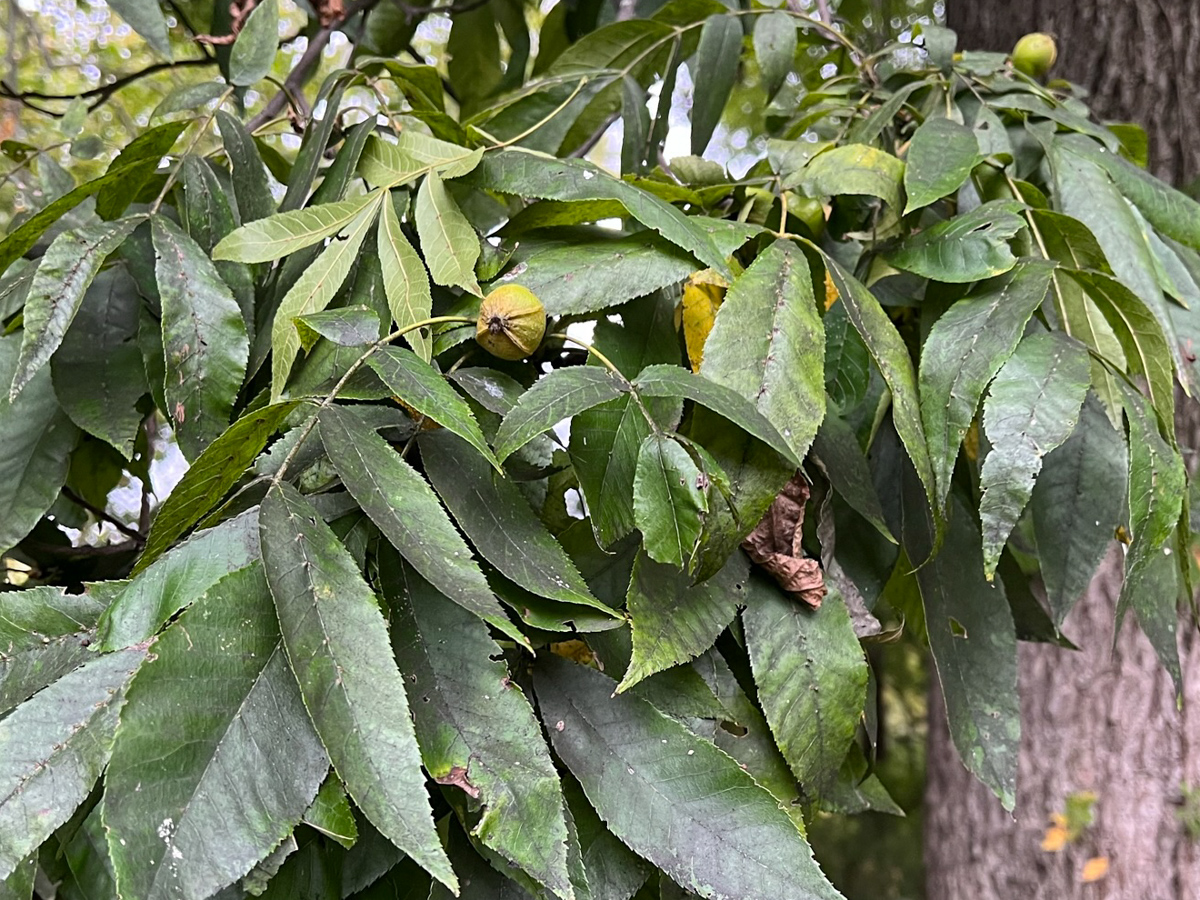
/
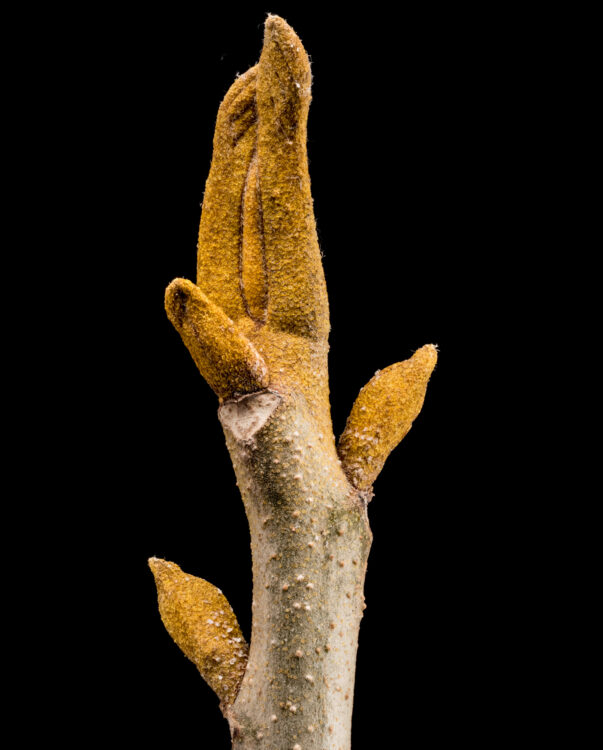
Bitternut hickory has 7-11 leaflets, bud scales that are leaflike and valvate (meeting at the edges rather than overlapping), bark that doesn’t exfoliate, and thin-husked fruits.
Bark: the bark of young trees is smooth and light gray. Older trees are shallowly grooved with thin, flat, interconnecting ridges.
The trees are monoecious (unisexual flowers, both sexes borne on the same trees). The males are presented in branched catkins. The fruits are smooth one-seeded nuts that split open along 4 sutures.
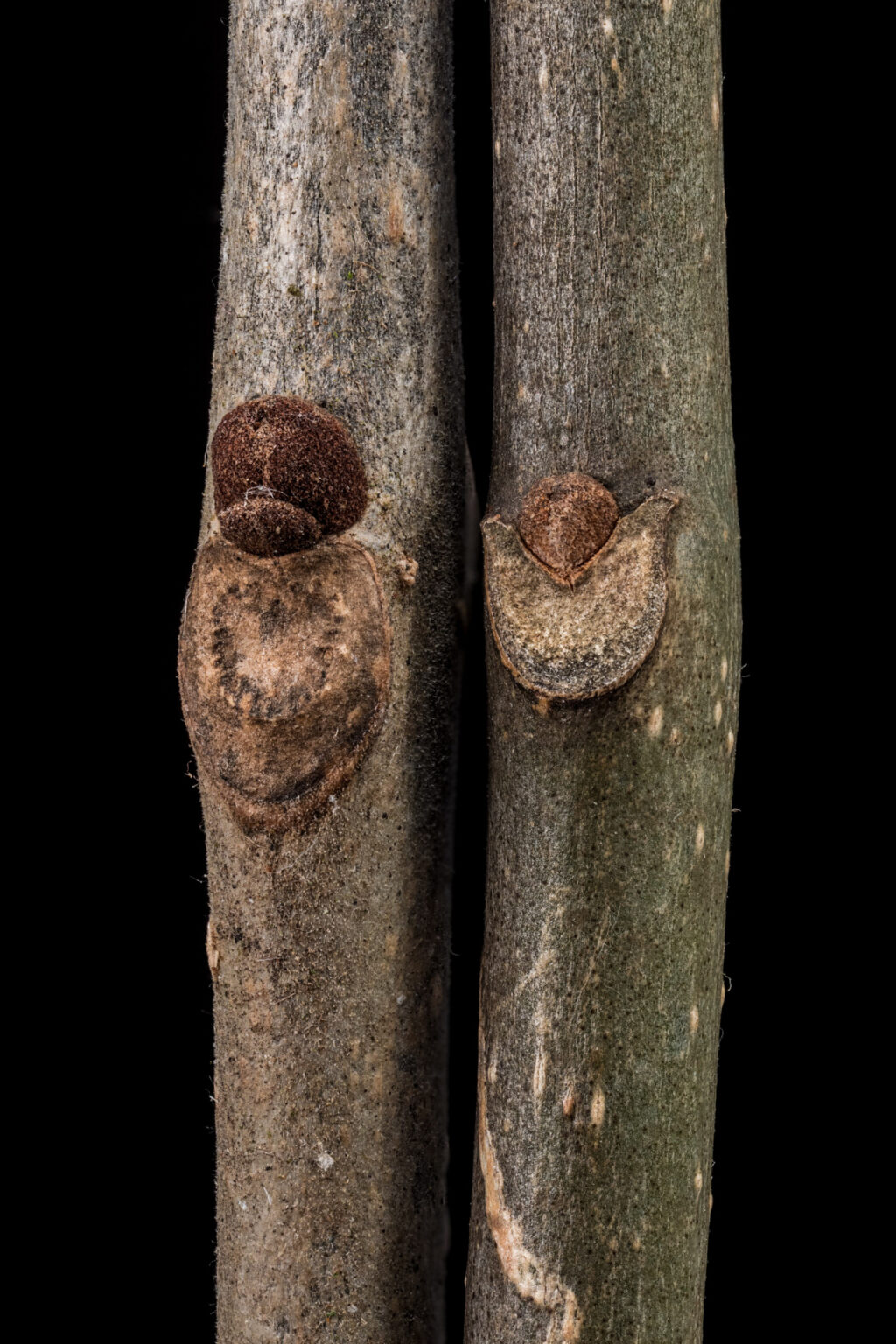
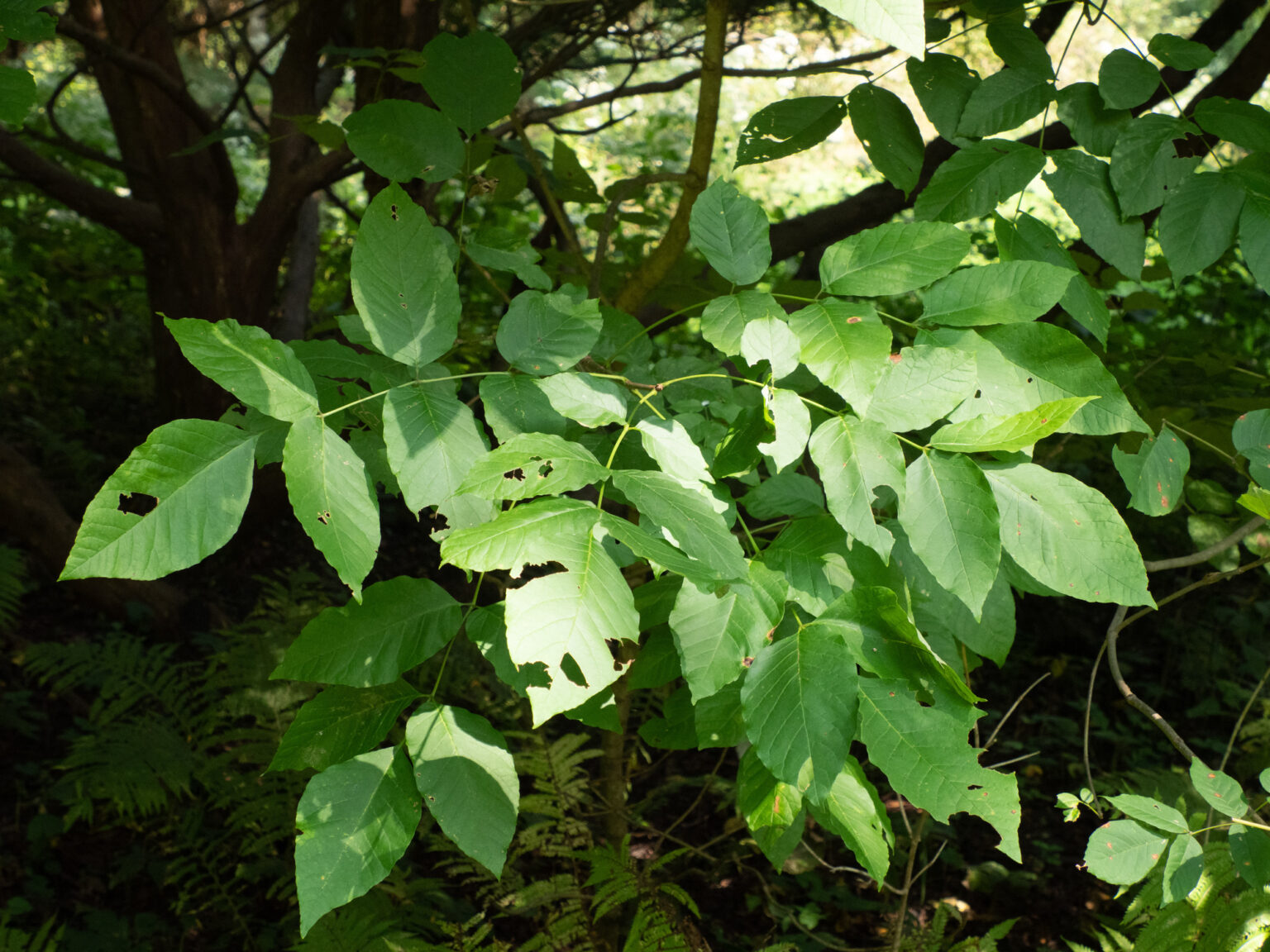
How to recognize white ash: Getting to ash is easy; it’s a tree with opposite pinnately compound leaves. Carrying on, the leaflets are stalked (eliminate black ash) and the twigs are round (eliminate blue ash), and you end up in the white ash versus green ash circle of confusion. Two things tell you it’s white ash: the upland habitat, and U-shaped leaf scars (on right- green on left)
Beech- Fagussmooth grey bark
leaves arre ovate shape and serrated margins with near-parallel pinnate veins and smooth (glabrous) on top and hairy (pubescent) below. The leaves also have tiny bristles along the margins.
The American Beech has distinctive buds that are long, pointy and light brown. They are often described as “cigar-like.” The twig has a somewhat zig-zag form and mature from hairy (pubescent) to smooth (glabrous). The winter buds are very slender and reddish-brown.
The bark of the American Beech stays smooth throughout its life and is a silvery gray color.

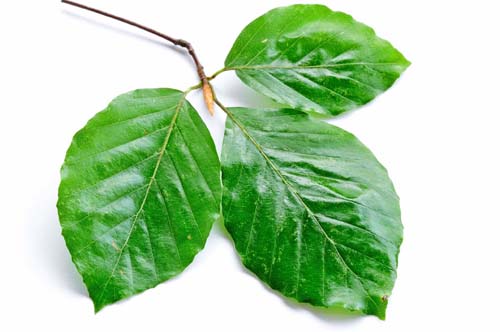
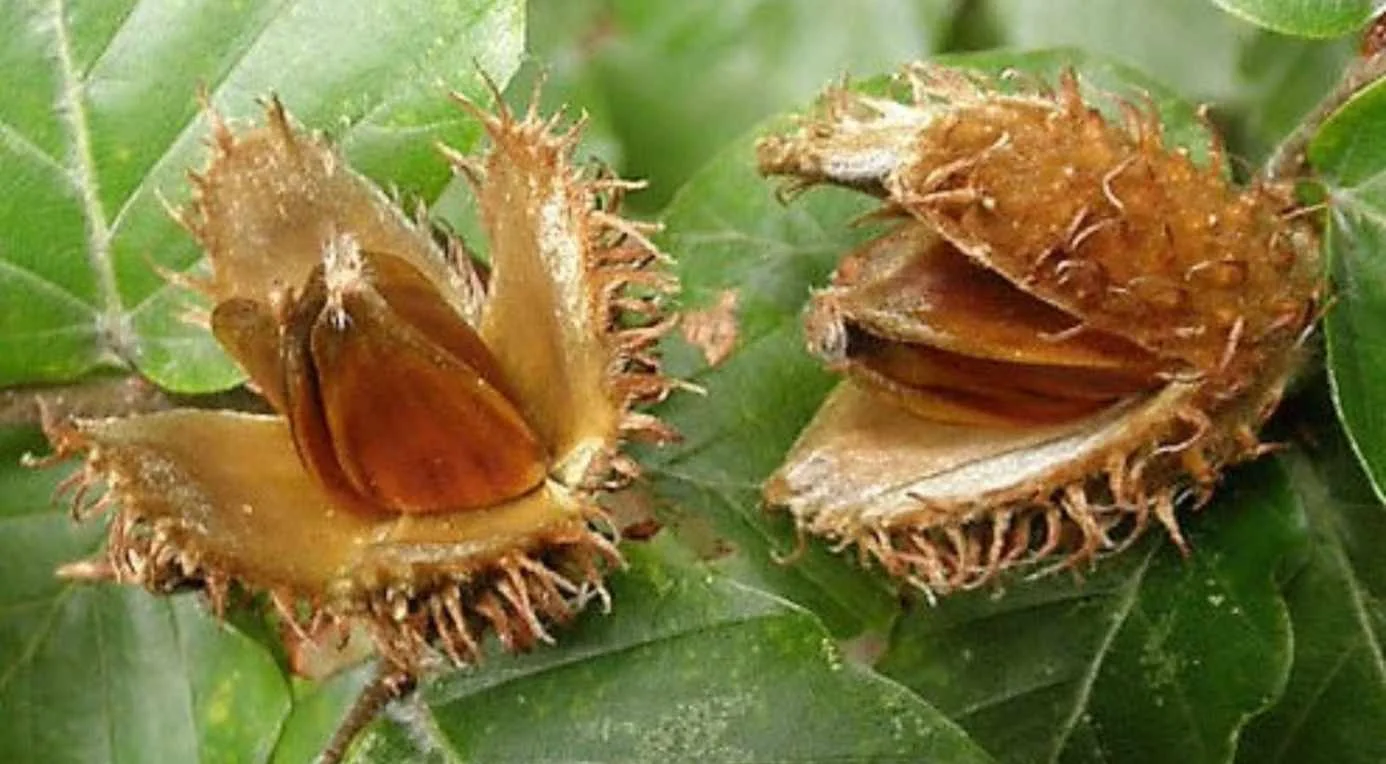
: Fagus to the beech
Pinnately compounded leaves in the US
ash/fraxinuss -5-7 leaflets identical
hickory/Carya- small bottom leaflets with large top one
walnut /juglans- 11-23 leafletsbottom and top leaflets smaller
legume/Fabaceae- extremly numerous leaflets that are uniform circular or oval can also be bipinnatly compound (Some North American examples of tree-sized legumes that occur in temperate climates include the black locust (Robinia pseudoacacia), yellow-wood (Cladrastis lutea), redbud (Cercis canadensis), honey locust (Gleditsia triacanthos), and Kentucky coffee tree (Gymnocladus dioica).Box elder- 3 leaflets per leaf and irregularly shaped). Iconic trees, such as mesquites, palo verdes, and ironwoods, all belong to the legume family
mnemonic-
“A Wonderful Leafy Home."
(A for Ash, W for Walnut, L for Legume, H for Hickory)
OR
"Farmers (Fabaceae) Juggle (Juglans) Cans (Carya) Freely (Fraxinus)."
Pine trees
take a bundle-
2-3 hard pine
5 = soft pine
easter white (east of Rockies)
South western white
whitebark
sugar super long cones
limbar
Tillia-
leaves of all Tilia species are heart-shaped, and most are asymmetrical.
mneumonic: "Tilia the Tree, Linden with Leaves, Basswood for Building, Lime for licking"
Elm-
The American Elm has pointed, ovate-shaped leaves with asymmetrical bases that are 3″ to 5″ long and 1″ to 3″ wide. The leaves have doubly serrated margins and pinnate veins. They are a dark green and turn yellow in the fall.
Ostrya virginiana= Hop Hornbeam, Eastern Hop Hornbeam, Ironwood
The common name comes from its hop-like fruit, but one of its other common names, Ironwood, is used for a close relative American Hornbeam, or Carpinus caroliniana, as well. These trees are distinct species and have very different characteristics, but because of the similar and same common names, they are often confused
The leaves of the American Hop Hornbeam are 3″ to 5″ long and are ovate to elliptical. The margins are doubly serrated, and the venation is pinnate. The leaves are quite soft and felt-like. The axils of the veins and the petiole are sometimes pubescent. Leaves are arranged alternately on the branch. each other.
The twigs of the American Hop Hornbeam are reddish-brown and pubescent. The buds are skinny and have many scales.
The American Hop Hornbeam’s bark has horizontal lenticels that resembles cherrybark when young. As it matures, it breaks into loose scales that give it a shreddy appearance.
The fruit of the American Hop Hornbeam are sac-like, seed-bearing pods. They form drooping clusters and are 1″ to 3″ long. The pods contain 1/4″ long nutlets.
Hornbeams are distinguished from their closely related birches by their respective fruits (irregular, papery nutlets on hornbeams, and shedding scaled catkins on birches) and barks (American Hornbeam has a completely smooth bark, and American Hop Hornbeam has thin scales, unlike any other birch).
Compared to distantly related trees with double-toothed margins, like elms, hornbeams are best identified by their unique fruit.
While the American Hornbeam’s fruit has seeds contained beneath horizontal sprays of bracts, the American Hop Hornbeam has hop-like fruit, which does not have bracts, but instead has a thin husk covering each seed completely.