The Reason for Seasons
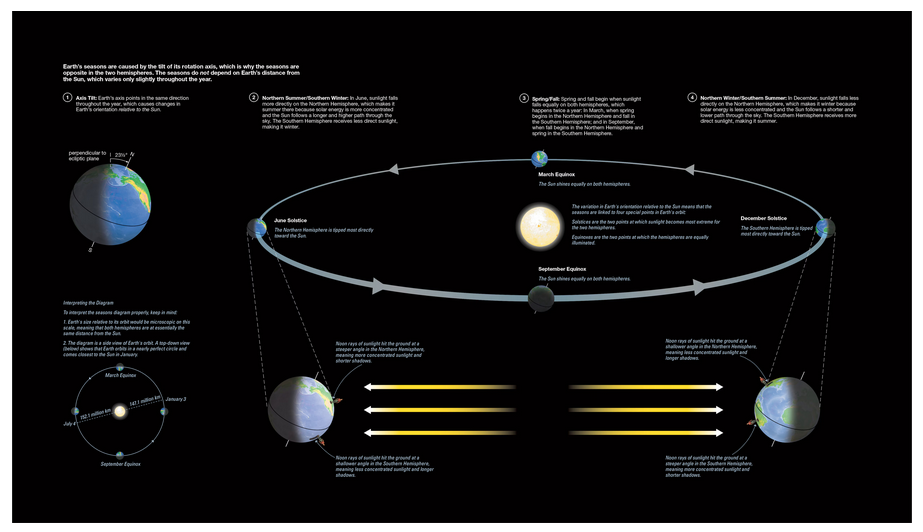
☼The Earth has a 23.5° axial tilt, which causes varying angles of sunlight to strike the Earth as it orbits the Sun, leading to the changes we observe in weather patterns and daylight throughout the seasons.
✱ Earth’s tilt of its axis remains pointed in the same direction in space (toward Polaris) throughout the year
the orientation of the axis relative to the Sun changes over the course of each orbit: The Northern Hemisphere is tipped toward the Sun in June and away from the Sun in December, while the reverse is true for the Southern Hemisphere.
✱ When the Earth is striking the Northern Hemisphere (June) at a steep angle, it’s striking the Southern Hemisphere at a shallower angle
Stepper sunlight angle = summer
more concentrated sunlight, which tends to make it warmer.
the Sun follows a longer and higher path through the sky, giving the hemisphere more sunlight
Shallower sunlight angle = winter
sunlight is less concentrated and the Sun follows a shorter, lower path through the sky.
☼Earth’s axis points in the same direction all year round, which means its orientation relative to the Sun changes as Earth orbits the Sun.
✱ Both hemispheres are illuminated equally in March and September.
It is therefore spring for the hemisphere that is on the way from winter to summer, and fall for the hemisphere on the way from summer to winter.
☼ The seasons on Earth are caused only by the axis tilt and not by changes in Earth’s distance from the Sun.
⪧ Earth is only about 3% farther from the Sun at its farthest point (which is in July) than at its nearest (in January)
Solstices and Equinoxes
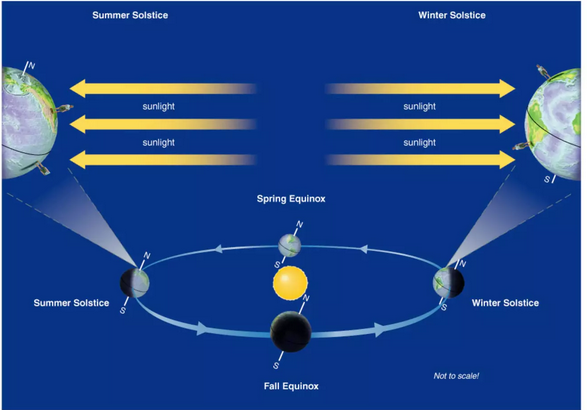
✱ The Equinoxes occur twice a year, marking the points when day and night are of approximately equal length, signifying the transition between seasons.
mark the changing seasons
four equinoxes corresponds to one of the four special positions in Earth’s orbit
⎯ The June solstice, called the summer solstice in the Northern Hemisphere, occurs around June 21 and is the moment when the Northern Hemisphere is tipped most directly toward the Sun and receives the most direct sunlight.
Highest path, rise and set at most extreme north of due east
⎯ The December solstice, called the winter solstice in the Northern Hemisphere, occurs around December 21 and is the moment when the Northern Hemisphere receives the least direct sunlight.
Lowest path, rise and set at most extreme south of due east
⎯ The March equinox, called the spring (or vernal) equinox in the Northern Hemisphere, occurs around March 21 and is the moment when the Northern Hemisphere goes from being tipped slightly away from the Sun to being tipped slightly toward the Sun.
⎯ The September equinox, called the fall (or autumnal) equinox in the Northern Hemisphere, occurs around September 22 and is the moment when the Northern Hemisphere first starts to be tipped away from the Sun.
⪧We can mark the dates of the equinoxes and solstices by observing changes in the Sun’s path through our sky
⪧The equinoxes occur on the only two days of the year on which the Sun rises precisely due east and sets precisely due west; these are also the two days when the Sun is above and below the horizon for equal times of 12 hours
equinox means “equal night”
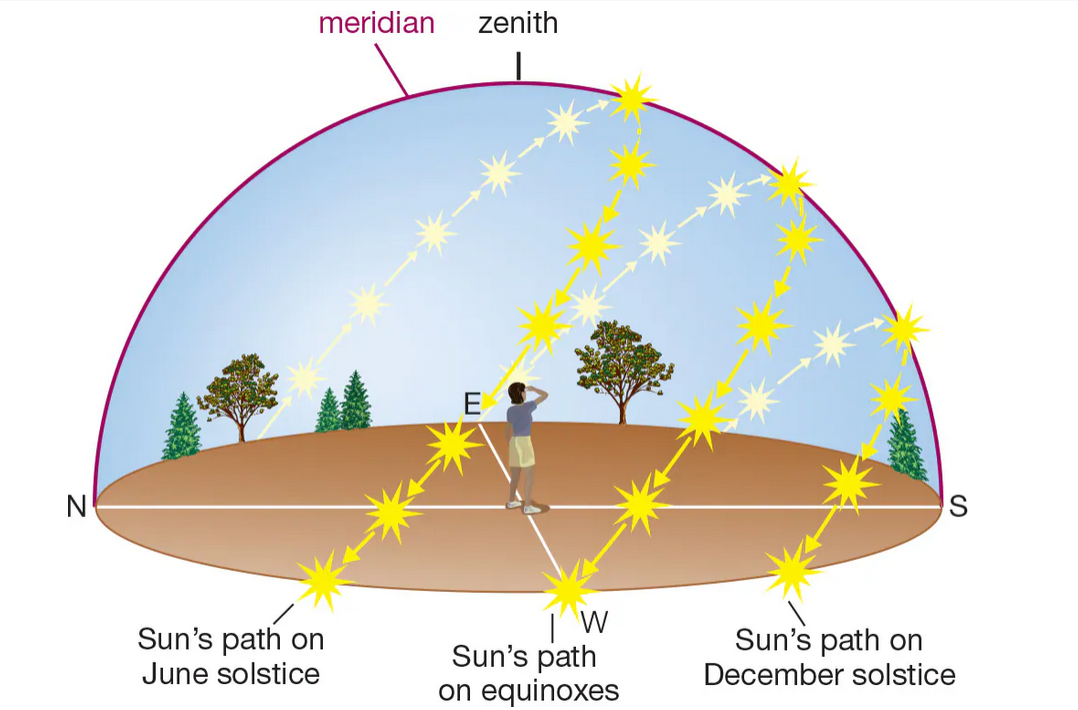
This diagram shows the Sun’s path on the solstices and equinoxes for a Northern Hemisphere sky (latitude 40°N). The precise paths are different for other latitudes; for example, at latitude 40°S, the paths look similar except tilted to the north rather than to the south.
☼The Sun rises precisely due east and sets precisely due west only on the days of the March and September equinoxes.
Seasons Around the World
☼ High latitudes have more extreme seasons.
Example:
➼ Vermont has much longer summer days and much longer winter nights than Florida.
➼At the Arctic Circle (latitude 66½°), the Sun remains above the horizon all day long on the June solstice, and never rises on the December solstice.
➼ The most extreme cases occur at the North and South Poles, where the Sun remains above the horizon for 6 months in summer and below the horizon for 6 months in winter.
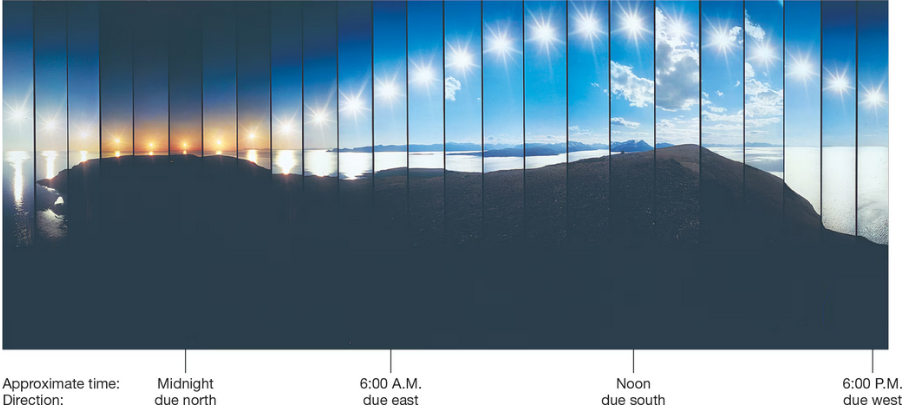
This sequence of photos shows the progression of the Sun around the horizon on the June solstice at the Arctic Circle. Notice that the Sun skims the northern horizon at midnight, then gradually rises higher, reaching its highest point when it is due south at noon
⪧Seasons also differ in equatorial regions, because the equator gets its most direct sunlight on the two equinoxes and its least direct sunlight on the solstices.
instead of the four seasons experienced at higher latitudes, equatorial regions tend to have rainy and dry seasons, with the rainy seasons coming when the Sun is higher in the sky.
☼ At very high latitudes, the summer Sun remains above the horizon all day long.
How does the orientation of Earth’s axis change with time?
Precession → The gradual wobble of the axis of a rotating object around a vertical line.
the reason why the solstices and equinoxes continue to happen around the same dates each year but why constellations associated with them change gradually over time.
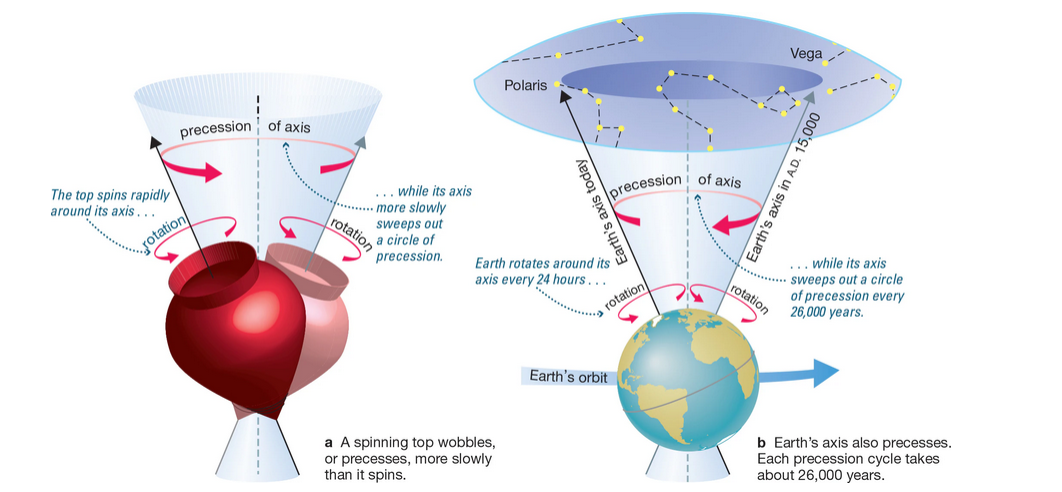
☼ Each cycle of Earth’s precession takes about 26,000 years. This gradually changes the direction in which the axis points in space.
Polaris won’t always be the North Star
Positions of equinoxes shift around the orbit; for example, the spring equinox, once in Aries, is now in Pisces
⪧ Precession does not change the amount of the axis tilt (which stays close to 23½°) and therefore does not affect the pattern of the seasons.
⪧ It changes the points in Earth’s orbit at which the solstices and equinoxes occur, and therefore changes the constellations that we see at those times.
⪧ Precession is caused by gravity’s effect on a tilted, rotating object.
A spinning top precesses because Earth’s gravity tries to pull over its lopsided, tilted spin axis.
The spinning Earth precesses because gravitational tugs from the Sun and Moon try to “straighten out” our planet’s bulging equator, which has the same tilt as the axis