week 3
Feminist Knowledge and Agency
there are three main feminist theories
Feminist Standpoint Theory
where you stand in society will affect the way you see the world
forexample people who experience oppresion can see things that other more priviledge groups dont see
Poststructural Feminist Theory
society and language shape how we undertand gender and identity
Affect Theory
emotions are connected to power in society as they can reinforce inequality or challenge it
nancy hartsock says that womens experiences can help reveal how society is organised around male dominance and patricia hill collins focusus on black womens experiences
the matrix of dominition = diff forms of oppresion can work together at the same time so experience can overlap but not evrry black women experiences oppresion in the same way
collins also argues that no single group knows everything about society because people can experience both priviledge and oppresion at the same time
Chandra mohanty critizises how some western women describe women in developing contries
she does this because women from other contries experiences diff things and will react a diff / certain way
donna haraway says that everyones knowledge comes from their own position and experiences. we need diff perspectives to understand the bigger picture.
cathy cohen talks about how race class, and sexuality connect to oppresion. we should be challenging systhems and rles that create oppresion rather then trying to fit into the existing institutions
sandra Harding - says that standpoint theroy starts by looking at our evryday lives and looking at people who experience oppresion because we can then understand how power works
poststructural feminisim is about hoe languages and society shape our identities. the ideas about gender and identity that we learn through social expectation, culture, language influences how we see ourselves and we should be asking where did these ideas come from and how does power help maintain them
Affect theory is hiow our emotions and bodily reactions shape society take for example you go into a room and feel uncomfortable
also society helps shape how we use our bodies and how we feel for example a women could feel pressure to be a certain way cause society has a certain expectation of feminity
allison jagger critisizes the idea that emotions interfere with knowledge and make people less objective
Reason = objective and reliable.
Emotion = subjective and unreliable.
itd also a way to undermind other as dominant groups have been associated with reason, while marginalized groups have been associated with emotion.
emotional hegemony = societys rule about which emotions are considered acceptable basicly who is allowed to cry, who should be happy, who should express anger…
emotions are also connected to value and what we believe is important. basicly it influences how we understand fairness,injustice and other
outlaw emotions = feelings that go against societies expected rules regarding to emotions
women should stay quiet and accept unfair treatment so when we go againt this its outlaw emotions and its a form of oppresion
sarah ahmed is a theorist who studied how emotions are connected to society,culture and power she also looked at affective economies = emotions circulate through society and become attached to certain. groups. the reason for this is because society tells us how we should feel and they are also shaped by out cultural beliefs
she looks at the movie bend it like beckham to show how society connects happiness with dominant culture expectations. it suggest that happiness comes from a white man,marriage and family and other. and people who challenge this are causing “bad feelings”
in the moviue we see typical charecter sterotypes
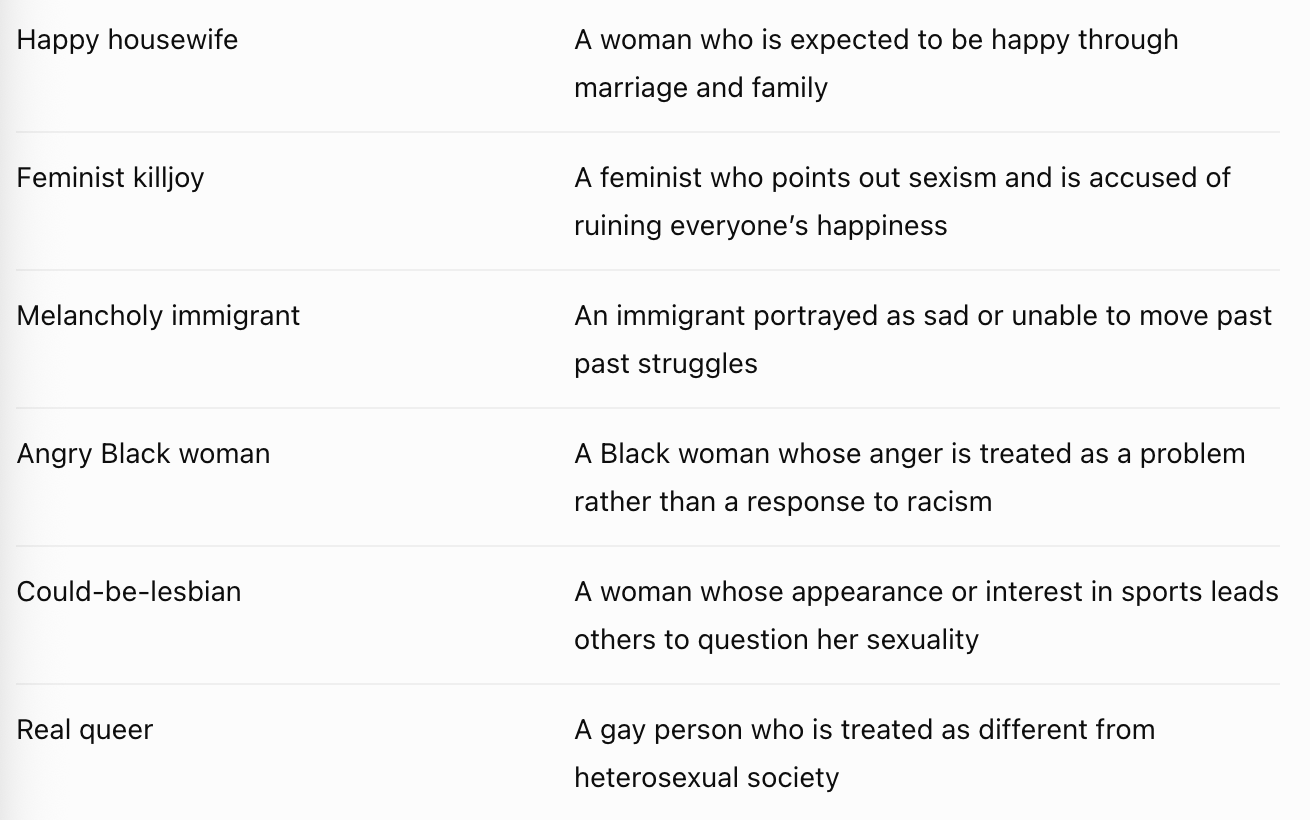
Kathy davis wrote our bodies, ourselves and focuses on womens bodies,health,illness and experiences. she also identifies three problems with feminist theory
the body problem - How can feminists talk about women's bodies without assuming all women have the same body or experience?
the expiremental knowledge - Should women's personal experiences be treated as valuable knowledge? (If a woman feels that a doctor is ignoring her pain, her experience matters. She should be able to question the treatment she receives.)
agency - Can women still take action if their experiences and identities are shaped by social power?
she also created theory in the flesh and she says that feminsit theory shouldent just be abstrat ideas it needs to be connected to real bodies,experiences,pain and more.
The biggest disagreement between these two approaches (standpoint and poststructural)concerns power, knowledge, and agency.
Poststructural feminists criticize standpoint theory because they believe it may treat women's experiences as too clear or reliable.Standpoint theory may create a new category of “women” without fully challenging the power structures that created that category.
Standpoint feminists argue that poststructuralism may make identity and knowledge so uncertain that it becomes difficult to organize political resistance.
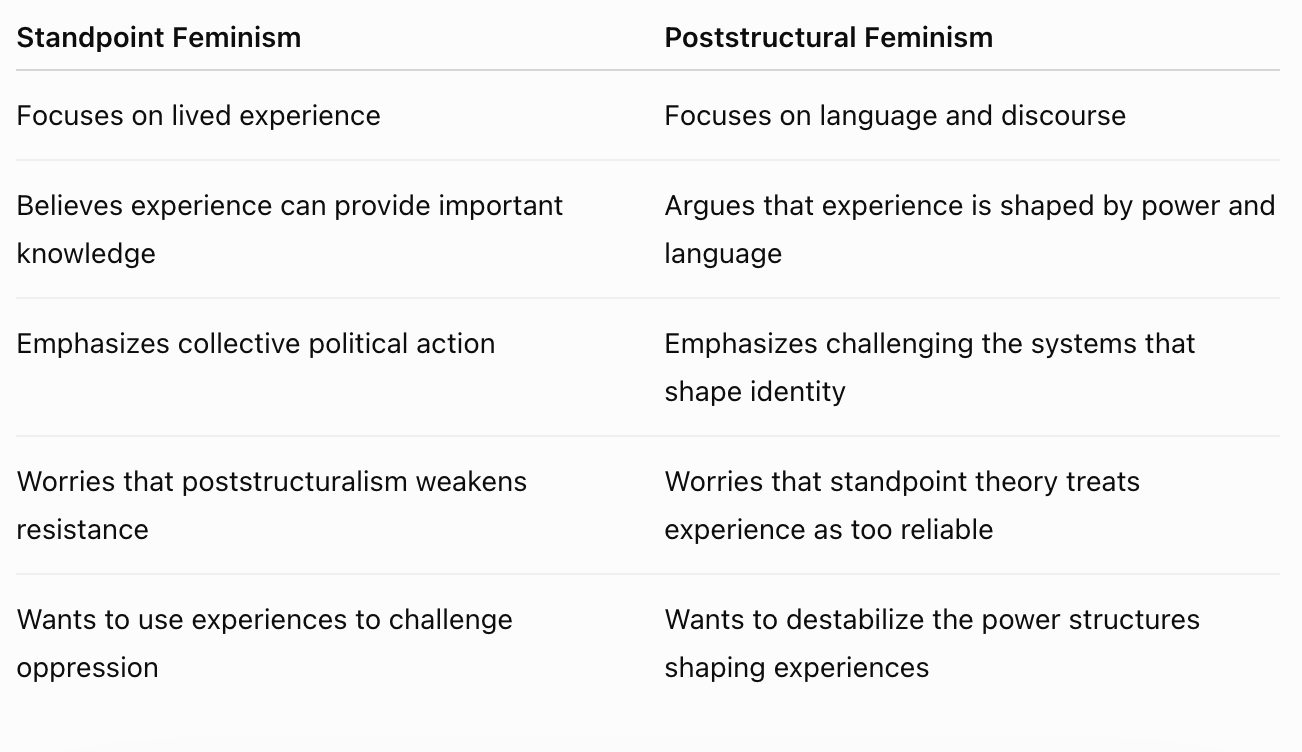
Standpoint Theories
Standpoint theory = Where you come from and your experiences in society affect what you know and how you understand the world. People who experience oppression may notice things about society that people in positions of power do not
Standpoint theory has been debated for decades because it challenges traditional ideas about science and knowledge. since traditional research is objective/neutral but its not always this way it can reflect the values of powerful groups instead
so harding sujest that feminist research should look at info that imrpouves womens uality of life and challeges inequality. research should not simply study people. It should also help address the problems they face. Research can also influence how society is organized, so researchers need to consider who benefits from the knowledge they produce.
Harding argues that gender cannot be studied separately from other forms of oppression. so feminist research needs to consider how different forms of oppression overlap or intersectionality
Your everyday experiences influence what you understand about society. However, Harding also argues that people do not automatically understand every aspect of oppression simply because they belong to an oppressed group.
"Study up" means studying powerful groups and institutions rather than focusing only on oppressed people. So rather than blaming individuals for being poor, researchers examine how institutions distribute wealth and resources and how how systems of power create and maintain inequality
Relativism is the idea that all knowledge or beliefs might be equally valid.
Harding says standpoint theory does not mean that every opinion is automatically correct.
however Not all feminists agree on which forms of oppression should receive the most attention and Feminist theory changes as different groups bring their experiences and concerns into the discussion.
another issue it Different disciplines may use standpoint theory in different ways.
Sociology: Focuses on women's experiences as a starting point for understanding society.
Political philosophy: Focuses on how feminist movements can change political ideas and systems.
Harding argues that academic disciplines can sometimes support powerful institutions.research may create categories that make it easier for governments or organizations to manage and control people.
Under Western Eyes Revisited
Mohanty is rewriting her original essay, “Under Western Eyes,” to explain what she meant, what she would change, and what she still believes.
When Mohanty first wrote the essay, she was a young scholar involved with international women's movements.
she was writing more from the perspective of someone outside Western academic institutions.
Now, she works within the U.S. university system.
She recognizes that she has certain privileges because of her position in academia.
Mohanty criticized Western feminist scholars for treating women from the Third World as if they all had the same experiences.
Mohanty argues that this approach ignores the differences between women's lives, cultures, histories, and political struggles. (the discursive colonization of Third World women)
Western scholars can control how women from other parts of the world are represented and understood through their writing and research.
Mohanty believes feminist research needs to look at both:
Micropolitics - everyday experiences
Macropolitics - global economics,political structures and more
originallly Mohanty focused heavily on the differences between Western women and Third World women. but she realised that some readers might misunderstand her argument as saying that women are too different to work together. but wehat shes trying to say is Women don't have to be the same to work together. We can recognize our differences while still building solidarity.
"Western" and "Third World" can be useful, but they don't fully describe the world. for example There are wealthy and privileged people living in countries traditionally considered part of the Third World. so she iontroduces One-Third World and wo-Thirds World
she also belives that the world has changed since she first wrote her essay. but they still affect womens lives
Neoliberalism: Economic and political ideas that often prioritize markets, privatization, and individual responsibility.
Capitalism: Economic systems that can increase inequalities between wealthy and marginalized communities.
Religious fundamentalism: Religious movements that can promote restrictive ideas about gender and women's rights.
Racism and sexism: Continuing systems of discrimination.
Militarization: The increasing influence of military power in society and politics.
Global inequality: Unequal access to information, resources, and opportunities.
Mohanty says that her focus has shifted toward anticapitalist transnational feminism
Anticapitalist: Critiques economic systems that create exploitation and inequality.
Transnational: Looks across national borders.
Feminism: Works toward gender equality and challenging oppression.
She believes feminists from different countries need to work together to challenge capitalism and the inequalities it creates.
he also emphasizes that capitalism is connected to Racism, Patriarchy, Heterosexism
Mohanty argues that feminist research should begin by looking at the lives of the most marginalized women, including poor women and Indigenous women.
Because studying the experiences of marginalized people can help us understand how power and inequality work throughout society.
Mohanty uses feminist scientist Vandana Shiva as an example.
she criticizes the World Trade Organization for allowing corporations to claim ownership over knowledge that Indigenous communities have developed and shared for generations.
For example, Indigenous people in India have long used the neem tree for medicinal and agricultural purposes. Corporations can take this existing knowledge, develop a product from it, and then get a patent, meaning they legally claim ownership of the invention. (biopiracy)
shiva talks about reading up meaniong Start with the experiences of marginalized people then look upward at the larger systems of power affecting them.
Mohanty says that something happening in one community can actually help us understand much larger global systems.
Mohanty argues that poor and marginalized women are often the people who experience the negative effects of globalization most strongly. so we should look at the people most affected by a system to understand how that system operates
How does globalization actually affect women's everyday lives? women's experiences and struggles can help us imagine different and more just ways of organizing society.
feminism needs to challenge globalization and capitalism. and antiglobalization need feminism as women are often at the center of anti globolisation issues like forced labour,poverty and more
there are three ways of teaching feminisim
Feminist-as-Tourist = learn about women from another country for a week. But the rest of the course continues to focus mainly on Western women.Women from other countries then become stereotypes
Feminist-as-Explorer = Instead of spending one week on another country, a class might have an entire course about certain women but These cultures can be treated as completely separate from the United States. can slo lead to cultural relativism (its just their culture)
Feminist Solidarity / Comparative Feminist Studies (the best one) = How are women's experiences connected? instead of studying U.S. women and Indian women separately, we might study women's experiences of factory labor in different countries. Women don't need to have identical experiences to work together.
Women can have very different experiences while still sharing common struggles and interests.
Mohanty thinks universities shouldn't just teach students facts about women around the world.She wants feminist education to encourage students to become active citizens who can participate in struggles for justice.
in class
everyone has a standpoint
everyone has a perspective but a standpoint must be acheived
strand of feminist thought are not linear and not neat cause were not monolithic
material life shapes conciousness (maxisim) material life shapes concioussness feminsit took this idea and talked about the gender analysys about the gender divide in work. for example care giving is a womens job and more.’There is an expectation to do this labour that is unachknowledge.
Manufacturing consent trhough dominant ideologies
Group work

Social Position : Mexian american how much she works she s women…
perspective : her work is being viewd part time simply her care for her grandmother does not provide a pay and being dismissed by her familly. and she dosent like it
Stand point : advocating for more public care service and better wages.

sandra harting - standpoiojt is an acheivement - you need to do work to get that standpoint.
things that we belive or think are natural needs analysis
so care work for example need analysys its life giving but also dismissed
you need to go againts the grain of dominance to reach a standpoint
why would harding say no i dont have advice for people - because everyone has a diff perspective and the sys and workld are always changing creating diff oppressions
ahmed - is more accessible and its because the feminsit in the late 20th century they need to write a specific way to be acknowledged in the academie. feminist theory is world making.
how do we learn about worlds when they dont accomodate us
“The meanings of feminism are contested because feminism is a heterogenous site of diverse ideologies and subjectivities fighting against a shifting, complex political terrain of intersecting hegemonies”
very common to debate the definition of feminisim
people have been historicly excluded feminisim
it useful to think in standpoint of theories not just theory
Anzaldua - mestisa conciencness - they dont occupy one stable location they live in between spaces and live in between sometimes contradictory worlds its metaphysical but also sometimes a physical boarder.
a new consiouness arioses from this (mestisas)
sit point is the transformative potential of diif perspectives
patricia hill collins - outsider within - have the ability to see the perspectives from both ends because they have specific identities
the outside position can be a source of strenghth
you can be inside a certain setting but still outside so you never fully belong and so you get this perspective that no on ereally has.
the way your able to perform is interesting cause it can change your positionality and wither your an insider or outsider.
situated knowledge (haraway) - any theory needs to talk about the history and all those things in the past, she also talks about it being a god trick. and a partial perception.
God trick - all knowledge comes from a main theory or perspective
Why might acknowledging and exploring the limits of what you can see actually make knowledge more rigorous rather than less rigorous?
the people who think they know everything acc dont
mohanty - see a diff standpoint as she revisits her work
situation fo the poor in the global north asnd south might have more incommon (feminist comparitive analysys / feminist knowledge building)
shiva is born into president india and understood culture the land and other then she was there when globolisation happened
start from the bottom and continue to learn about priviledge (read up) the view from below is much more important then the view from above.