CH 5
Viruises infect every type of cell, bacteria, algae, fungi, protozoa, plants, and animals
Louis pasteur hypotheses that rabies were caused by a living thing smaller than bacteria and proposed the term virus latin for posion
Ivanocki and beijernick showed disease in tobacco caused by virus
Loefferler and Frosche discovered an animal virus that causes foot and mouth diesease in cattle.
These early reasearchers that that viruses are so small they get through filters that would prevent from bacteria from passing
VIRUSES ARE NOT LIVING
A live virues is an active and dead virues is inactive
Virueses do not have the characteries of life such as metabolism virueses canot live independe without otu their host so they are consdiered as obligate intracellular parasates. They dont have ribsomes to create protein for their own. Every virues is specefic for every type of cell it can infect.
infectous partical/obligate intracellular parasite same thing
MUST HAVE A HOST
They are everywhere, but virueses are NOT CELLS.
Virueses do have nucleiec acid they can either be a DNA or RNA virues, they do have genetic materia which is enough to replacte once they are on a host, and have surface proteins whihc is specfic to the type of host they can attach to. Some may have spikes to attack to specefic host. this is their first mechanism for reporduciton.
Classfied by RNA, DNA, hosts and diseases they cause, strucutre, chemical compositions, similiarities in gentic makeup
Best describes viruess: obligate intracellular parasites.
Strucutes to invade or control a host
Extrnal coating of protien (capsid)
core containing one or more nucleic acid strains of DNA or RNA
Somestimes one or two enzymes (glyco portiens surface protiens help attach to host)
ALL VIRUSES HAVE CASPID, SURFACE PROTEIN NUCLEIC ACID STRAINS OF DNA OR RNA
Capsid: Protein shell that surrounds the nucleic acid
Nucleocapsid: Capsid together with the nucleic acid
Naked viruses consist only of nucleocapsid
Some viruses have an envolope and some virueses have an extra membbrane
Envlope: external covering of a capsid, usually a modified piece of the host;s cell membrane
spikes can be found on nacked or enveloped viruses
Project from the nucleocapsid or the nevolope, allow viruses to dock with host cells
Virion: fully formed virus that is able to establish an infection in a host cell. Mature virus that can infect a host.
Nacked virues: Nuevled aicd, protiend coting (capsid<, spike
Envolpe virues: capside, nuevleic acid,a dn extra membrane, spike, protein. MOst often animal virues cause membrans is most comparaiblei to the phospholiped membran which is comptaibly to animal.
do not need to know the different types of shapes
Bacteriaphages or T even infects bacteria
Virueses classfef by how they replaciate.
Retroviruess: like hiv use a specfieci enzyme to create DNA to make RNA
HIVe is a retroviures. have a reverse transcripte, single stranded rna, causes AIDs
Reverse transcriptase synthesesizes DNA from RNA
Viruses multiply
Viruses are depend of host
Adsorption- attach, adherar to host
Penetration - entry
uncoating- shed membrane
Synthesis
Assembly
Release
Absorption: Virus can invade its host cell onlty through making an exact fit with specifific host molecule
Host range: limited range of cells that a virus can infect:
Hep b: liver cells of humans
Poliovirus: intestinal and nerve cells of primates
Rabies: various cells of all mammals
Cells that lack compatible cirus receptors are resistant to absoprtion and invasion by that virus
Tropisms: specificaties of virueses for certain tissues
Penetration through endocytosis. virues is engulfed by the cell and enclosed in a vacuole or vesicle
Direct fusion of the viral envelope with the host cell membrane.
Uncoating: IF a virues has an envolope then you see this step
Replication and protein production syntehesis
DNA virues: hosts nucelues and they are replicated there
RNA virueses: go to the ribsomes and strat replaction in the cytoplams
Retrovirues enzyem turn RNA genomes into DNA through
Assembly and release
Assembly: Virues is put together during the synthesis process
Release: Virues released by infected cells is variable controled by size of virus and health of the host cells
When therie is a relase of a virues that burst through the membrane it can damage or kill the cell aka an exaple of a cytopathi effect.
Cytopathic effect: Virus induced damage to the cell that alter its microscopic appearance
Alter structure effect nucleues, organels that get damaged too much damage to the cell can kill it
CPE examples: Change in shape and size, developlemtn of intracellular changes. inclusion bodies: compacted masses of viruses or damage cell organelles in the nucleus and cytoplams. Syncytia: fusion of multiple damaged host cells into single large cells containing mutliple nuclei (gaint cells)
Persisten infection due to latenet stage in the viral replication cycle. Some virues does not go through the 6 steps some stary dormit in the host.
Provirues: Viral DNA incorporated into the DNA of the host ex; mealses virus
Chronic latent state: periodically become activated under the influence of various stimuli ex; herpes, zoster viruses
Transformation: th effect of oncogenic or cancer causing viruses.
Loss self regulator mecahnicl
transformed cells: increase rate of growth, cahnge in chromosomes, change in cells surface molecules, cappacity to divide idefinitely
ex: papillomaviruses, herpesvirueses, hepatits b viruess, Htlv-l
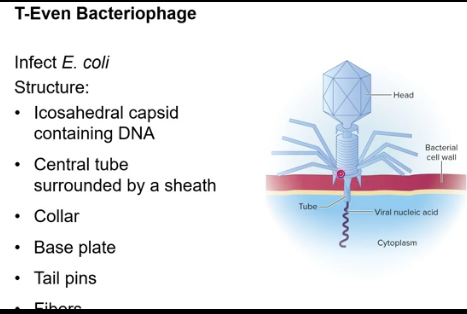
Bacteriopahge: bacteria eating looks like a bug
Infecs bacteria cells although dont effect humans cells dirrectely it can affect the bacteria in humans. which is more harmful
T-even bacteriophage
E.coli
Lytic cylce the six steps but with matruate and lysis at the ends
lytic means to burst or split. kills the host
meantwhile the lysogenic state deveolplemt of a prophage the viral dna/genetic material gets incoprated into bacteria dna which causes latent stage where bacteriaum contiunes to repolacte and reporduce more of the virual genomes that in now part of their dna hides until something cuases the replaction process
'
Temperate phages: undergo absoprtion and penetraion, dont relase immdegily or underungero replication they enter an inavcivte prophage stage
Lysogeny: condtion in which the host chromosome carries bacteriophage DNA
Induction: prophage in a lysogenic cell becoems activatdd and progresses directly into viral replication and the lytic cycle
This makes bateria more pathogentic to the host, it makes it harder to kill and antibiotes less affective
Lysogenic conversion: whena bacterium acquires a new trait from its temperate phage
corynebacterium diphtheriae- diphtheria toxin
virbrio cholerae - cholera toxin
clostridium botulinum - botulinum toxin
Viruses require living cells as their “meduium”
In vivo: laboratory bred animals and embryonic bird tissues
In vitro: cell or tissue culture methods
Primary purposes of viral cultivation: isolate and identify virueses in clinical specimens, prepare viruses for vaccines, do detailed research on virual strucutre, multiplication cycles, genetic, and effects on host cells
Bird eggs contiang embroyes: sterile enviorment, contain thier own nourishment, intact and self-supporting unit. Usally chicken, duck and trukey.
Viruses injected through the eggshell by drilling a small hole or making a small window
Viruesl in cell culutes we can see plaque deveplment
Plaques: areas where virues infected cells have been deswtroyed show up as clear, well-defined patches in the cell cheet, visibile manifestation of cytopathic effects
Prions
Composed of primairly protien (no nucleic acid) smaller than virues
Exact mode of infection tbd
Deposted as long protein fibril int he brain tissue of humans and animas
Cause cahnges in other proteins kind like zombies can caus eother ptoetine to change shape and cause disease
ex creutzfeldt jakob disease: afflicts the cns and cause degeneration and death. Mad cow diesea/bovine spongiform encepathopathy, shy-drager syndrome or multiple system atrophy resembles parkinsons disease
Prions is described as an infectionous protein.
Type 1 diabetes, MS, various cancer, alzheimers, obestiy
Antibiotis are not design to treat viral infections it used to kill bacteria
Antivirual drugs are used to stop steps of virual life cycle, vaccins are used to boost immune system to prevent the spread of virues
ANTIBIOTICS ARE NOT AN EFFECTIVE METHOD FOR TREATING VIRAL INFECTIONS
Virus capable of infecting cell called active while one that cant cause infection is inactive
Viruses do not have ATP nor have ribosomes for protein synthesis
Viruses contain a protein shell surrounding the genome and thier nucleic acid is rna
naked and envolped
capsomere: monomer of a capsid
icosahedron 20
Synthesiezes DNA directly from RNA using reverse trasncriptase: retrovirus Enzyme called reverse transcriptase
Envoledped viruses resleased from host cell through budding/exocytosis
Nacked viruses released through lysis/rupture
adsorption
Viruses can only adsorb cells of specfic tissue types are called tropism
Virues can use to enter an animal cell fusion of the viral envelope and the cell membrane, engulfment/phagocytosis of virus
Cytopathic effects in virally infected animal cells: syncytia, inclusion bodies
Viral DNA incorporated into DNA of eukaryotic host cell: provirus
Viruses remain hidden in cells and periodically become reactived aka like herpes are chronic latent
Persistent infections: infections in cells harbor the virus but are not immediately lysed
Viruses cause cancer by causing a loss of growth regulation and introducing oncogenes to a host cell
Injection: The nucleic acid from T-even bacteriophage enter the host cell
Lysogeny: Intergation of the viral genome into the host chromosome
Lysogenic conversion: Bacterium acquires new trait from its temperate phage
phage dna incorparted into bacterial host genome enter prophage state
Prion: Abnormal protein fibrils
Two nonvellular infectiouns agents prions and viroriods are emdcially important
Viroid: compsed completely of RNA