16_1 Hitler's rise
Page 1: Hitler’s Rise to Power
Key Points
Hitler served in World War I and joined the German Workers’ Party in 1919, which later became the Nazi Party.
After a failed coup in 1923, the Nazis gained support during the Great Depression.
Hitler was appointed German Chancellor in January 1933.
Page 2: Hitler Up to 1914
Early Life and Aspirations
Birth and Early Ambitions
Born in Braunau, Austria, in 1889, aspired to be an artist.
Unsuccessful in gaining admission to Art College in Vienna.
Struggles in Vienna
Lived in a homeless shelter and made a living by painting portraits.
Move to Munich
Relocated to Munich in 1913, enlisted in the G erman army when WWI started.
World War One Experiences
Combat Injuries and Recognition
Wounded twice; awarded several medals.
Temporarily blinded by mustard gas in October 1918; became aware of Germany's surrender.
Sense of Betrayal
Hitler felt betrayed by the government for the defeat in WWI, blamed the Jewish population for the loss, claiming a ‘stab in the back.’
Page 4: The Beginnings of the Nazi Party
Post-war Political Involvement
Role in the German Workers’ Party
Sent to Munich to spy on the German Workers’ Party; later joined in September 1919.
Party Development
Led by Anton Drexler; party renamed the National Socialist German Workers Party in 1920 (Nazi Party).
Core Beliefs
By 1921, Hitler had taken over the leadership of the party. They had a 25-point programme, containing ideas including:
Destroying the Treaty of Versailles.
Preventing Jewish people from being German citizens.
Introducing new laws on immigration
Page 5: The Munich Putsch
Context and Events
Cause: In 1923, Hitler sought to overthrow the government due to Germany's post-WWI struggles.
Beer Hall Incident (8 Nov): Hitler stormed a Munich beer hall where Bavarian leader Gustav Kahr was meeting, gaining support from General Ludendorff.
Uprising and Arrest (9-11 Nov): Hitler marched through Munich but was arrested after the police were tipped off.
Prison and Mein Kampf: Sentenced to 5 years, Hitler was released after 9 months and wrote Mein Kampf, detailing his antisemitic and Aryan superiority beliefs.
Page 6: Changing Fortunes of the Nazi Party
Electoral Trends
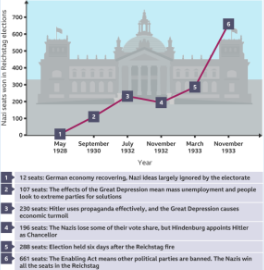
Page 7/ 8: Hitler Becomes Chancellor
Post-Prison Struggles:
unsuccessful in elections
their ideas were not appealing
Great Depression (1929): The economic crash gave Hitler an opportunity, with 6 million unemployed in Germany.
Blame on:
→ Jewish people (less than 1% of the population) T
→ The Treaty of Versailles for the crisis.
Nazi Propaganda: The Nazis used propaganda to promise solutions to Germany’s problems, gaining support and winning seats in the Reichstag.
Hitler’s Campaign: Hitler traveled across Germany, using speeches to connect with people and show he understood their struggles.
SA (Brownshirts): The SA, with 2 million members by 1933 helped:
intimidate opponents
disrupt meetings
promote Nazi policies (especially targeting Communists)
Appointment as Chancellor: By summer 1932, the Nazis were the most popular party. President Paul von Hindenburg, believing Hitler could be controlled, appointed him Chancellor on 30 January 1933.
(Page 9: Propaganda Posters)
Analysis of Propaganda
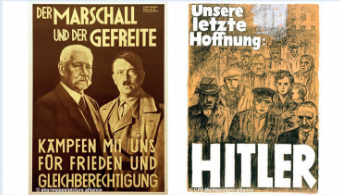
SOURCE 2: A propaganda poster showing Hitler with von Hindenburg. Caption reads the “The Marshal and the Corporal. Fight with us for freedom and Equal Rights.
SOURCE 3: A propaganda poster. Caption reads “Our last hope: Hitler”
Page 10: The Reichstag Fire
Context: After becoming Chancellor, Hitler aimed to secure absolute power and pass laws without needing approval from the Reichstag, with President Hindenburg still above him.
The Fire (27 February 1933):
A fire broke out in the Reichstag building just before another election.
A Dutch communist, Marinus van der Lubbe, was found inside and confessed to starting the fire.
Debate over Responsibility: Historians disagree on whether the fire was a Nazi plot to justify cracking down on Communists and Jews. → Some argue van der Lubbe, who had mental health issues, could not have acted alone.
Posthumous Pardon: In 1998, van der Lubbe was posthumously pardoned by a German court.
Page 12: Chancellor to Dictator
Reichstag Elections (5 March 1933): The Nazis didn’t win a majority, limiting Hitler’s power.
Enabling Act (23 March 1933): Hitler passed the Enabling Act, allowing him to make laws without Reichstag approval by intimidating opposition, securing a two-thirds majority.
Hindenburg’s Death (August 1934): After President Hindenburg died, Hitler merged the roles of Chancellor and President, declaring himself Führer and completing his rise to dictatorship.