Motivation
What is motivation? The combination of direction & intensity of effort.
Direction: if a person seeks out, approaches, or is attracted to a situation
Intensity: how much effort a person puts into a situation
Views of Motivation
Participant/ trait centered view
motivated behavior is a function of individual characteristics
needs, goals, personality
Situation centered view
motivated behavior is determined by a situation (leadership, the moment, W-L)
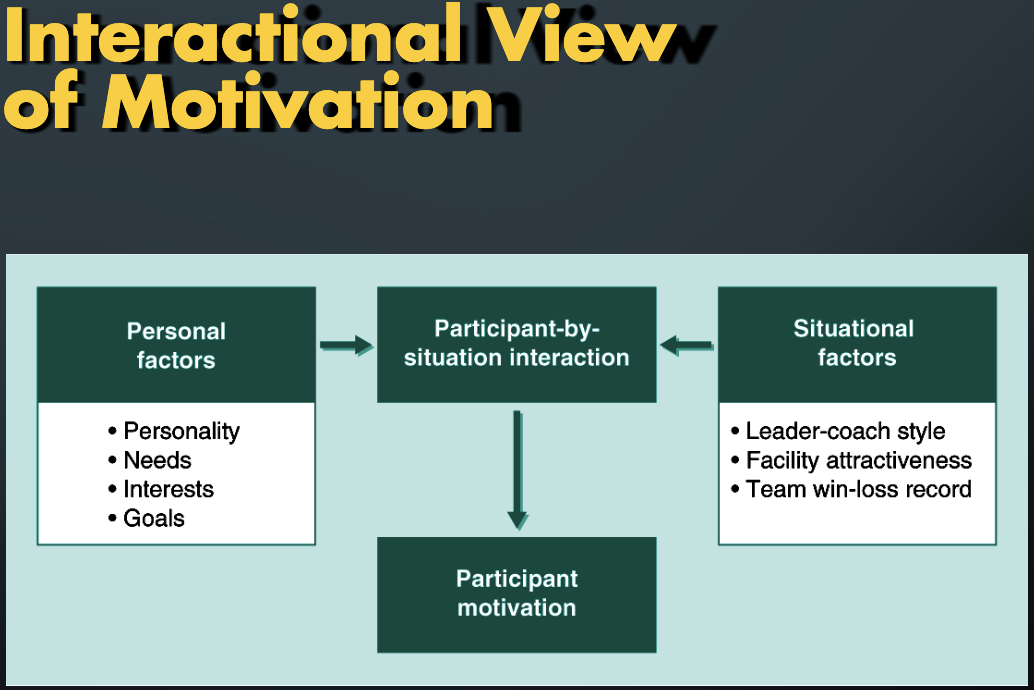
Interactional view
motivated behavior is a result of personal and situational factors
5 Guidelines for Building Motivation
Both situations & traits motivate people
People have multiple motives for involvement
multiple motives
motives can compete
motives change over time
Identify motives
major motives: improve skills, have fun, social, thrills & excitement, success, develop fitness
Change the environment to enhance motivation
environment can be competitive or recreational
provide multiple opportunities
tailor environment to individuals
Leaders directly & indirectly influence motivation
Use behavior modification to change undesirable motives
rewards
Achievement Motivation
some people strive for success in tasks, persevere, & feel pride in accomplishment
Attribution Theory
people explain their successes or failures on:
stability: how stable our control is
locus of control: if you have control over it
locus of causation: if control is internal or external
Achievement Goal Theory
Ego goal orientation: focuses on comparing performance w/ & defeating others
Task goal orientation: focuses on improvements relative to one’s past performances
we SHOULD have two separate scales measuring ego & task orientation respectively
Motivational Rewards
intrinsic vs extrinsic
controlled vs not controlled
Implications for Professional Practice
Recognize interaction of personal & situational factors
Emphasize mastery of task goals & downplay outcome goals
Monitor & alter attributions
Assess & correct inappropriate attributions
Determine when competitive goals are appropriate
Enhance feelings of competence & control