6.3.1 Ecosystems- Summary Notes
Ecosystems
Start here
An ecosystem includes all the organisms living in a particular area known as the community as well as all the non-living elements of that particular environment.
The distribution and abundance of organisms in a habitat is controlled by both biotic (living) factors e.g. predators andpathogens and abiotic (non-living factors) such as light levels and temperature. Each species has a particular role in its habitat called its niche which consists of its biotic and abiotic interactions with the environment.
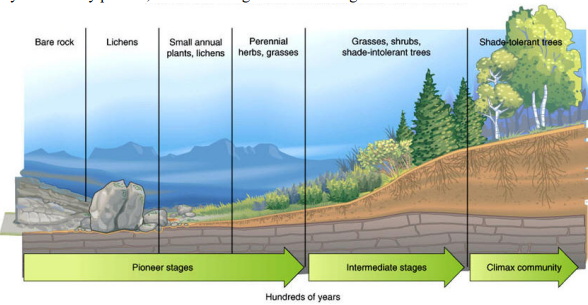
Succession
Succession is the change of one community of organisms into the other. Primary succession occurs when area previously devoid of life is colonised by communities of organisms for instance after the eruption of a volcano which lead to formation of a rock surface. The area is first colonised by the pioneer species such as lichens which are adapted to survive in such harsh conditions. As organisms die, they are decomposed by microorganisms thus adding humus, this in turn leads to formation of soil which makes the environment more suitable for more complex organisms. Over time, the soil becomes richer in minerals thus enabling larger plants such as shrubs to survive. Eventually, a climax community is established which is the final seral stage of succession, a self-sustaining and stable community of organisms. Secondary succession occurs in a previously colonised area in which an existing community has been cleared. This type of succession can occur after events such as forest fires. As a soil layer is already present, succession begins at a later stage.
In any ecosystem, plants synthesise organic compounds from either atmospheric or aquatic carbon dioxide. Most of the sugars synthesized by plants are used by the plant as respiratory substrates whereas the remaining sugars are used for synthesis of biological molecules which form the biomass of plants.
The biomass can be measured in terms of mass of carbon or dry mass of tissue per given area per given time. The chemical energy stored in dry biomass can be estimated using calorimetry.
• Net primary productivity (NPP) – the rate at which energy is transferred into the organic molecules that make up new plant biomass, that is the chemical energy store in plant biomass after respiratory losses to the environment have been taken into account
• Gross primary productivity (GPP) – the rate at which energy is incorporated into organic molecule in the plants in photosynthesis, that is the chemical energy store in plant biomass, in a given area or volume, in a given time
• Therefore: NPP = GPP – R
• The net primary production is available for plant growth and reproduction as well as to other trophic levels in the ecosystem such as decomposers and herbivores
• The net production of consumers (N) such as animals can be calculated by:
N= I – (F+R) where I represents the chemical energy store in ingested food, F represents the chemical energy lost to the environment in faeces and urine and R represents the respiratory losses to the environment.
Nitrogen cycle
Nitrogen is an essential component of metabolism as it is required for the synthesis of proteins and nucleic acids. Nitrogen cannot be used in the form of gas, therefore to be of any use to plants, it first needs to be fixed either in the form of ammonium ions or nitrates. The process occurs as following:
• Nitrogen is first fixed by bacteria such as Rhizobium which live in the root nodules of leguminous plants such as pea plants.
• The bacteria have a mutualistic relationship with the plant where they exchange the fixed nitrogen for glucose.
• In anaerobic conditions, which are maintained with the use of special oxygen absorbing proteins, enable nitrogen reductase to reduce nitrogen gas to ammonium ions
• Ammonium ions are subsequently released by bacteria in the putrefaction of proteins from dead organic matter.
• Chemotrophic bacteria (Nitrosomonas) oxidise ammonium ions to nitrites
• Nitrobacter subsequently oxidise nitrites to nitrates in the presence of oxygen
• Plants absorb nitrates from soil for nucleotide synthesis
• In anaerobic conditions, denitrifying bacteria convert nitrates back to oxygen gas for respiration. Nitrogen gas and nitrous oxide are produced in the process
Carbon Cycle
Carbon is a component of all organic molecules and as such is recycled through the environment by the processes of photosynthesis, feeding, respiration and decomposition.
Sampling Abundance of organisms can be measured with the use of:
• Line transect- where a line is placed down across the habitat and species in contact with the line are recorded
• Quadrat – a square frame of a given size, randomly placed in the area being sampled, species inside the quadrat are identified and counted to determine the abundance
• Belt transect – 2 tape measures are laid out and samples are taken between the two at set intervals along the tapes