Coordination Compounds
Introduction
Transition metals form numerous stable compounds in which the metal shares electron pairs with anions/neutral molecules → modern term: coordination compounds.
Coordination chemistry underpins modern inorganic, bio–inorganic chemistry & many industrial processes.
Biological: are classic coordination entities.
Practical: metallurgical extractions, analytical titrations, homogeneous/heterogeneous catalysis, electroplating, dyeing, medicines.
Werner’s Theory of Coordination Compounds
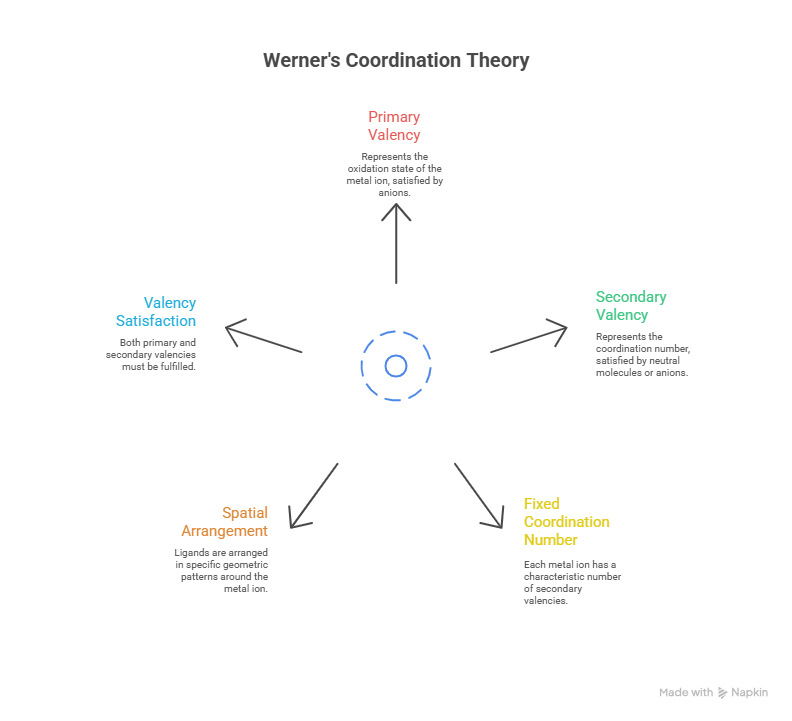
Alfred Werner (1866–1919) prepared/characterised many complexes; proposed two valences for metal ions:
Primary valence = usual ionic valence; ionisable; satisfied by anions (e.g., has primary valence ).
Secondary valence = coordination number (CN); non-ionisable; satisfied by ligands directly bound to metal.
Key postulates
Secondary valence is fixed for a given metal and dictates a definite spatial arrangement (coordination polyhedron).
Common geometries: octahedral, tetrahedral, square-planar.
Evidence: Cobalt(III) chloride–ammonia series; AgNO precipitation & conductance showed groups remain bound (Table sample):
(yellow) → 3 AgCl, 1:3 electrolyte (secondary valence 6)
(purple) → 2 AgCl, 1:2 electrolyte
(green/violet) → 1 AgCl, 1:1 electrolyte
Demonstrated isomerism (same empirical formula, different properties).
Fundamental Terminology
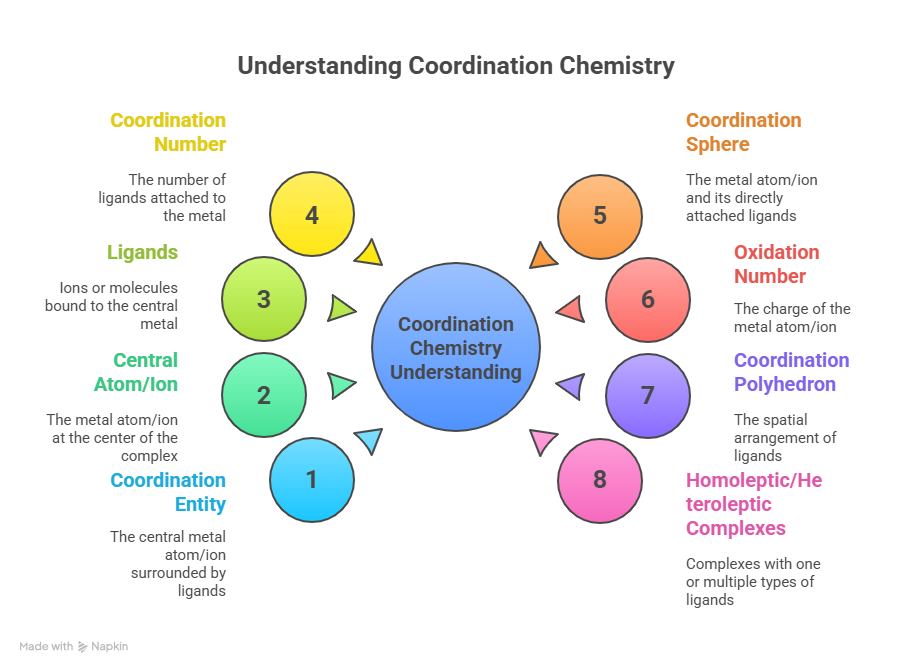
Coordination entity: central atom/ion + ligands inside (e.g., ).
Central atom/ion: Lewis-acidic metal site (e.g., in ).
Ligand: ion/molecule donating lone pair(s).
Denticity: unidentate, didentate (e.g., ), polydentate (e.g., -hexadentate).
Chelate ligand: uses ≥2 donor atoms simultaneously → chelate complexes more stable.
Ambidentate: two different donor atoms; binds through either, not both (e.g., , ).
Coordination number (CN): number of σ-donor atoms attached (π bonds not counted); examples:
(CN=6), (CN=4).
Coordination sphere: full entity in brackets; outside ions = counter-ions.
Coordination polyhedron: spatial arrangement of donors (octahedral, tetrahedral, square-planar, trigonal-bipyramidal etc.).
Oxidation number: hypothetical charge on metal after heterolytic removal of ligands; given in Roman numerals e.g., Cu(I).
Homoleptic vs heteroleptic: single ligand type (e.g., ) vs multiple types (e.g., ).
Homoleptic Complex:A coordination complex in which only one type of ligand is attached to the central metal atom/ion.Example: [Co(NH3)6]3+[Co(NH_3)_6]^{3+}[Co(NH3)6]3+ → All ligands are NH3
Heteroleptic complex: A coordination complex with multiple types of ligands attached to the central metal atom/ion (e.g., [ ext{Co(NH}3)4Cl_2]^+}).
Nomenclature Rules (IUPAC)
Writing Formulae
Metal symbol first, then ligands (alphabetically by ligand symbol/abbreviation, independent of charge).
Polyatomic ligand formulas in parentheses; whole entity in .
Overall charge outside as superscript (e.g., ).
Counter-ions written left (cations) or right (anions) of bracket to achieve electroneutrality.
Naming
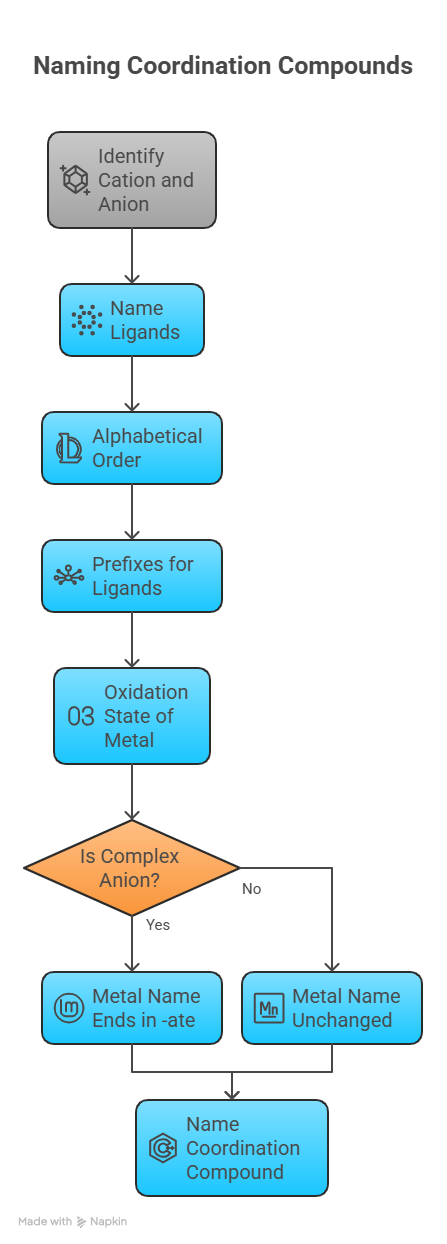
Name cation before anion in full compound.
Within entity list ligands alphabetically, then metal.
Anionic ligands end in -o (IUPAC 2004 draft: -ido; e.g., chloro→chlorido).
Neutral: usual names except aqua (HO), ammine (NH), carbonyl (CO), nitrosyl (NO).
Prefixes mono-, di-, tri- etc.; if ligand already contains prefix, use bis, tris, tetrakis [ligand] .
Oxidation state of metal in Roman numerals ( ) after the entity.
For anionic complexes, metal name ends in -ate (sometimes Latin root, e.g., ferrate).
Neutral complex named like cationic.
Illustrative examples
→ triamminetriaquachromium(III) chloride.
→ diamminesilver(I) dicyanidoargentate(I).
→ potassium tetrahydroxidozincate(II).
Isomerism in Coordination Compounds
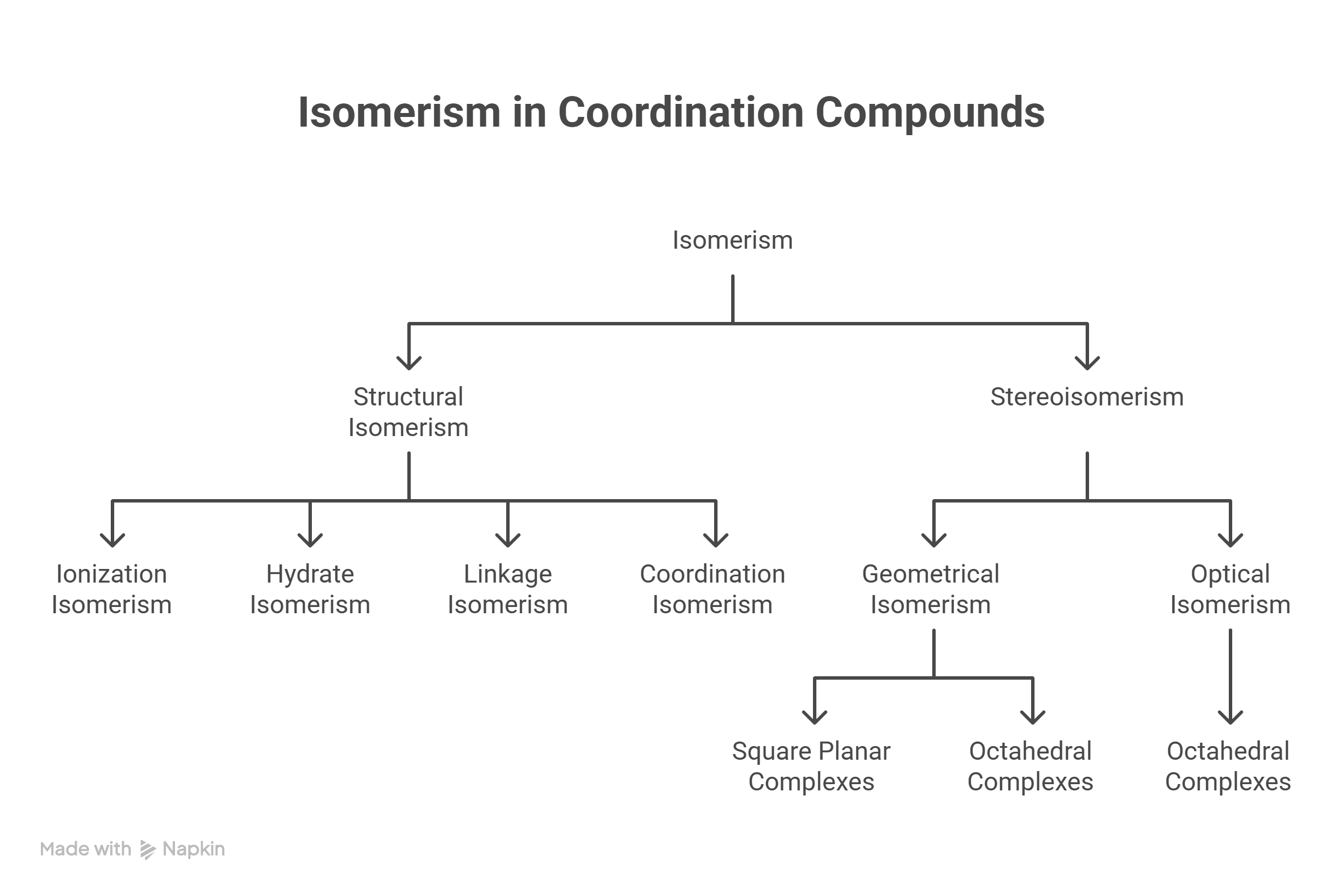
Stereoisomerism
Geometrical (cis/trans, fac/mer) – Isomers have the same empirical formula but differ in the spatial arrangement of ligands around the central metal atom. This can manifest as cis/trans isomerism e.g., square-planar ; octahedral ; fac/mer in .
Optical (enantiomers) – Optical isomerism (enantiomerism) occurs in chiral coordination complexes that are non-superimposable on their mirror images and lack a plane of symmetry. Examples include [Co(en)3]3+[Co(en)3]3+ and cis-−[PtCl2(en)2]2+−[PtCl2(en)2]2+.; e.g., , cis-.
Structural isomerism
Linkage – ambidentate ligand binds through different atoms: vs .
Coordination – exchange of ligands between cat./an. entities: vs vice-versa.
Ionisation – interchange of ligands & counter-ions: vs .
Solvate (hydrate) – solvent in/out of sphere: (violet) vs (grey-green).
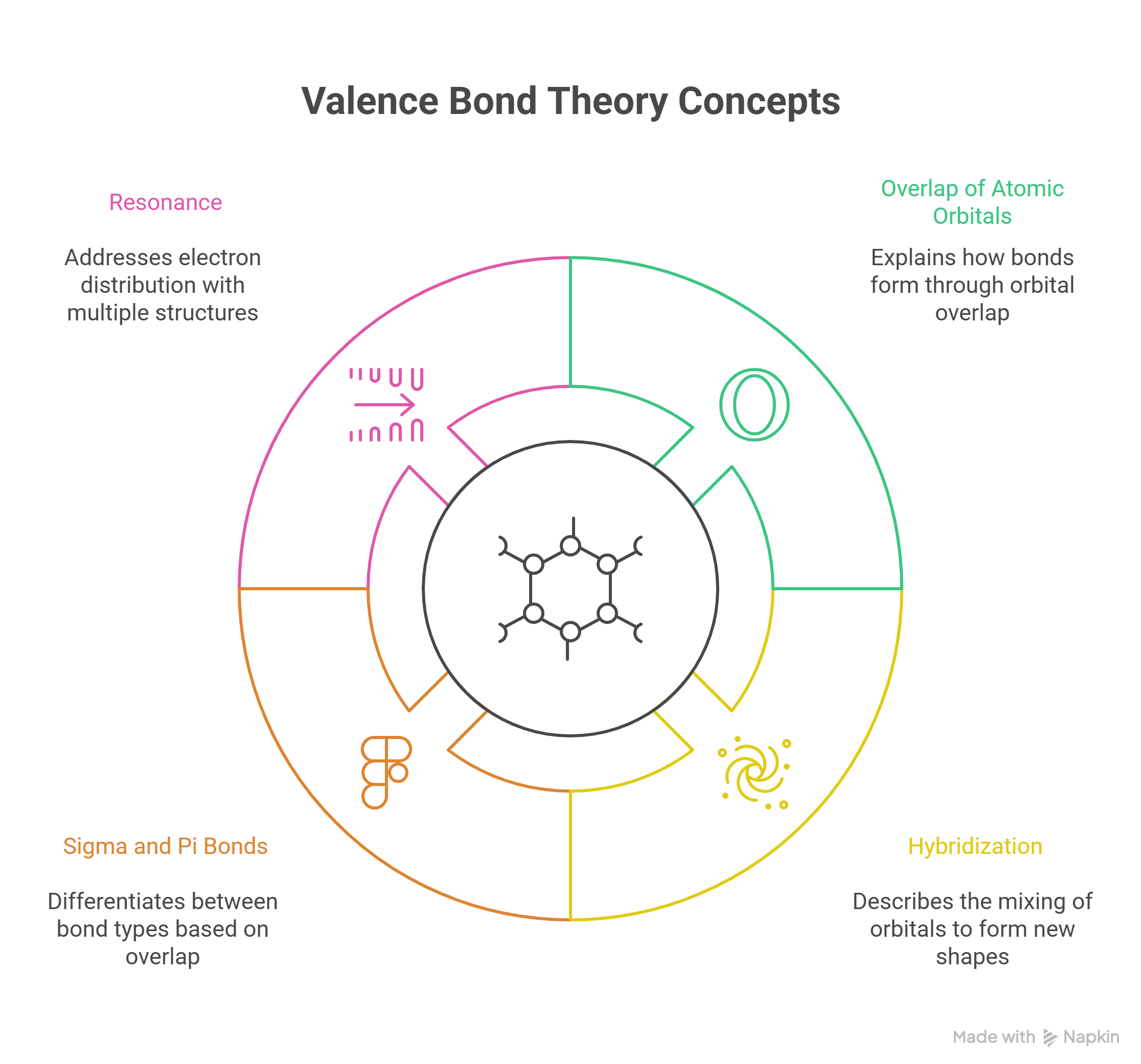
Valence Bond Theory (VBT)
Metal ion hybridises its orbitals (d, s, p) to accept σ-donor lone pairs.
Common schemes & geometries:
• → tetrahedral (CN 4);
• → square-planar (CN 4);
• → trigonal bipyramidal (CN 5);
• (outer) or (inner) → octahedral (CN 6).
Examples
Inner-orbital low-spin uses (3d pair up; diamagnetic).
Outer-orbital high-spin uses (4d involved; paramagnetic).
: (tetrahedral, 2 unpaired e⁻, paramagnetic).
: (square-planar, all paired, diamagnetic).
Limitations: qualitative only; cannot predict colours, energies, ligand strength, etc.
Crystal Field Theory (CFT)
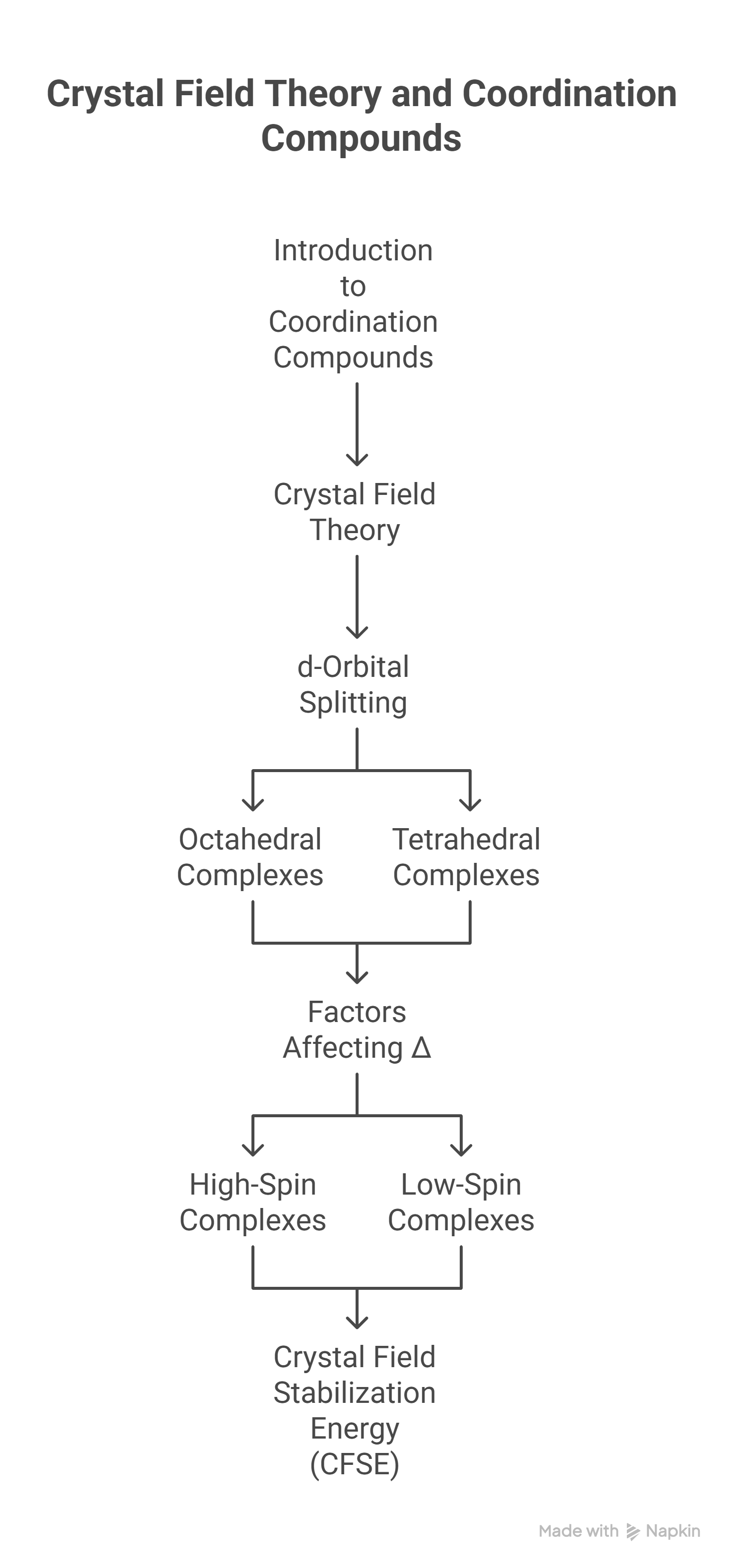
Treat ligands as point charges/dipoles; purely electrostatic.
Octahedral field: degeneracy of orbitals splits into lower and higher .
Energy gap ; raised , lowered .
Tetrahedral field: inverse splitting; ; usually high-spin.
Spectrochemical series (increasing field strength ):
Electron configurations depend on rivalry between and pairing energy :
If → high-spin (weak-field ligands).
If → low-spin (strong-field ligands).
Colour originates from transitions absorbing specific visible wavelengths; complementary colour observed.
(d) absorbs blue-green (~498 nm) → appears violet.
Changes in ligand alter → colour change e.g., Ni(II) series with en (green → violet).
Magnetic moments (spin-only): BM; support high vs low spin assignments.
Limitations: neglects covalency, incorrectly predicts field order of anionic ligands; improved by Ligand Field & MO theories.
Metal Carbonyls
Homoleptic carbonyls: only CO ligands; zero-oxidation metals.
Geometry examples: tetrahedral; trigonal-bipyramidal; octahedral.
Bridged dimers: (Mn–Mn bond); (2 μ-CO bridges).
Synergic M–CO bond: dual interaction
σ-donation: CO lone pair (C) → empty metal orbital.
π-back-donation: filled metal → CO antibonding .
Reinforces both M–C and weakens C–O (observed IR red-shift).
Importance & Applications
Analytical chemistry: colourimetric detection (e.g., DMG for Ni), complexometric EDTA titrations (water hardness).
Metallurgy: cyanide leaching of Au/Ag via ; purification via carbonyls: Mond process .
Biological: chlorophyll (Mg-porphyrin), haemoglobin (Fe-porphyrin), vitamin (Co-corrin), metallo-enzymes (carbonic anhydrase, carboxypeptidase A).
Industrial catalysis: Wilkinson’s catalyst (alkene hydrogenation), many others.
Electroplating/Photography: smoother deposits from ; fixer hypo dissolves AgBr via [\text{Ag(S2O3)_2}]^{3-}.
Medicinal: chelate therapy (EDTA for Pb, D-penicillamine for Cu); anti-cancer drugs e.g., cis-platin .
Tables & Key Data
Hybridisation vs Geometry
→ tetrahedral (CN 4)
→ square-planar (CN 4)
→ trigonal-bipyramidal (CN 5)
/ → octahedral (CN 6)
Example oxidation-state calculations
: let x=OS(Co); → .
: → .
Representative Worked Illustrations
Magnetic moment & geometry: has BM ⇒ unpaired e⁻ ⇒ high-spin d tetrahedral (), not square-planar.
Predicting spin state: (weak field) → d high-spin, 5 unpaired; (strong field) → low-spin, 1 unpaired.
Square-planar diamagnetism: requires dsp; d electrons pair up, no unpaired e⁻, hence diamagnetic.
Created by:MAYA D N ,HSST CHEMISTRY