Unit 3
Apply VSEPR theory to molecular shape, polarity and dipole moment (5.1 – 5.3)
Interpret the valence bond theory and hybridization of atomic orbitals (5.4-5.5)
Identify intermolecular forces and apply them to physical changes (6.1-6.3)
Calculate the molar mass of atoms, ions and molecules (2.4, 2.5)
Calculate using moles and Avogadro’s Number (2.4, 2.5)
Write and balance chemical reactions (7.1, 7.2)
5.3 Polar bonds and polar Molecules
Bond dipole (Bonds)
The charge separation caused by difference in the electronegativty between two atoms results in a bond dipole
Bond dipole: separation of electrical charge created when atoms with different electronegatives form a covalent bond. This is a TYPE polar bond
** When electrons have an unequal amount of distributed electrons, bonds will have a certain charge attached to them, depending on how electronegtive the atom is *

Permanent dipole: permanent separation of electrical charge in a molecule resulting from unequal distributions of bond and/or lone pairs of electrons
Polar molecules (Atoms)
Polar Bonds: bonds between atoms, in which there are an unequal distribution of electrons in a covalent bond.
Polar Molecules: Molecular shapes that give rise to distributions of electric charge that is not evenly distributed.
in the molecule, certain regions have more positive charge/s and ones with more negative charge/s
POLAR MOLECULES WILL ALWAYS HAVE A PERMANENT DIPOLE.
for molecules to be polar, they must have polar bonds
MAIN DIFFERENCE:
POLAR BONDS: Unequal electrons between bonds (Smaller)
POLAR MOLECULES: Unequal charge between atoms ( larger
Measuring polarity
Dipole moments
Molecules polarity is related to the overall charge separation in the molecules
It is determined by the degree to which the molecule aligns with a
strong electric field.
A molecule’s polarity is measured by its dipole moment (μ).
• Units = debyes (D)

5.4 Valence Bond Theory and Hybrid Orbitals
Valence bond theory
Valence Bond theory: a quantum mechanics–based theory of bonding that assumes covalent bonds form when half-filled orbitals on different atoms overlap or occupy the same region in space.
theory merges quantum mechanics and Lewis’s model of shared electron pairs to explain molecular bonding. A chemical bond forms when atomic orbitals overlap.
Overlap: Bonds forming when 2 obrtials on different atoms, occupy the same region of space
The formation of chemical bond leads to increased electron density along the internuclear axis
Electron density: probability of finding an electron within a specific volume around a nucleus
internuclear axis: Imaginary line connecting the nuclei of two atoms in a chemical bond
The resulting bond of overlapping electrons or a valance bond theory bond, is a sigma bond
Sigma Bond: a covalent bond in which the highest electron density lies between the two atoms along the bond axis

Another type of bond, is a pi () bond.
pi () bond: A covalent bond, in which electron density is greatest above and below.

Hybridization
The mixing of atomic orbitals to generate new sets of orbitals that may form sigma bonds with other atoms
The mixing results in the formation of a new set of wave function, defining four equivalent hybrid atomic orbitals
Hybrid atomic orbitals: in valence bond theory, one of a set of equivalent orbitals about an atom created when specific atomic orbitals are mixed.
Hybrid models
Sp³ hybrid orbitals: Four hybrid orbitals, that have a tetrahedral orientation produce by mixing one s, and three p orbitals

Sp² hybrid orbitals: Three hybrid orbitals in a trigonal planar orientation formed by mixing one s and two p orbitals
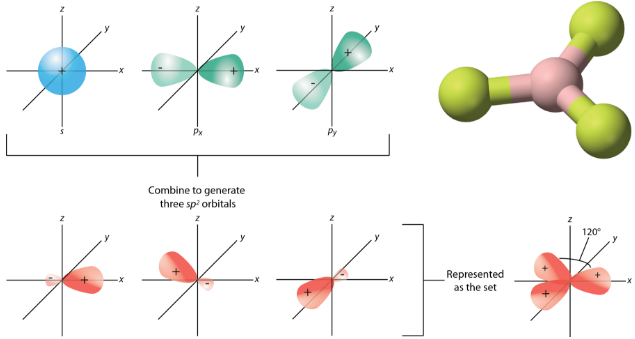
Sp^1 Hybrid Orbitals: Two hybrid orbitals on opposite sides of the hybridized atom formed by mixing one s and one p orbital
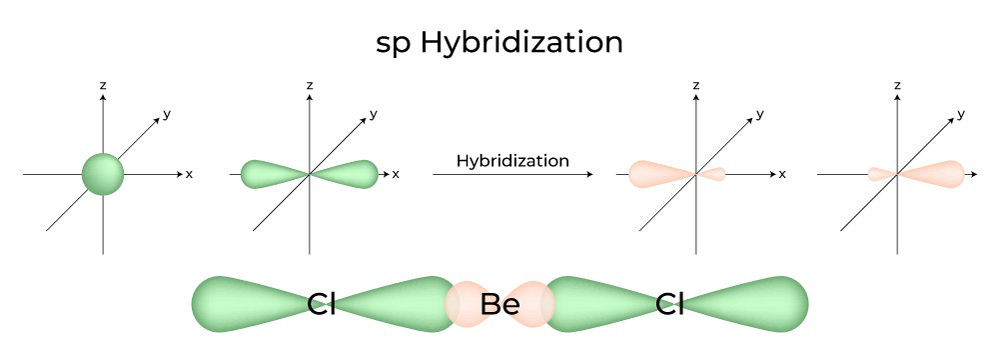
FULL CHART:

5.5 Molecules with multiple “Central” atoms
Central atoms and Molecular recognition
Molecular recognition: The process by which molecules interact with other molecules to produce a biological effect.

Molecules with Multiple Central Atoms: In certain atoms, there are more than one central atoms.The hybridization of and geometry around each carbon must be determined independently.
6.1 Intramolecular Forces versus Intermolecular Forces
Intermolecular
Intermolecular force/s: Forces that exist BETWEEN molecules and hold them together in the liquid or solid phase.
attraction between two molecules and/or ions
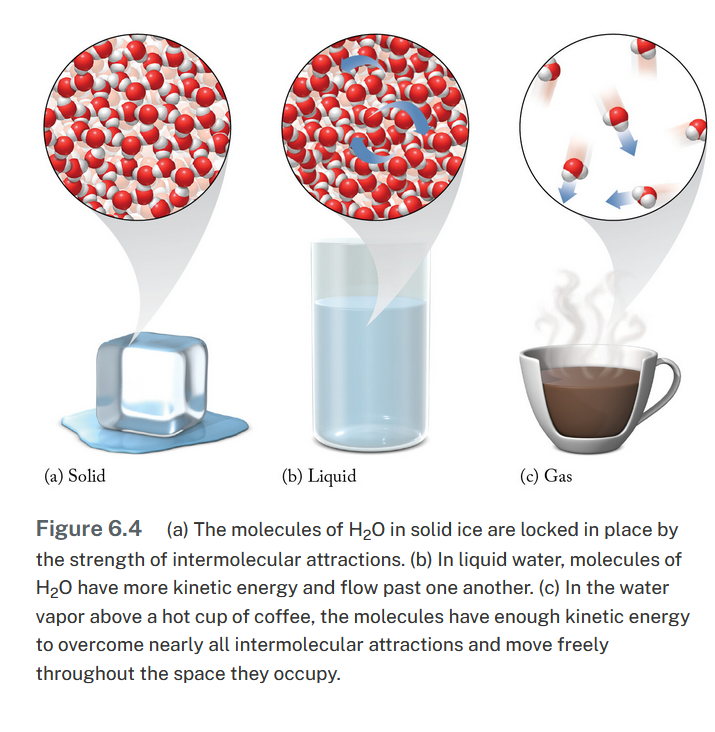
These forces are weaker than intramolecular forces and act over longer distances.
Intermolecular forces influence the physical properties of all substances.
Intramolecular
Intramolecular: forces that hold atoms together within a molecule.
Hold the atom together, rather than exist separate like intermolecular

Shorter distance between molecules
Stronger bonding force between molecules.
6.2 London Dispersion Forces
Boiling Points and Atomic Number
Boiling points: The temperature at which an molecule turns into its gaseous form
The temperatures at which a liquid's vapor pressure equals external pressure
TREND BETWEEN BOILING POINTS AND ATOMIC NUMBER
As atomic number increases, so does boiling points
the stronger the particles’ attractions for each other, the more energy needed to separate them—and, in turn, the higher the boiling points.

Temporary Dipoles
When 2 atoms not bonded to each other are attracted to each other, due one atom’s positive nucleus is attracted to the other atom’s negative electrons, even as their electron clouds repel each other. This causes a temporary dipole
Temporary dipoles: Separation of charge produced in an atom or molecule by a momentary uneven distribution of electrons, also referred induced dipole
only intermolecular force present in between nonpolar molecules.
The presence of temporary dipoles in atoms and molecules creates an electrostatic way for them to interact with other atoms and molecules.

London Dispersion Forces
London Dispersion force: intermolecular force between atoms or molecules, cause by temporary dipoles
Polarizability: the relative ease with which the electron cloud in a molecule,ion, or atom can be distorted, inducing a temporary dipole
Greater polarizability leads to stronger temporary dipoles and stronger intermolecular interactions
London dispersion forces become stronger, as atoms and molecules become larger
Strength of London Dispersion forces depend on
Number of electrons- strength increase if electrons increase,
Size of atoms/molecules
Shape of molecules

Hydrocarbons
Hydrocarbons: a compound whose molecules contain only carbon and hydrogen atoms
Alkane: a hydrocarbon, in which each carbon atom is bonded to four other carbon or hydrogen atoms

Effect of Shape on Intermolecular Forces
Constitutional Isomers: Compounds with the same molecular formula, but different connections between the atoms in their molecules.
More branching in the structure leads to a smaller surface area, which causes a decrease in the London dispersion forces between molecules.

Viscosity
London dispersion forces, also influence viscosity of liquids
Viscosity: measure of a fluid’s resistance to flow.
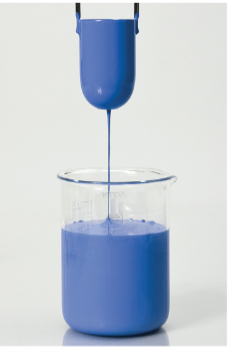
As intermolecular forces increase, the molecules cannot slip past each other as easily. MEANING: Intermolecular forces increase, Viscosity increases
The viscosity of liquid alkanes increases as the number of carbon atoms and the molar mass increases.

6.3 interactions involving polar molecules
Dipole–Dipole Interactions
Dipole-Dipole interactions attraction between regions of polar molecules that have partial charges of opposite sign
Polar molecules are attracted to each other by dipole–dipole interactions.
Polar molecules have an overall dipole moment and the partial negative charge on one molecule is attracted to the partial positive charge on another molecule.

Hydrogen bonding (Dipole-Dipole interaction type)
Hydrogen bonding: dipole-dipole attraction between a positive H atom, covalently bonding to on highly electronegative atom ( N,O, or, F ), another very electronegative atom.
Hydride: Where hydrogen combines with another element, to form an new element or compound.
Water (H2O)
Ammonia(NH3)
Titanium
NaH

Influence of Intermolecular Forces on Boiling Point
Depending on the functional groups present in a molecule, different types of intermolecular forces are possible.
The presence of hydroxyl groups (-OH) allow for hydrogen bonding, resulting in higher boiling points.

Ion-Dipole interactions
Ion-Dipole interaction: an attractive force between an ion and molecule, that has a permanent dipole
* Cations and anions can interact with molecules that have a permanent dipole.
*Ionic salts can interact with polar water molecules, causing them to dissolve in water

Sphere of Hydration
When ions dissolve in water, they become surrounded by a number of water molecules, which are organized in multiple layers.
The dissolved ions are referred to be hydrated.

Inner sphere: The water molecules closet to the ions, will form ion-dipole interactions
Outer sphere: The water molecules outside the inner sphere, will form hydrogen bonding to the inner spheres water molecules
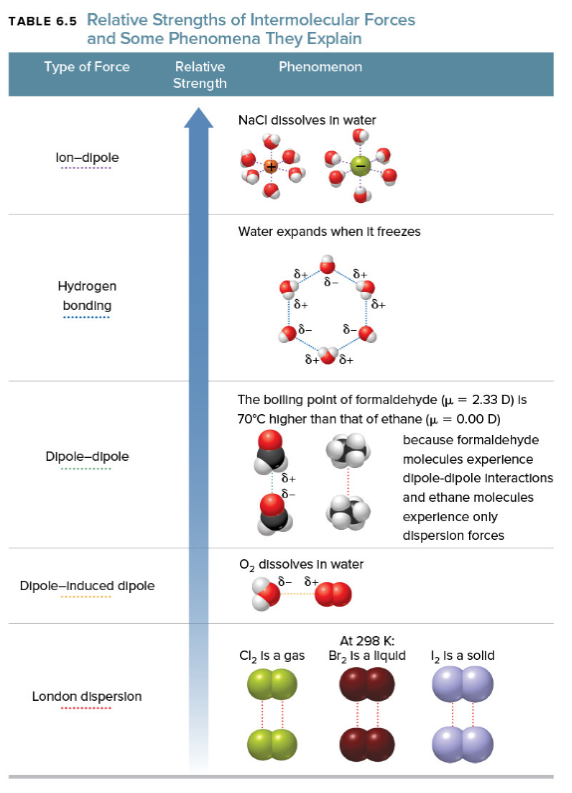
Relative Strengths of
Intermolecular Forces
The strength of intermolecular forces present in between molecules affects:
State of matter and solubility
Boiling point
Physical properties of substances
6.4 Trends in solubility
context:
solution is a homogeneous mixture of two or more substances.
solvent: Compound of a solution, for which the largest number of moles are present
The component that dissolves the other part of the solution
Solute: any component in a solution other than the solvent,
The component that dissolves the solvent
Solubility: Maximum quantity of a substance that can dissolve in a solution
the maximum amount of a solute that can dissolve in a specific amount of solvent
Miscible
Miscible: When two liquid compounds have unlimited solubility in each other. Capable of being mixed in any proportion-without reacting chemically.
Strength and number of interactions among solute particles and interactions of solvent molecules determine solubility.
Nonpolar solutes may dissolve in water due to dipole-induced dipole interactions.
The dipole in water can induce a dipole in oxygen, causing it to be slightly soluble
Solute-solvent interactions
Solute-Solvent interactions: Attractive forces (ion-dipole or hydrogen bonding), that occur between particles of a solute and a solvent, determining solubility.
Polar solutes | Polar solvents: Polar solutes tend to dissolve polar solvents, due to strong dipole-dipole interactions, between the molecules of both. This is refereed to like dissolves like
Non-polar solutes | Polar solvents: Nonpolar solutes dont dissolve or dissolve very little in polar solvents because the interaction is much weaker than the interactions that keep the solute molecules attracted to each other, and solvent molecules are attracted to other solvent molecules
Non-polar solutes | non-polar solvents: Non-polar solutes and non-polar solvents dissolve easily in one another, because of the dipole-dipole interaction between the 2- same reason for polar and polar. like dissolve like

Competing Intermolecular Forces
Ketones: organic compounds defined by a carbonyl group (C tripple bonded to O) bonded to two carbon atoms
Ketones become less soluble in water as the length of the carbon chain increases
The ketones become more hydrophobic (repel water(Thomas)) due to the larger nonpolar region.
The smaller ketones are hydrophilic because the dipole– dipole interactions promote solubility

2.4 The Masses of Atoms, Ions, and Molecules
The Mole
Mole: Si unit for expressing quantities of substances
1 mole = particles (Avogadro’s constant)
Mole is the number of atoms in exactly 12 grams of carbon-12

Conversions using Avogadro’s constant
Avogadro’s constant can be used to convert between number of particles and number of moles of a substance (VICE VERSA)

Molar Mass
The Molar mass: The mass (in grams) of one mole of a substance (atom,molecule, formula unit)
Same numerical value as mass in u.

Conversions among Moles, Mass, and Particles

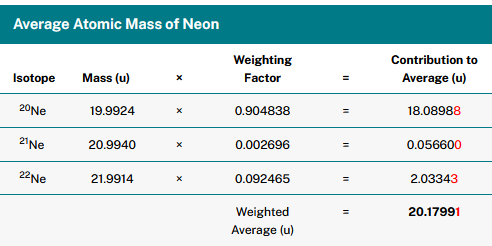
Average atomic mass
Average atomic mass: Weighted average of masses of all isotopes of an element.
Calculation : multiplying natural abundance of each isotope by its mass in unified atomic mass units, and then summing the products
Natural abundance: Proportion of a isotope.Expressed as a percentage typically
(Natural abundance * mass) + …..

Molecular Mass
Molecular mass: The molecular mass is the sum of all the average atomic masses of the atoms that are chemically bonded together
Sum of all atomic masses

Formula Mass
Formula Unit: Smallest electrically neutral unit of an ionic compound
Formula mass: Mass in unified atomic mass units of one formula unit of an ionic compound

7.1 Chemical Reactions and the carbon Cycle
Stoichiometry
Stoichiometry: The balancing in a chemical reaction for it to be legitmate. Reactions must always be balanced.
the number atoms of each Element must be the SAME on the reactant side and the product side of the arrow.

Writing Balanced Chemical Equations
Law of conservation: the law stating that: all chemical equations must be balanced
Total number of atoms of each element, must be the same amount on the left and right side
(Number of atoms, must be same on both sides)
The masses of the products must equal masses of the reactants.

Steps to Balance Chemical Equations
Write a preliminary expression containing a single particle (atom, molecule, or formula unit) of each reactant and product with a reaction arrow separating reactants from products. Include phase symbols indicating physical states.
(Write equation of each reactant and product on both sides, separating them with a arrow, and indicating what states each atom is in)
Check whether the expression is balanced by counting the atoms of each element on each side of the reaction arrow.
(Check if both sides are balanced, if not continue)
Choose an element that appears in only one reactant and one product and balance it first.

Choose coefficients for the other substances so that the number of atoms for each element is the same on both sides of the reaction arrow.
(add more of that substance through coefficents, inorder to balance it)