Renaissance - Exploration
Test Review Sheet
Test Review Sheet
Renaissance
How did the Renaissance impact the world views of Europeans?
Humanism
Art
The Church and the People
Reformation
Martin Luther
95 Theses
Martin Luther's Speech Excerpts
Challenges to the Church
Scientific Revolution - Big Ideas for each scientist
Copernicus
Galileo
Bacon
Descartes
Newton
Kepler
Incas and Aztecs
Use the documents from class to understand the foundational pieces of each civilization
Government
Absolutism
Divine Right of Kings
Absolute Rulers
Examples of Absolute Ruler’s beliefs
What is Government?
Exploration
Why not China?
Why Europe?
Impact on Native Americans
Renaissance
The renaissance was the rebirth of life turning towards secular achievements.
Commercial (business revolution):
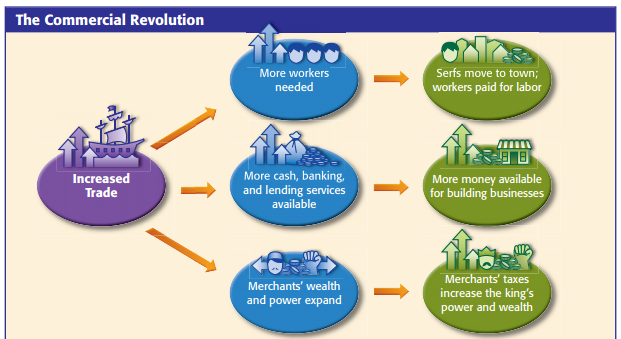
Increased the need for banks + the wealth
Venice became a center for trade (near water, center of Europe, constantinople)
Merchant/middle class forms
Trade acted as a primary catalyst for the Renaissance by generating immense wealth, shifting Europe from a land-based feudal economy to a commercial, urban society.
Greek/Roman Influence, Humanism, emphasis on the individual, secular achievements
Religious leaders as regular people (Jesus as baby not tiny man)
Vocab:
Golden age - time of inventions/innovations and creativity
Humanism - philosophy of the importance of humans
Humanist - scholars who studied secular subjects
Philosophy - ideology about a topic
Renaissance - rebirth of europe → creativity and inventions
Secular - non religious
Guilds - group of people with the same skills (craftspeople)
Reformation
Protest (to challenge or dissent) + ant (a person who) = protestant
Re (again) + formation (the process of shaping or making) = reformation
Martin Luther
German monk and reformer who sparked the protestant reformation
Found the Catholic Church lacking in spirituality and he believed it was full of corruption
Indulgences - the buying and selling of lesser punishments for sin were occurring, was raising money for St Peters cathedral in Rome.
Papal (pope, the papacy) - bothered Martin as well. The bible, Luther argued should be the source of Christian teachings
All people of faith were equal. The priests didn’t need to interpret the bible for the people.
Bible>Pope
Prints Bibles in common languages
English
German
French
95 theses
What he was arguing for
The Protestant Reformation
Led to the formation of the protestant churches
Led to religious and political divisions. Catholic vs. Protestant
Religious conflicts. Religious civil wars in Germany and France, and Spanish and Catholics battled English Protestants.
Anti-Semetism. Prosecution to Jews
Witch Hunts. Believed many women were witches
LOOK AT QUESTIONS ON THE PROTESTANT REFORMATION PACKET
Scientific Revolution
Nicolaus Copernicus (1473–1543)
The Big Idea: Heliocentrism. * The Shift: He challenged the "Geocentric" model (Earth-centered) that had dominated for over 1,000 years. He proposed that the Sun is the center of the universe and that the Earth is just another planet rotating on its axis and revolving around the Sun.
Impact: While his model wasn't perfect (he still thought orbits were circular), it sparked the "Copernican Revolution," fundamentally changing humanity’s place in the cosmos.
Johannes Kepler (1571–1630)
The Big Idea: Elliptical Orbits.
The Shift: Using the massive data sets from Tycho Brahe, Kepler proved that planets do not move in perfect circles. Instead, they move in ellipses (ovals).
Key Law: He also discovered that planets move faster when they are closer to the Sun, proving that the universe operates according to precise mathematical laws.
Galileo Galilei (1564–1642)
The Big Idea: Observational Astronomy & Inertia.
The Shift: Galileo was the first to use a telescope to look at the heavens. He discovered sunspots, craters on the moon, and the moons of Jupiter—proving the heavens were not "perfect" and unchanging.
Key Contribution: He championed the Experimental Method. Rather than just speculating, he conducted experiments (like rolling balls down inclined planes) to understand the laws of motion.
Francis Bacon (1561–1626)
The Big Idea: Empiricism (The Inductive Method).
The Shift: Bacon is often called the "Father of the Scientific Method." He argued that scientists should not rely on ancient texts, but should instead gather data through direct observation and experimentation.
Philosophy: He believed "Knowledge is Power" and that science should be used to improve the human condition.
René Descartes (1596–1650)
The Big Idea: Rationalism & Deductive Reasoning.
The Shift: While Bacon focused on the senses, Descartes focused on the mind. He famously stated, "Cogito, ergo sum" (I think, therefore I am).
Key Contribution: He developed Analytical Geometry (linking algebra and geometry) and argued that the entire physical world could be understood through mathematics and logic.
Isaac Newton (1642–1727)
The Big Idea: Universal Gravitation.
The Shift: Newton tied everything together. He proved that the same force pulling an apple to the ground is the force keeping the planets in orbit.
Key Work: In his book Principia, he outlined the Three Laws of Motion. He viewed the universe as a giant "clock" that functioned according to rational, predictable mathematical principles.
Summary Table
Scientist | Primary Contribution | Tool/Method |
|---|---|---|
Copernicus | Heliocentric Theory | Mathematical Calculation |
Kepler | Elliptical Orbits | Planetary Data |
Galileo | Telescopic Discovery | Observation/Experiment |
Bacon | Empiricism | Inductive Reasoning |
Descartes | Logic/Mathematics | Deductive Reasoning |
Newton | Universal Laws of Motion | Calculus/Physics |
Incas and Aztecs
Aztecs
Developed an indigenous system for irrigation agriculture called chinampas
Organized government system
Different councils for cities
Calpulli = responsible for taxes, schools, and helping people
People paid taxes but not tribute
Areas organized into provinces
Money system (cotton mantas)
They kept track of what system owed the government taxes
Record keeping
Had a form of writing
Sacrifices
Organized religion
Public squares + markets
Labor specialization
Medicine
Incas
Knew how to preserve food
Used quipu to record information (record system)
Colored woolen cords
No writing system
Road system linking cities across mountains
Advanced cities with important infrastructure
Irrigation, canals, agriculture = public works
Divided families into groups led by a chief
System for big projects
Governments
Absolutism - political sovereignty and government power is centralized in a monarch (ruler/king/queen) who rules by the divine right of kings without checks and balances on their power or authority
Divine right of kings - the idea that God created the monarchy and that the monarch acted as God's representative on Earth. An absolute monarch answered only to God, not to his or her subjects.
What is Government?
Lead and protect the people
Protection from invitations
Provide resources
Laws
Infrastructure
Jean Domat -
Renowned jurist during reign of Louis XIV
Explained theory on absoluteism in On Social Order and absolute monarchy
The idea of obedience
The Theorist of Absolutism
Jacques-Bénigne Bossuet (1627–1704)
Bossuet wasn't a king, but he provided the "instruction manual" for them. As a French bishop and theologian, he was the primary architect of the Divine Right of Kings.
Beliefs: He argued that kings were appointed by God and were responsible to God alone. To rebel against a king was to rebel against the Divine order.
Justification: In his work Politics Drawn from the Very Words of Holy Scripture, he stated that royal authority is sacred, paternal, and absolute.
Expression: His theories provided the moral and legal bedrock for Louis XIV’s reign.
The "Absolute" European Monarchs
Louis XIV of France (r. 1643–1715)
The "Sun King" is the ultimate poster child for absolutism.
Beliefs: He famously (allegedly) said, "L'état, c'est moi" (I am the state). He believed the king should be the central force around which the entire nation orbits.
Justification: He utilized Bossuet’s Divine Right theory to bypass traditional French legislative bodies.
Expression: He built the Palace of Versailles, forcing the nobility to live with him so he could keep them under his thumb through elaborate court etiquette and surveillance.
James VI & I (r. 1567–1625)
King of Scotland (as James VI) and England (as James I), he was a scholarly king obsessed with the theory of monarchy.
Beliefs: He wrote The True Law of Free Monarchies, arguing that kings are "breathing images of God upon earth."
Justification: He struggled with the English Parliament, believing they had no right to limit his prerogative.
Expression: His reign was marked by constant friction with the House of Commons over taxes and religion, setting the stage for the English Civil War.
Catherine II "The Great" of Russia (r. 1762–1796)
An Enlightened Despot, Catherine expanded Russia’s borders and modernized its administration.
Beliefs: She championed the Enlightenment (corresponding with Voltaire) but believed Russia was too vast to be anything other than an autocracy.
Justification: Her Nakaz (Instruction) argued that the monarch’s absolute power was necessary to ensure the "safety of every citizen."
Expression: She modernized the legal code and founded the Hermitage Museum, but she also reinforced serfdom to maintain the support of the nobility.
The Great Eastern Emperors
Suleiman I "The Magnificent" (r. 1520–1566)
The longest-reigning Sultan of the Ottoman Empire.
Beliefs: He saw himself as the "Shadow of God on Earth" and the protector of the Islamic world, but also a successor to Roman Emperors.
Justification: His authority was dual: religious (as Caliph) and secular/legal (as Kanuni, the Lawgiver).
Expression: He overhauled the Ottoman legal system to harmonize Sultanic law with Sharia and led massive military campaigns into Europe and the Middle East.
Akbar the Great (r. 1556–1605)
The Mughal Emperor known for his incredible religious tolerance and administrative genius.
Beliefs: He believed a ruler must be a father figure to all subjects, regardless of faith. He even attempted to create a syncretic religion, Din-i-Ilahi.
Justification: He shifted authority away from the orthodox Muslim clergy (ulama) and toward the person of the Emperor.
Expression: He abolished the jizya (tax on non-Muslims) and created a meritocratic bureaucracy called the Mansabdari system.
The Hongwu Emperor (r. 1368–1398)
The founder of the Ming Dynasty, he rose from a penniless peasant/monk to overthrow the Mongols.
Beliefs: He was deeply suspicious of the scholar-official class and believed in a highly centralized, Neo-Confucian moral order.
Justification: He claimed the Mandate of Heaven, the traditional Chinese belief that the heavens granted the right to rule to a virtuous leader.
Expression: He abolished the office of the Chancellor, taking direct control of all government affairs, and used a secret police force to purge tens of thousands of suspected rivals.
Summary of Authority
Leader | Source of Authority | Primary Expression |
|---|---|---|
Louis XIV | Divine Right | Versailles / Centralized Bureaucracy |
Catherine II | Enlightened Autocracy | Legal Reform / Imperial Expansion |
James VI/I | Divine Right / Royal Prerogative | Political Treatises / Conflict with Parliament |
Suleiman I | Religious (Caliph) & Legal (Kanun) | Standardized Legal Code / Military Conquest |
Akbar | Universal Ruler / Divine Radiance | Religious Tolerance / Bureaucratic Reform |
Hongwu | Mandate of Heaven | Abolition of Chancellor / Purges |
LOOK AT QUESTIONS ON THINKING ABOUT GOVERNMENT