Task 6 - Extended response (Curious Incident 🐕🕵️♂️)
Notes about the task:
- 1 of 2 questions - curious incident- extended response - G2
- practice question - director and or designer (teams)
- 4 dot points 4,5,5,4- marks
⭐need quotes
- stick with the one role, e.g. lighting the whole question
HINTS:
- Revise elements of drama
- revise elements and principles of design
- revise social context and other themes
- revise form and style ( how it’s written and how it is performed)
- "epic theatre" - highly physical (presentational non-realism)
-revise Brecht - introduction, workshop activity, rehearsal process, alienation techniques (labelling of props, exposure of lighting)
- revise blocking: clear key and numbering system where and when people or things shift
- Curious incident, there are resources on Teams

What is the curious incident of the dog in the nighttime?
A 15-year-old Christopher Boone, discovers that his neighbour’s dog has been killed so he sets out to solve the murder, and in doing so, he uncovers a family secret. This leads him on a frightening and life-changing journey to find his mother.
Who is it written by?
Original author = Mark Haddon
Adaption author = Simon Stephens
Form = non-realism
Style = presentational
Drama Elements:
Elements of drama • character: representing real and defined traits that drive motivation, including subtext
role: representing a persona and/or stereotype
relationships: connection between two or more characters, including status
situation: specified setting and given circumstances
voice: use of accent, articulation, emphasis, pace, pause, pitch, projection, tone and silence
movement: use of energy, facial expressions, gait, gesture, pace, posture, proxemics, stillness and weight
focus: where attention is directed
tension: anticipation or conflict that drives the dramatic action
space: use of performance space to define settings
time: the fictional time and linear structure
language: realistic and credible
symbol: literal
audience: passive viewers looking through a ‘fourth wall’
mood: intended by text and/or creative team
atmosphere: the impact of a drama performance felt by an audience
Space: Use of performance space to define settings
Character: Representing real and defined traits that drive motivation, including subtext.
Principles of design: (5 Principles)
Balance, contrast, emphasis, repetition and scale/proportion
Balance: objects, colours, sound etc., can be symmetrical, providing an impression of evenness, or asymmetrical, providing an impression of imbalance or discomfort
Contrast: occurs when there is a marked difference between two aspects. This can be used to focus audience attention or used as a symbol; for example, use of contrasting light and dark colours in design or contrasting volume in sound
Emphasis: bringing the audience’s attention to something by making it bigger, stronger, louder, brighter or clearer
Repetition: the selection of elements to be featured more than once in a performance 19 Drama | ATAR course | Year 11 Syllabus
Scale/proportion: the relationship between the size of objects, presented on stage
Elements of design: (7 elements)
costume, set, lighting, line, shape, texture and colour.
costume
The clothing, accessories, and makeup worn by actors.
Communicates character, time period, status, culture, and personality.
Helps the audience understand who a character is and what they represent.
set
The physical environment on stage (furniture, props, backdrops, stage layout).
Establishes place, time, and mood.
Can be realistic (a living room) or symbolic (abstract shapes to suggest emotion).
lighting
How the stage is lit (intensity, colour, direction, focus).
Creates atmosphere, highlights characters, suggests time of day, and directs audience attention.
line
The use of lines within design elements (straight, curved, jagged, vertical, horizontal).
Can suggest emotion or meaning (e.g. jagged lines create tension, smooth curves create harmony).
Found in set pieces, costume patterns, or even light beams.
shape
The overall outline or form of objects, costumes, or the set.
Geometric shapes (squares, circles, triangles) or organic shapes (natural, irregular forms).
Shapes can communicate symbolism (e.g. circles = unity, sharp angles = conflict).
texture
The surface quality of materials (rough, smooth, soft, shiny, matte).
Seen in costumes, sets, or props.
Helps create realism or mood (e.g. rough textures might suggest poverty, luxury fabrics suggest wealth).
colour
The use of colour in costumes, set, props, and lighting.
Symbolic meanings (red = passion/danger, blue = calm/sadness, white = purity).
It can show mood, emotion, or relationships between characters.
Social context:
Neurodiversity & Disability Representation
The play is significant for how it represents autism (though Christopher is never explicitly labelled in the text, he clearly demonstrates traits on the spectrum). At the time of writing (early 2000s), there was growing awareness of autism, but still a lot of misunderstanding. The play challenged audiences to see the world through Christopher’s perspective.
In the play, it is never explicitly stated that Christopher has Aspergus’s disease; however, through the characterisation of Christopher, there a clearly displayed traits of Autism or someone on the spectrum. In an interview/ film by the National Theatre, the author Mark Haddon says, “its not a novel of disability its a novel of difference”. This concept challenges the way that the audience view the world through christopher’s alternate perspective.
Family Structures & Relationships
It reflects modern family issues: divorce, single parenting, conflict, and the effects of parental choices (lies, affairs, abandonment). These were increasingly visible social concerns in late 20th–early 21st century Britain.
The rate of family dynamic changes has been on the rise since the early 2000’s, the Curious Incident highlights the themes of lying, divorce and being a single parent which ultimately have the impact of leaving children feeling lost, abandoned and in addition to the trust issues and loss of relationships that follow.
Education & Inclusion
Highlights barriers faced by neurodiverse students in mainstream schools. Christopher is academically gifted in maths but struggles with social interaction—raising questions about how education systems support or fail different learners.
The idea that school does not foster those who are neurodiverse is an idea that is clearly displayed in this text. It is evident that Christopher is not supported by the structure of the school system, and this is shown through the narrations of Siobhans.
Themes:
Truth & Lies
Central theme: Christopher’s quest for truth contrasts with the lies told by adults (his father hiding his mother’s letters, his mother hiding her affair).
Raises the question: Is lying ever justified to protect someone?
After being lied to, Christopher does not know how to deal with some of his thoughts, as he does not know if they are true or false.
“I do not tell lies. Mother used to say that this was because I was a good person. But it is not because I am a good person. It is because I can't tell lies."
"A lie is when you say something happened that didn’t happen."
Family & Trust
Explores the fragility of family bonds and the difficulties of rebuilding trust once it’s broken.
Christopher struggles to reconcile with his father after the betrayal.
Often, Christopher feels like the adults around him have broken his trust.
The gesture of the hands touching as well as the quote “And then I realised you and your father were probably better off if I wasn’t living in the house,” - what his mother said.
Isolation vs. Connection
Christopher often feels isolated due to his struggles with communication and sensory overload.
Despite this, he craves independence and connection—seen in his journey to London and dream of studying at university.
Because Christopher is ‘different’ he often feels like a burdend and like he doesnt belong.
“Is it because I’m too noisy and sometimes I’m ‘difficult to control’?”
Coming of Age / Independence
A bildungsroman (coming-of-age story). Christopher grows in confidence, taking risks, and proving his ability to function independently in a confusing world.
When Christopher decides to go on the train and find his mother, he gains more confidence and discovers how independent he is. This is shown through strong character development in the play.
“I decided to go out on my own.”
“I went to London on my own… I found my mother. I was brave.”
Perception & Perspective
The play makes the audience experience the world through Christopher’s eyes, forcing them to see ordinary events (like riding the Underground) as overwhelming or extraordinary.
Challenges audiences to rethink “normality.”
Christopher’s unique perspective allows him to view things and ‘crack codes’ in ways that are different to those of neurotypical people. Themes of strong logic, organisation and sensory overload.
“Prime numbers are what is left when you have taken all the patterns away,” and also the scene where he turns left to get back to where he was originally.
Order vs. Chaos
Christopher seeks order through maths, logic, and patterns, while the world around him is chaotic and unpredictable.
The tension between order and disorder drives both the story and the design of the play (e.g. grid-like staging vs. chaotic light/sound sequences).
In Christopher’s ideal world, everything would have order, but he soon discovered on his journey that his family, the city life and relationships are very far from that.
“This is not a train. This is life. And I have to stay on it.”
BRECHT
⬆ Bertolt Brecht = German Practitioner (playwright and poet)
designed to wake up and challenge the audience.
Creator of epic theatre - the alienation effect or the Estrangement effect.
Brecht creates plays that force audiences to think uncomfortable thoughts about money, power and ethics “Art is not a mirror which to reflect reality but a hammer with which to shape it” - Brecht
Awkening the waking brain and waking them up to the political reality.
the appel is intellectual and not emotional (no crying)
I weep when they weep, I laugh when they laugh ⬅DRAMATIC THEATER
EPIC THEATER ➡ I laugh when they weep, I weep when they laugh.
ejecting the disbelief of the theatre
Third person dialogue.
Narrator
signs and placards
half curtains
role swapping
Remind you that you ARE watching a play
Tried to turn the place of entertainment into a place of education
🎭 Brecht (Epic Theatre) - presentational
Focus: Critical thinking, social issues, audience awareness.
1. Alienation Effect → Stage Directions Out Loud
Activity: Read or perform a scene, saying your stage directions aloud (e.g., “He paces nervously”).
Instructions: Don’t try to “become” the character—stay detached.
2. Gestus → Frozen Power Poses
Activity: Create frozen images that express social power (e.g., rich vs poor, boss vs worker).
Instructions: Justify the pose and add a short line or gesture to enhance it.
3. Placards → Caption This Scene
Activity: Perform a scene while holding signs that state your character’s motives or status (e.g., “Greedy landlord”).
Instructions: The placard should make the audience think critically.
4. Narration → Step Out Monologues
Activity: Mid-scene, step out of character and narrate what your character is doing and why.
Instructions: Speak to the audience directly—break the fourth wall.
5. Role Reversal → Class Hierarchy Swap
Activity: Rehearse a scene, then switch roles (especially across class/power lines).
Instructions: Discuss how switching roles changes your perspective.
Example of set design:
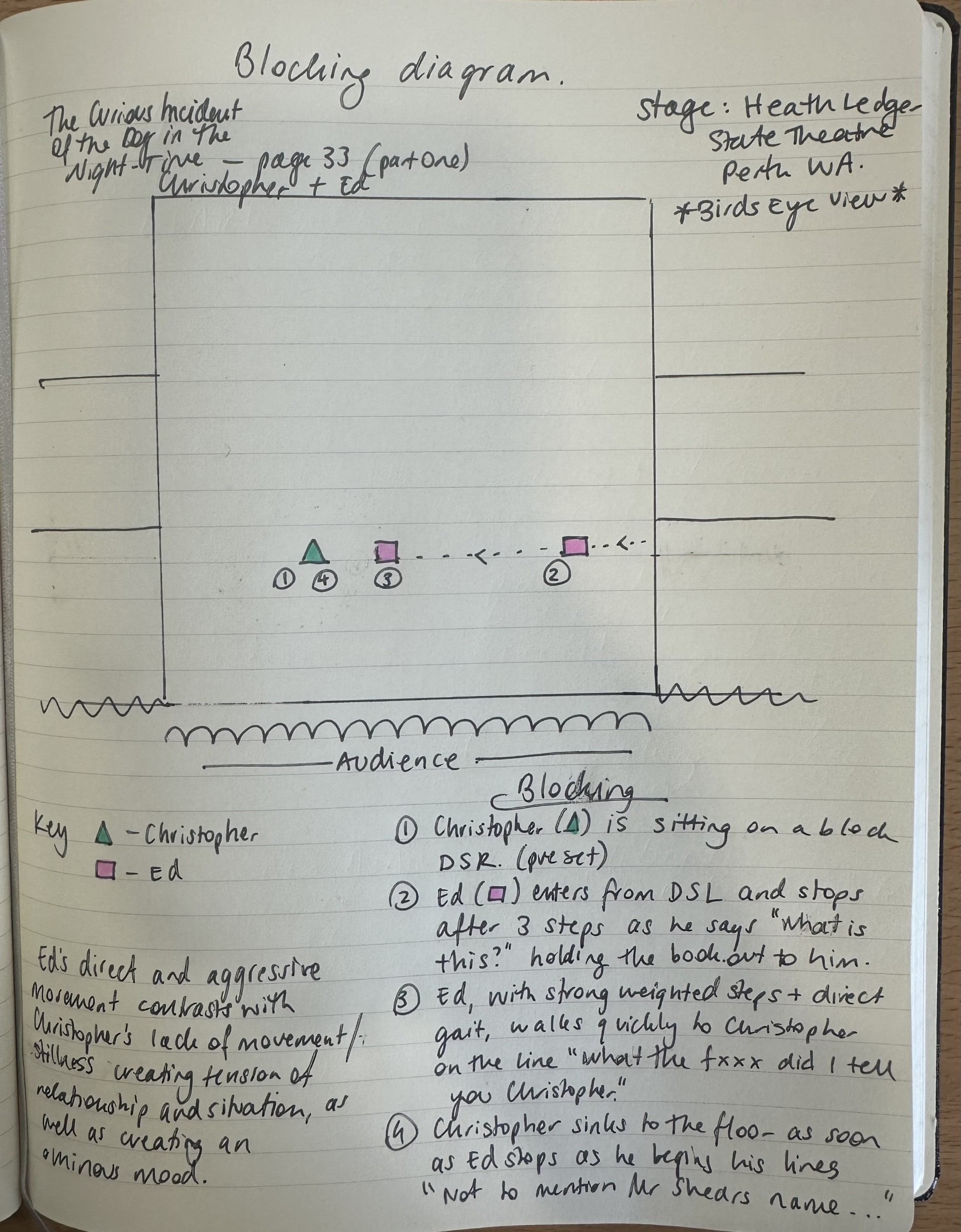
⬆ What to include
Correctly label the stage - title of play, stage and perspective
Draw it in the perspective of a bird’s eye view
Give the diagram a title (blocking diagram)
Have a key
Have a quick blurb describing what the labels mean and what is happening.
Step it out → be very specific, what are they doing, where are they on the stage?
^ Show this both in writing and also in words in the area provided.