Extinction
1. Extinction and Relapse Processes
Extinction involves the reduction of a learned behavior when the reinforcement that previously followed the behavior is no longer provided. However, relapse processes can occur, where the extinguished behavior reappears after some time. This can happen through mechanisms such as spontaneous recovery, renewal, reinstatement, and resurgence.
2. Cognitive Networks After Extinction
After extinction, cognitive networks that were formed during the learning phase are not entirely erased. Instead, new learning occurs that inhibits the original memory. This means that the original behavior can still be triggered under certain conditions, leading to relapse.
3. Extinction Without Omitting the Outcome
Extinction can also be achieved without completely omitting the outcome. This involves altering the contingency between the behavior and the outcome, such as by making the outcome less predictable or less desirable, which can reduce the behavior without entirely removing the reinforcement.
4. Clinical and Practical Implications of Extinction
In clinical settings, extinction is used to reduce maladaptive behaviors, such as in exposure therapy for anxiety disorders. Understanding the mechanisms of extinction and relapse can help in designing more effective interventions that minimize the chances of relapse. Practical applications include behavior modification programs in educational and organizational settings.
Definitions:
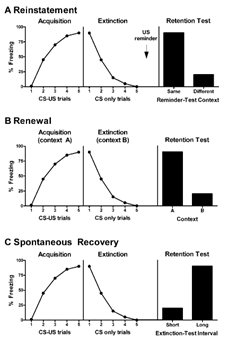
Spontaneous Recovery: This is the reappearance of the conditioned response (CR) after a period of time has passed since extinction. For example, after completing therapy, a person who had extinguished their fear of dogs might unexpectedly feel a surge of fear upon seeing a dog after several months
Renewal: This occurs when the extinguished behavior reappears due to a change in context. For instance, a behavior that was extinguished in one environment may reappear when the individual is placed in a different environment
Reinstatement: This is the return of the extinguished behavior following non-contingent exposure to the reinforcer. For example, if a person who has extinguished a fear of dogs is exposed to a dog bite, the fear response may return
Resurgence: This refers to the reappearance of a previously extinguished behavior when a more recently reinforced behavior is also extinguished. For example, if a person stops receiving reinforcement for a new behavior, they might revert to an older, previously extinguished behavior
Chaining Response:
Chaining involves linking together a sequence of behaviors into a complex activity. Each behavior in the chain serves as a cue for the next behavior and as a reinforcer for the previous behavior. For example, teaching a child to wash their hands might involve breaking down the task into smaller steps such as turning on the tap, applying soap, scrubbing hands, rinsing, and drying. Each step is taught and reinforced sequentially until the entire chain is learned.
Forward Chaining: the behaviour is taught in its natural occurring order.
Backward chaining: the behaviour learns from the final behaviour moving toward the front.
Difference Between Chaining and Shaping:
Chaining: This technique involves teaching a complex behavior by breaking it down into smaller, manageable steps and teaching each step in sequence. Each step is reinforced until the entire sequence is learned.
Shaping: This technique involves reinforcing successive approximations of the desired behavior. It starts by reinforcing a behavior that is close to the target behavior and gradually requires more accurate approximations of the target behavior before providing reinforcement.
Week 12: Extinction
Chaining
Q: Define chaining?
A: Teaching a sequence of behaviours to a learner
Q: How does chaining differ from shaping?
A: In shaping, only one behaviour is being taught, however, due to it being an unusual behaviour it requires successive approximation and refinement. In chaining, we are teaching several behaviours to be performed in a certain order
Extinction and Rescorla-Wagner Model
Q: How does the Rescorla-Wagner Model explain extinction?
A: Through negative prediction error (we expect a certain amount of a reinforcer/US, but if we get less than that inhibitory conditioning occurs.
Extinction Phenomena
Q: Define the following extinction phenomena
Phenomena | Definition |
Spontaneous Recovery | The sudden recovery of a response that has under gone extinction |
Rapid Reacquisition | The phenomena where learning a previously extinguished behaviour is faster than when it was first acquired |
Reinstatement | When an extinguished response reappears without the presentation of the CS |
Renewal | Reappearance of an extinguished CR when the context changes |
Resurgence | Reappearance of an extinguished response A, when another response B, which was reinforced during the extinction of response A is also extinguished |
Q: In what situations can reinstatement occurs?
A: Upon representation of the US (Drug/Primed Reinstatement), when a stimulus that is associated with the US (Cue-induced reinstatement), or under stress (Stress-induced reinstatement)
Q: What implications does renewal have about our understanding of the role of context in extinction?
A: Extinction is specific to a context (with extinction in operant conditioning being particularly bad)
Q: What do these extinction phenomena suggest about how extinction occurs?
A: That extinction is not the unlearning of a previous association, but the creation of a new inhibitory behaviour
Methods of Extinction
Q: What are the 4 methods you can use to extinguish an association?
A: Contingency degradation, reducing the magnitude of the reinforcer, punishing the response, or providing an alternative response (such as social interaction)
Q: How can consolidation/reconsolidation be used to increase the effectiveness of extinction?
A: Behaviours undergoing consolidation/reconsolidation are particularly susceptible to extinction. Thus, extinction is most effective before a behaviour has been consolidated or right after a behaviour has been reactivated/primed (e.g. by using a cue)
Individual Differences in Extinction
Q: What effects do the following factors have on extinction? If possible, explain how these effects occur.
Factor | Effect |
Age | Due to the neuroplasticity that occurs during adolescence, juvenile humans and animals are more susceptible to extinction |
Sex-related Hormones | Estradiol (the predominant sex hormone in females) has been shown to facilitate extinction |
Protein Synthesis Inhibitors | As extinction involves the formation of a new association, which neurologically requires protein synthesis to occur, substance that inhibit protein synthesis, such as propanalol, can also inhibit extinction |
W12: Extinction
|
Test Your Knowledge Quiz |
Q1: In a behaviour chain, what role does each intermediate stimulus typically serve?
(SR) conditioned reinforcer for the previous step: - Signals that the previous action was correct and effective - Provides a sense of progress towards the ultimate goal - Assoc. w/ final reward
(SD) discriminative stimulus for the next step: indicates whether or not responding will lead to reinforcement. Ex: The ladder serves as a discriminative stimulus indicating that if they climb up they will be rewarded (or will be closer to the reward
Explanation: reinforces the previous action of taking them out and signals that it's time to assemble the sandwich. ‘reward’ moving closer to actual reward **Moving closer to main reward reinforces the previous and motivates the next.
* Each stimulus (all stimuli between the initial cue and the final reward in a behaviour chain.) in the middle of a response chain is assumed to serve two functions: it is a conditioned reinforcer for the previous response and as a discriminative stimulus for the next response. | A1: a) only as a conditioned reinforcer for the previous action b) only as a discriminative stimulus for the next action c) as both a conditioned reinforcer for the previous action and a discriminative stimulus for the next action d) as neither a reinforcer nor a stimulus
|
Q2: After extinction, under which condition is the conditioned response most likely to occur? *After extinction, the conditioned response remains available but is inhibited by the extinction context. In a new context, this inhibition is absent, making the CR most likely to occur in unfamiliar contexts
| A2: a) when the CS is presented in the original learning context b) when the CS is presented in the extinction context c) when the CS is presented in a new, unfamiliar context d) when the US is presented without the CS |
Q3: Based on research examining age-related differences in extinction learning, which of the following statements is most accurate? E.g. Fear response returns more easily Role of hormones: (estradiol/estrogen) IN ADULTS: ● Proestrous (high estradiol) = FACILITATED extinction ● Metestrus (low estradiol) = IMPAIRED extinction IN ADOLESCENTS (OPPOSITE EFFECT): ● High estrogen = IMPAIRED extinction ● Low estrogen = BETTER extinction | A3: a) adolescents show better extinction retention compared to adults and children b) adolescents demonstrate poorer extinction retention compared to other age groups c) extinction learning improves linearly with age from childhood to adulthood d) age has no significant effect on extinction learning or retention |
Q4: In a behaviour chain, is the following statement true or false: Each reinforcer has equal value regardless of its position in the chain? * Does not have *Responses farthest from reinforcement are the weakest and easiest to extinguish | A4: a) true b) false
|
Q5: Which of the following is not true about the extinction paradigm? | A5: a) extinction is the reduction in a learned behaviour b) original learning cannot be retrieved c) extinction is not erasure of the original learning |
Q6: For the inhibition of a conditioned response after extinction to occur, which of the following must be true? * The context node connects to the inhibitory node only if both the CS and extinction context are present. If either is missing, inhibition doesn't occur, allowing the conditioned response to potentially happen. | A6: a) only the CS must be present b) only the extinction context must be present c) either the CS or the extinction context must be present d) both the CS and the extinction context must be present |
Q7: Which of the following best describes the core principle of Pavlovian conditioning? a,c = operant conditioning d = observational/social learning/modelling | A7: a) learning that a specific behaviour leads to a reward or punishment b) learning that one event/stimulus predicts another event/outcome c) learning through trial and error to maximize rewards d) learning by observing others' behaviours and outcomes |
Q8: Research shows hormonal effects on extinction shows that:
ADULTS: High estradiol facilitates extinction ADOLESCENTS: High estradiol impairs extinction *adolescence is opposite | A8: a) hormones affect extinction only in females b) hormones affect extinction only in males c) hormones affect extinction in both males and females d) hormones have no effect on extinction rates |
Q9: Which of the following is an example of reinstatement? a) spontaneous recovery b) renewal c) reinstatement - experiencing reinforcer alone | A9: a) A rat stops pressing a lever for food pellets. After a week without training, it suddenly starts pressing the lever again when returned to the chamber b) After extinction training in a white chamber, a rat that learned to press a lever for food is placed in a black chamber and starts pressing the lever again c) A rat stops pressing a lever for food pellets after extinction. Later, it receives some free food pellets in its chamber, and then starts pressing the lever again
|
Q10: Which of the following is an example of resurgence? a) stress-induced reinstatement - stress triggers return b) resurgence - return after extinction of alternative behaviour c) cue-induced reinstatement - drug cues trigger return d) rapid reacquisition - quick return when CS-US paired again | A10: a) after extinction of cocaine seeking, a rat is exposed to a stressful situation and begins drug-seeking behaviour again b) a rat learns to press a green button for food, then this is extinguished, and it learns to press a red button instead. When the red button stops working, the rat returns to pressing the green button c) after extinction of lever pressing for drug, the rat is exposed to drug-associated cues (light/tone) and begins pressing the lever again d) after extinction, the rat is given a single drug-lever pairing and quickly returns to its previous high rate of lever pressing |
Q11: When a rat learns that pressing a lever (R) in a specific chamber (context) leads to food (O), this primarily demonstrates: | A11: a) stimulus-response (S-R) association b) stimulus-outcome (S-O) association c) context-outcome-response association (occasion setting) d) response-outcome (R-O) association |
Q12: Which of the following is an example of using magnitude of reinforcer to change behaviour? a) magnitude b) alternative reinforcer c) punishment d) punishment | A12: a) a teacher reduces a student's gold stars from five to one for completing homework b) a parent gives their child screen time instead of candy for cleaning their room c) a trainer adds a time-out when a dog jumps on visitors while still rewarding sitting d) a coach makes athletes run extra laps when they arrive late to practice
|
Q13: After a behaviour has been extinguished, which phenomenon occurs when the behaviour spontaneously reappears following a period of time (e.g. one month), without any other changes or interventions? a) Spontaneous recovery (time passage causes return) b) Reinstatement (no US presentation) c) Renewal (no context change) d) Rapid reacquisition (no new CS-US pairing) **example tip: remember key terms/concepts eg time/context/pairing etc | A13: a) spontaneous recovery b) reinstatement c) renewal d) rapid reacquisition |
Q14: A person successfully completes drug rehabilitation in a treatment centre. Upon returning home, their drug-seeking behaviour returns. This is an example of: a) Reinstatement (no drug exposure/US presentation) b) Renewal (change in context from clinic to home triggers return) c) Resurgence (no alternative behaviour being extinguished) d) Spontaneous recovery (return not due to time passage) | A14: a) reinstatement b) renewal c) resurgence d) spontaneous recovery |
Q15: Which occurs without any external trigger? a) Reinstatement (needs US) b) Renewal (needs context change) c) Spontaneous recovery (just needs time) d) Resurgence (needs alternative behaviour extinction) | A15: a) reinstatement b) renewal c) spontaneous recovery d) resurgence |
Q16: Which requires both CS and US to be paired again? b) Reinstatement (US alone) c) Renewal (context only) d) Resurgence (about alternative behaviour) | A16: a) rapid reacquisition b) reinstatement c) renewal d) resurgence |
Q17: A person completes drug rehabilitation and remains drug-free for six months. After receiving a small amount of the drug from a friend, their drug-seeking behaviour returns. This demonstrates: a) Reinstatement (exposure to drug/US alone triggers return of drug-seeking) b) Renewal (no change in context) c) Resurgence (no alternative behaviour being extinguished) d) Spontaneous recovery (return triggered by drug exposure, not time) | A17: a) reinstatement b) renewal c) resurgence d) spontaneous recovery |
Q18: During an experiment, a participant's conditioned response was extinguished. When the CS-US pairings were reintroduced, the behaviour was relearned at the same rate as the original learning, showing no savings effect. This phenomenon is: a) Reacquisition - behaviour returns through new CS-US pairings at original learning rate b) Rapid reacquisition - behaviour returns faster than original learning due to savings effect c) Reinstatement - behaviour returns after US presentation alone d) Renewal - behaviour returns due to context change | A18: a) reinstatement b) rapid reacquisition c) reacquisition d) renewal |
STUDY TIP:
→ Study using multiple modalities including verbal (rehearse info to others), audible (listen to lectures), written (summary sheets), visual (draw diagrams, tables)
Next Session… |
SUMMARY:
- Reinstatement occurs when the conditioned response (CR) returns after the unconditioned stimulus (US) is presented again, even without the conditioned stimulus (CS).
Differentiating Factor requires presentation of US.
- Renewal occurs when the conditioned response (CR) returns after extinction when the context changes
Differentiating Factor: contextually contingent.
- Spontaneous recovery is the reappearance of the conditioned response (CR) after a period of time has passed since extinction. *time can be considered ‘context’
Differentiating Factor: passage of time.
- Rapid reacquisition is the faster relearning of the conditioned response after extinction when the conditioned stimulus and unconditioned stimulus are paired again *savings effect
Differentiating factor involves re-pairing of CS-US.
- Resurgence occurs when a previously extinguished behavior reappears after a different behavior that was reinforced during extinction is also extinguished. ** explains why old problem behaviours might suddenly reappear.
Differentiating Factor: extinction of alternative behaviour.