Unit 05 Notes: e- Theories, Bohr Models, Dot and Lewis Structures
Background Information
Negatively charged, least massive subatomic particle.
So small we ignore the mass when talking about the mass of an atom.
However, electrons determine the chemical properties of an element, so we cant completely ignore them.
Protons we said were the DNA of the element.
With that same thought process, the e- is the personality of the element.
It tells how, when, and what the element will associate with.
The key e- in an element are valence e-.
Valence electrons - e- located in the outermost energy level.
Ground state - the lowest allowable energy state of the atom.
Excited state - when an e- gains energy.
E- Theories
Where do we find e- in an atom?
Depends on who you ask!
There have been several different models of the atom.
Rutherford
Bohr
de Broglie
Heisenberg
Schrödinger
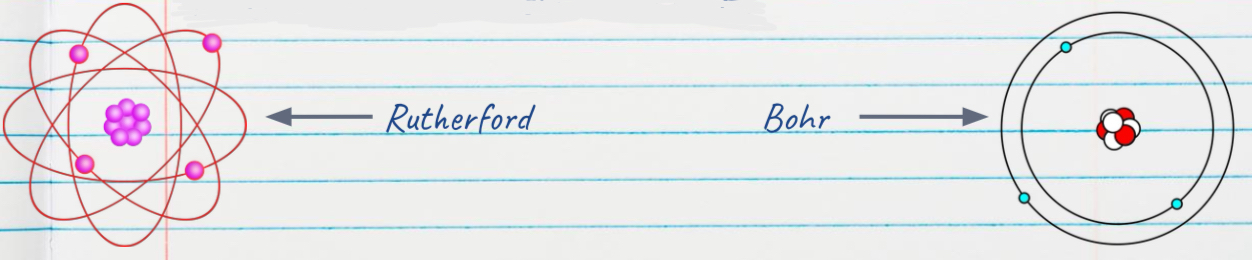
Rutherford and Bohr
E- were distributed around the nucleus in orbitals.
Planetary models
Rutherford’s were equidistant form the nucleus.
Bohr’s specific levels based on E.
de Broglie
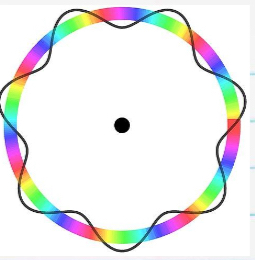
Particles of matter can act like waves
If e- have wavelike motion and are restricted to circular orbits of fixed radius, the e- is allowed only certain wavelength, frequency, and energy.
His mathematical equation predicts that all moving particles have wave characteristics.
Heisenberg
It is impossible to make any measurements on an object without disturbing the object (at least a tiny amount.)
For example, to find an e- by bumping it with a photon, it would lead to a change in both the velocity and position of the e- because the photon adds energy to the system.
Heisenberg Uncertainty Principle
It is fundamentally impossible to know precisely both the velocity and position of a particle at the same time.
QMM
Erwin Schrödinger used mathematical equations to describe the behavior of e-.
Modern description of the atom comes from the solutions to his equations - the quantum mechanical model.
Just like the Bohr model, the energy of e- are restricted to certain values.
E- are treated like waves
E- do not have a set path around the nucleus
The location of e- are described by probability.
The probability of finding an e- in a certain volume is represented by a cloud.
The more dense the area of the cloud, the higher the probability of finding an e-
The less dense area would represent those areas where the probability of finding an e- are low.
These clouds represent where the e- is about 90% of the time.
Checkpoint 01:
Which scientist(s) used mathematical equations to explain the behavior of e-?
Schrödinger and de Broglie.
How does the QMM overlap with the other e- models?
It overlaps with the other models like Bohr’s because it says that there e- energy is restricted to certain values, as well as saying it acts like waves, and by saying that electrons do not have an exact location and are in an area.
Bohr and the E-: Bohr Models
Said e- move in circular paths (orbits) at a fixed distance from the nucleus.
e- had defined energy levels - they were found only in specific orbits.
The fixed energies the e- could have were energy levels.
7 total energy levels
Energy levels are not evenly spaced - higher energy levels have less space between them.
Drawing Bohr Models
Things to remember: Deals with every subatomic particle
The number of protons is equal to the atomic number of the element.
The number of neutrons is determined by rounding the atomic mass To the nearest whole number and subtracting the number of protons.
Since atoms are neutral, the positive charge must be equal to the negative charge. This means the number of e- will be equal to the number of protons/atomic number of the atom.
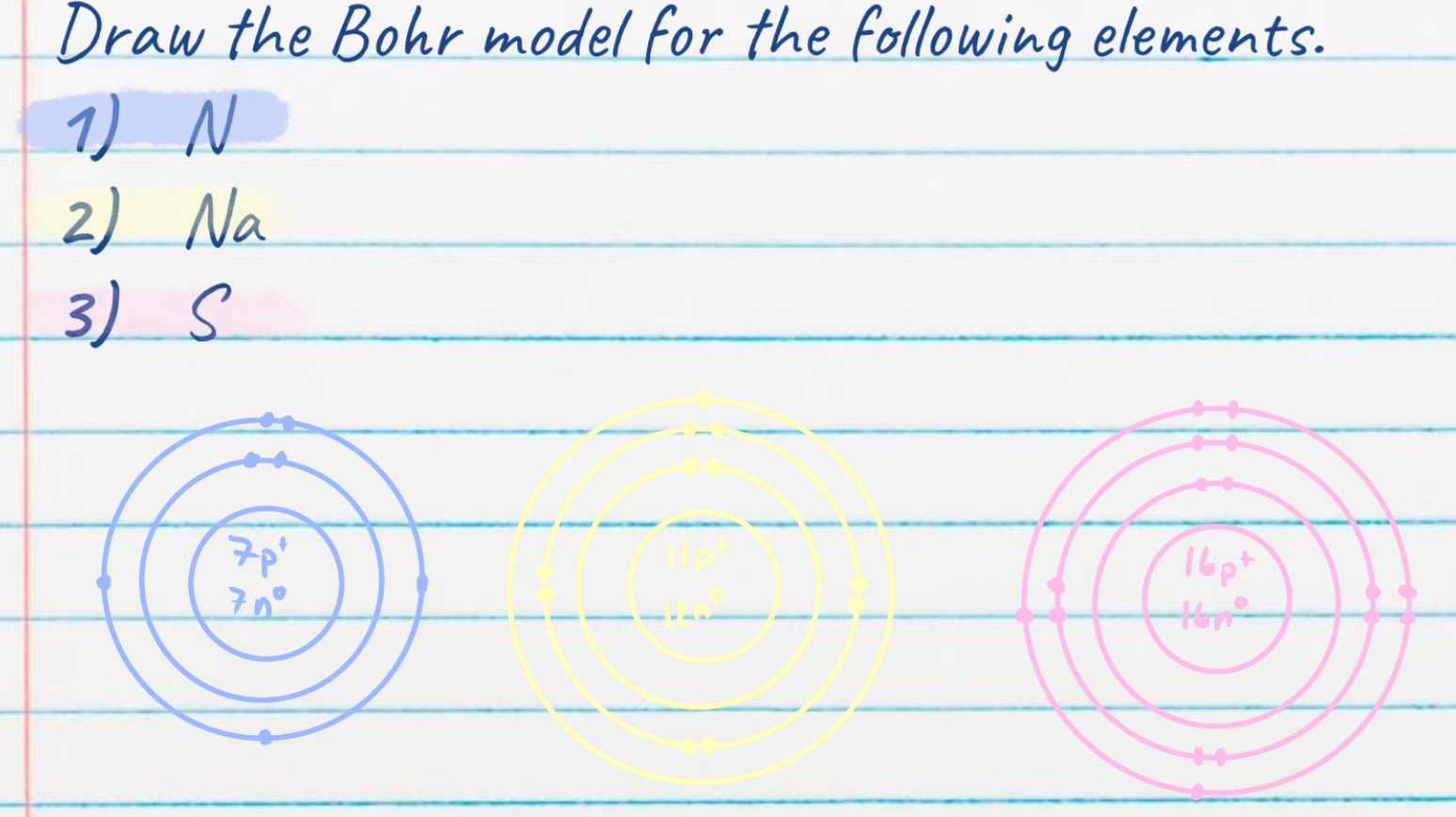
Determine the number of each subatomic particle.
Draw the nucleus of the atom with the protons and neutrons in the nucleus.
Draw the energy levels and place the e- in the energy levels based on this information:
Energy level one can hold 2 e-
Energy level two can hold 8 e-
Energy level three can hold 18 e-
Checkpoint 02:
Dot Structures
What are they?
How do you draw them?
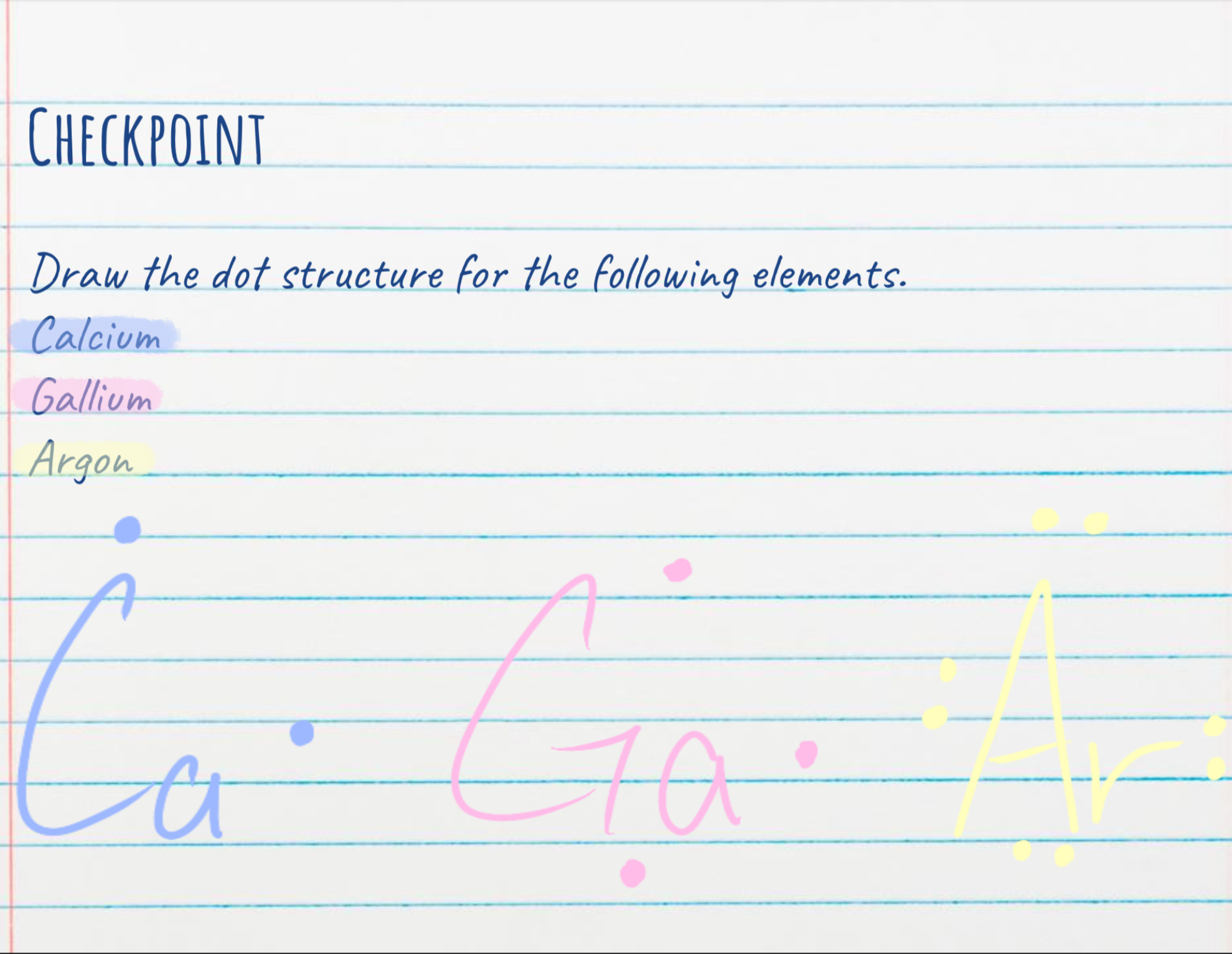
Dot structures are similar to Bohr models because they are a representation of electrons.
In the Bohr model, we were looking at all the electrons for the element. In a dot structure, you are only going to account for the valence electrons.
Electron dot structures are diagrams that show valence electrons as dots.
To determine the valence electrons, you have to look at the element’s location on the periodic table.
The element’s group number tells us the number of valence electrons, for elements in groups 1, 2, and 13-18.
We will not look at dot structures for elements in groups 3-12, the transition metals.
Elements in group 1 have 1 valence e-.
Groups 2 elements have 2 valence e-.
In groups 13-18, the group number minus ten tells you the number of valence e-.
Now that we know the valence electrons are determined by the group number on the periodic table, we have what we need in order to draw a dot structure.
Write the symbol for the element.
Determine the number of valence electrons.
Place dots around the symbol to represent the valence electrons. Keep in mind, the same rule applies here as before with Bohr models, you will not pair the electrons unless there are five or more valence electrons (exception - Helium).
Helium looks like this: H:
Checkpoint 03:
Lewis Structures
Dot structures for molecules basically.
Chemist Gilbert Lewis explained why elements tend to form ions.
His explanation is the octet rule.
In forming compounds, atoms tend to achieve the electron configuration of a Nobel gas
Octet = 8
To achieve the octet, electrons can be unshared or shared.
Unshared electrons are those belonging to only one atom.
They will be counted once when tallying your electrons.
Shared electrons are those electrons shared between two atoms.
These electrons get counted twice when tallying your electrons.
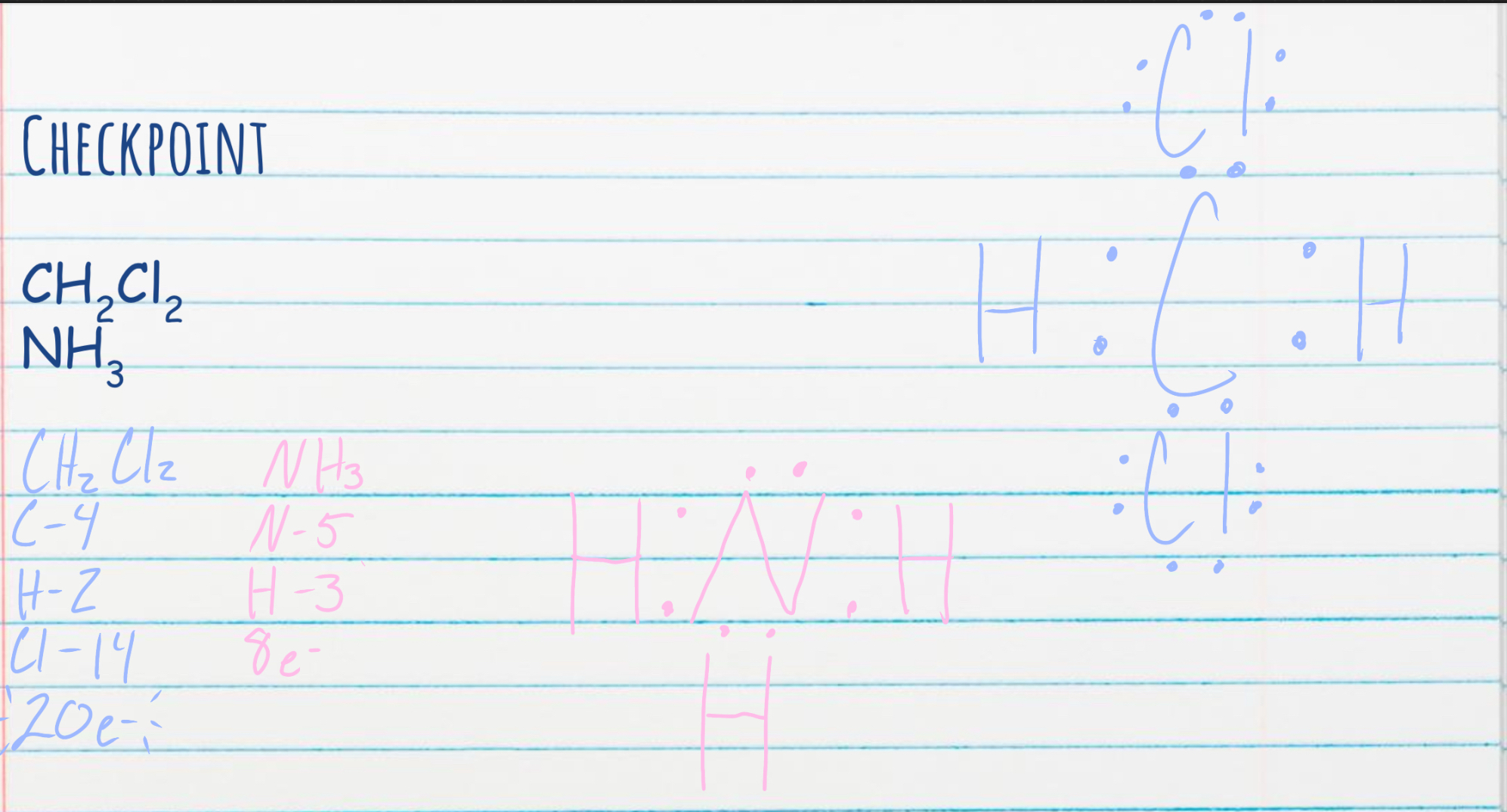
Determine the total number of valence electrons you have.
Look at the elements that make up the molecule and count how many each one is bringing to the electron party.
Determine the central atom if needed.
The element with the lowest electronegativity will be your central atom. (Further down a group and more to the left on the PT).
Hydrogen can never be your central atom because it can only form one bond.
If carbon is in the formula, it will usually be your central atom.
Put two electrons between atoms to show a bond.
A chemical bond is formed by sharing two or more electrons.
The paired e- can be represented by a - or by :.
Complete the octets for all of the atoms using the remainder of the electrons.
Remember octet means 8, so we want every element, except for hydrogen, to have 8 electrons (dots) around it.
Two VERY, CERY, IMPORTANT tings to use as a check for your Lewis structure.
Did you use only the number of e- that were brought to the party? If so, pat yourself on the back. If you used more or less, go back to the beginning and start over.
Is each element “happy”? Think about a baby. Babies are happy when they are full. Atoms in Lewis structures are the same way. In order to be full, the atom must have a total of 8 electrons around it. They can be shared or unshared, but there has to be 8.
If you have satisfied both of these requirements, you probably have a good Lewis structure.
Lewis Structures and Multiple Bonds
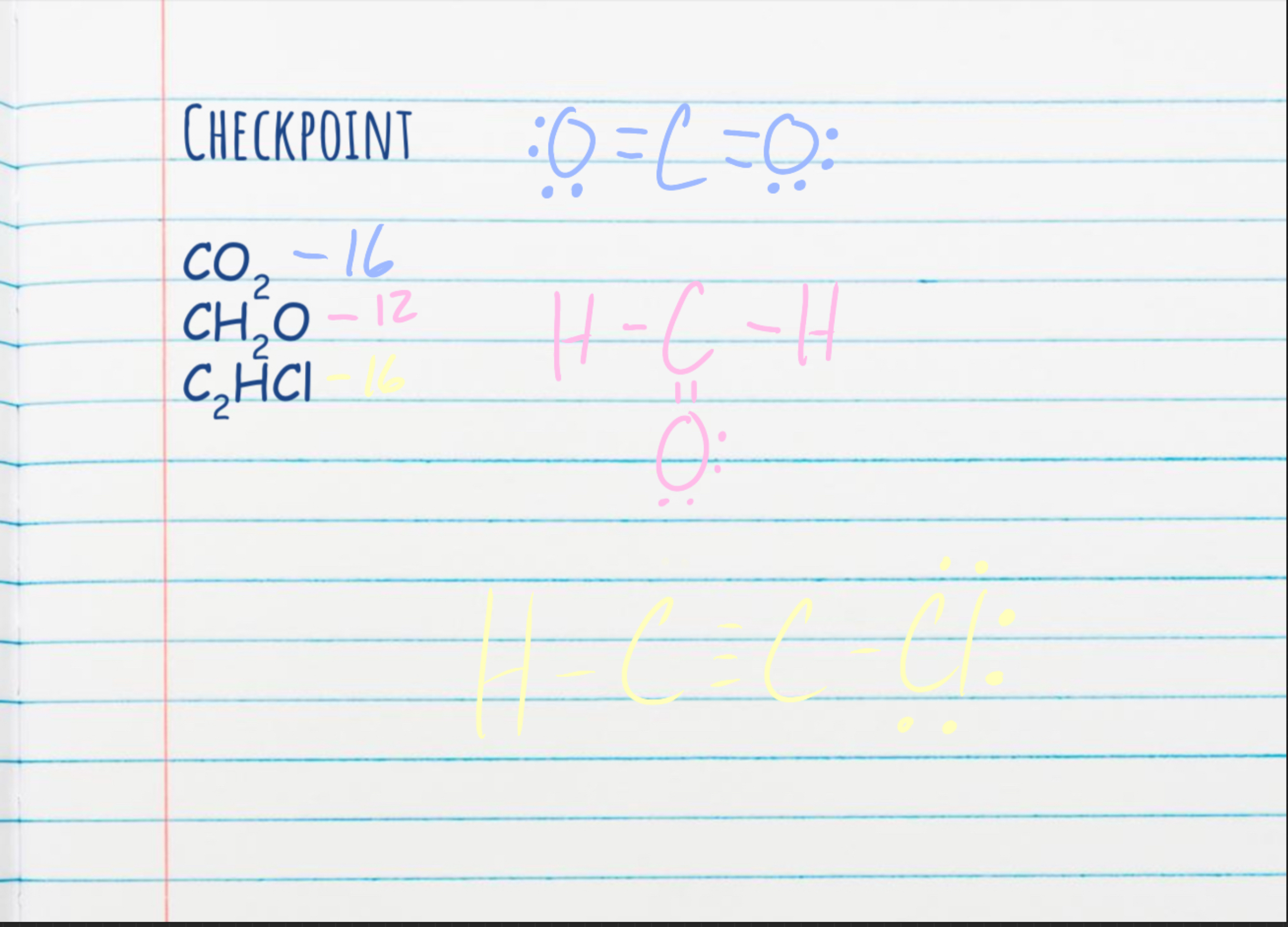
Some elements can form multiple bonds.
In other words, they can share more than two e- with another atom.
Single bond = 1 shared pair
Double bond = 2 shared pairs
Triple bond = 3 shared pairs
You will still follow the same steps as before for determining the number of valence electrons-.
When you have your total, divide that number by 2. This will tell you how many pairs you will have.
Each atom will still have an octet.
Ions
For an element, the only subatomic particle that cannot change is the proton.
When we change neutrons, we get isotopes.
When we change electrons, we get ions.
Ions are atoms that have lost or gained electrons.
The reason they gain or lose electrons goes back to the octet rule. They want to be full or “happy” in terms of valence electrons or the outer orbital.
Some atoms lose e- (metals), while others tend to gain e- (nonmetals).
Cations are formed when e- are lost and anions are formed when e- are gained.
The number of e- lost or gained depends on their location on the PT.
Group 1 elements lose 1 e- and form a +1 cation.
Group 2 elements lose 2 e- and form a +2 cation.
Group 13 elements form a +3 cation.
Group 14 elements form a +4 or -4 ion depending on the type of element.
Group 15 elements form a -3 anion.
Group 16 elements form a -2 anion.
Group 17 elements form a -1 anion.
Group 18 elements are full and therefore do not form an ion.
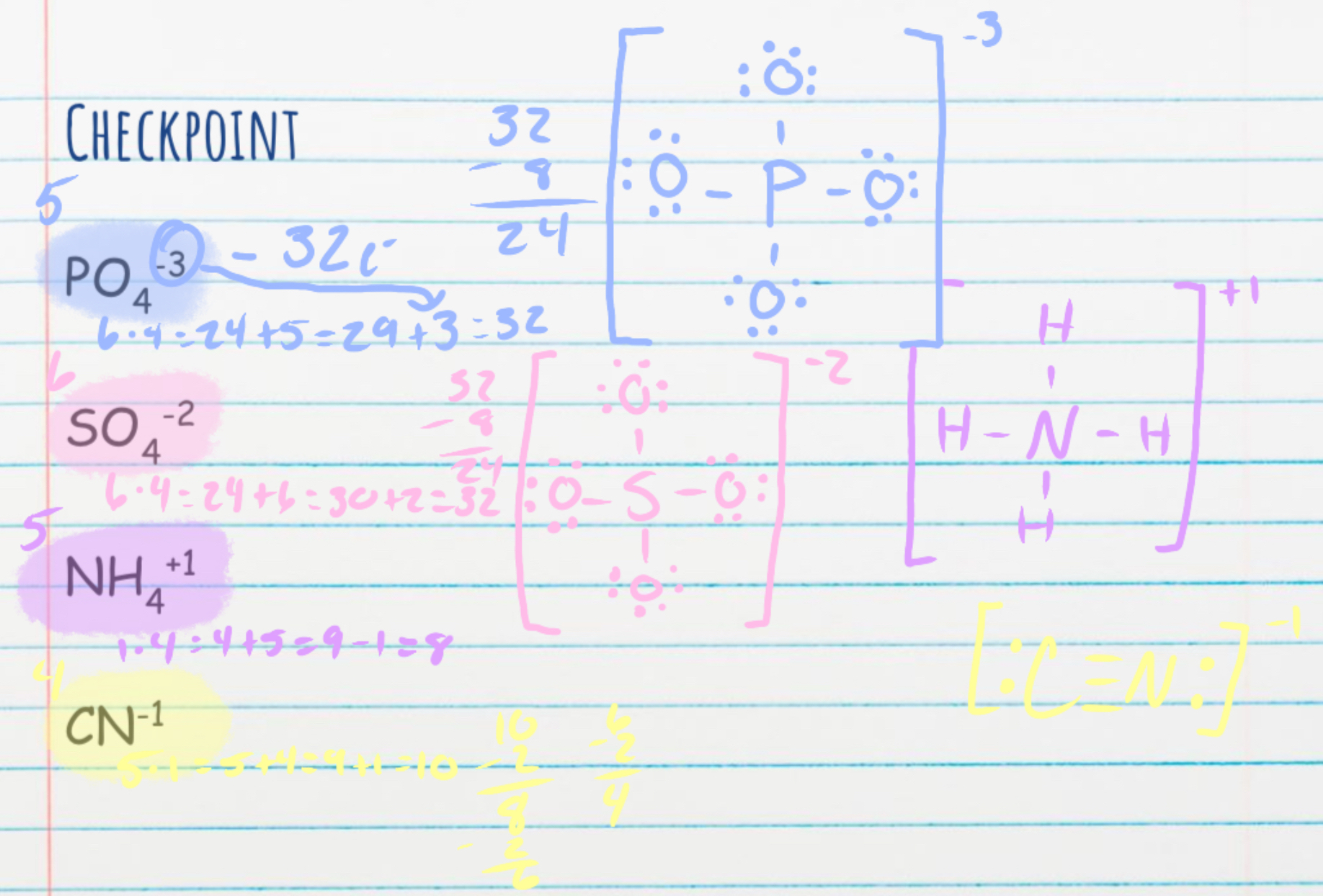
Dot Structures for Polyatomic Ions
A group of atoms covalently bonded that has an overall charge.
The charge determines whether you will add e- (negative charge) to subtract e- (positive charge).
The number on the charge tells you how many e- to add or subtract. Remember a 1 is sometimes understood and not written.
You determine the total number of valence e- just like you have in all the other examples and then account for the ion by adding or subtracting the required number of e-.
Complete the dot structure like before, but when done, place it in brackets with the ion charge outside the brackets.