(Module 40) The Global System of Agriculture
The Global Supply Chain:
Global Supply Chain: Agribusinesses, organized at the global scale; encompassing all elements of growing, harvesting, processing, transporting, marketing, consuming, and disposing of food for people.
Interdependence of Agricultural Production: The global supply chain of agriculture is dominated by a handful of multinational corporations, collectively engaged in agribusiness that control multiple stages of the process.
Agribusinesses that produce chicken own or control: Mill, Hatcheries, Slaughtering Plants, Secondary Processing Facilities, Product Brands.
Contract Farming: Arrangement between and independent farmer and an agribusiness company to produce a crop; the agribusiness provides the farmer with all the supplies needed to produce a crop in exchange for a guaranteed price and a buyer.
About 25,000 farmers in the US are under contract with 30 agribusinesses to raise chickens, and about 90 percent of all US chickens are now raised under contract.
Agribusinesses sell in both national and global markets.
Proprietary Seeds: Seeds that are developed and entirely owned by a company.
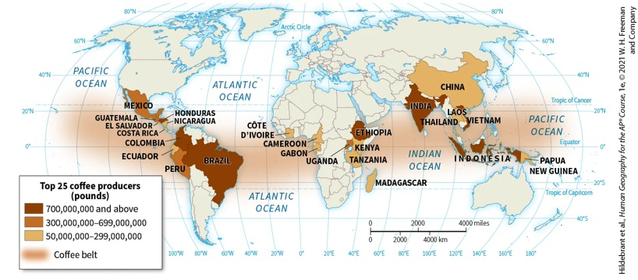
Export Commodity: A cash crop that is produced for export to wealthier countries at the expense of crop production for local consumption.
Dependency on one or two export commodities can leave a country vulnerable when crops fail or tastes change, or when competition from other areas decreases exports and income.
Ex: Coffee (Ethiopia, Guatemala, Nicaragua).
Political Relationships:
Subsidies: Guaranteed prices for staple food crops.
International trade favors the farmers in wealthier countries as government subsidies keep the prices of their agriciltural exports artificially low.
Farmers in developing countries find it difficult to compete with those low prices.
Famine: Extreme scarcity of food.
Many developing countries do not grow enough food to feed their populations and cannot purchase enough imported food to make up the difference.
Bangladesh, a very poor country, suffered a major famine in 1974.
Internal government policies can also lead to famine, as in China’s forced collectivization on state-run farms. During China’s Great Lead Forward (1958-1961), around 30 million rural peasants died of starvation; is one of the factors that led to the one-child policy today.
Infrastructure:
The first road built during Spanish colonization of Mexico was El Camino real, which linked the port of Veracruz with Mexico city.
This was not built to benefit to the local population but to exploit natural resources.
Infrastructure built by colonial powers left a lasting imprint.
The primary goal was to transport trade goods sout of their colonies, bypassing the local population’s need for food.
While there have been improvemenst in the last few decards, the primary systems still remain, carrying goods from plantations out of the countries and raising the level of food insecurity in the local region.
Patterns of Worldwide Trade:
Many developing countries have been quite successful in increasing export of tropical products, bit they risk over reliance on specific crops (e.g., coffee)
Global trade fluctuated as consume tastes change as competition increases.
regional trade agreements that reduce or eliminate taxes on imported goods are also a factor in worldwide trade.
Agribusinesses have a strong incentive to keep costs down and profits high, which has domino effects across the agricultural system and the economy (tariffs passed to the consumer).