Development of the Atoms
Atoms in the Eyes of the Philosophers and the Scientists
- The ancient greeks and the emergence of alchemy are the two historical periods that played an important role in the development of the atomic theory
The Ancient Greeks
- Leucippus and his student Democritus introduced the idea that a substance is made up of invisible fragments
- Leucippus is known as the first atomist
- Democritus believed that all matter has very small particles called atoms.
- Atoms are derived from the Greek word “atomos” meaning “indivisible” or “uncuttable”.
- Democritus is dubbed the “Father of Atomism”.
- Atomism is the philosophy for which all matter is produced from atoms.
The Emergence of Alchemy
- Alchemy is the act of changing one substance to another
- Aristotle suggested that everything was composed of 4 elements such as water. air, earth, fire
- A 5th element was sooner added by Aristotle known as the “aether”.
- aether is where stars are made from
- Aristotle did NOT believe in the existence of atoms and asserted that all matter was continuous and an idea that was accepted for almost 2000 years
- Empedocles of Agrigentum considered air, water, earth, and fire as the four essential elements that are sources of all kinds of matter
- Thales of Miletus is the first pre-Socratic philosopher (or in other words, a Classical Philosopher)
- Thales asked the question, “What is matter composed of?”
- Thales believed that water is the ultimate substance that constituted matter.
- The goals of alchemists consist of intertwined spiritual and mythical concepts to transmute base metal to gold, discover a universal cure for diseases, and discover means of prolonging life. NONE OF THESE AIMS SUCCEEDED
- The elixir of life was thought to bring wealth, health, and immortality
- The philosopher’s stone was thought to be the highest and purest form of matter
- Discovering the relationship of humans and the cosmos to understand and improve the human spirit
The End of the Alchem Era
- Robert Boyle wrote a book called “The Skeptical Chymist” in 1661 which resulted in scientists finding experimental results known as the atomic theory of matter.
- According to Boyle, the elements water, fire, earth, and air are not true for they can still be broken down into iron, oxygen, lead, hydrogen, and sulfur.
Atomic Mass
- An atomic mass is the total protons and neutrons present in a nucleus of an element
- An isotope is an atom of the same element but w/ different mass numbers.
Atomic Number
- An atomic number refers to the number of protons an element has in its atom
- An atomic number is also known as an element’s identity
- In a neutral atom, the no. of protons = no. of electrons
- Henry Gwyn Jeffreys MoselEy experimentally found that different metals bombarded with electrons produced varying frequencies of X-rays, which resulted to the differences in the positive charge in the nucleus of elements.
- Mosely correlated the frequencies to whole numbers, which he assigned to each element: the atomic number
Structures of Atoms and Modern Atomic Models
Structure
- An atom is defined as the tiniest particle of an element that retains the chemical properties of that element.
- The nucleus is the central part of an atom
- A nucleus is composed of protons and neutrons, which are both collectively called nucleons
- A nucleus contains most of an atom’s mass
- A proton is a positively charged particle in a nucleus
- A proton has a magnitude charge of 1.6022*10^-19 coloumbs
- Each proton weighs as much as 1.67262*10^-24 grams
- Ernest Rutherford discovered protons in 1919
- A neutron is an unchanged or neutral particle
- James Chadwick proved the presence of a neutron
- A neutron is slightly heavier than a proton
- An electron is a negatively charged particle.
- Robert Millikan found out that an electron has a charge of 1.6022*10^-19 coloumbs
- The mass of an electron is 9.10*10^-28 grams
- An electron is located in the shells that surround an atom’s nucleus
- The electrons are discovered by Joseph John Thompson
Modern Atomic Models
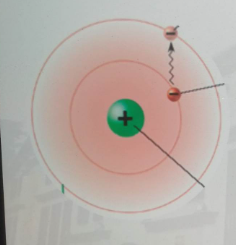
- In 1913, Niels Bohr proved the stability of particles, that the equal no. of protons and neutrons will make an atom electrically neutral and stable
- In Bohr’s model of an atom, the electron moves and stays in a particular, circular orbit at fixed distances from the nucleus where they do not lose or gain energy.
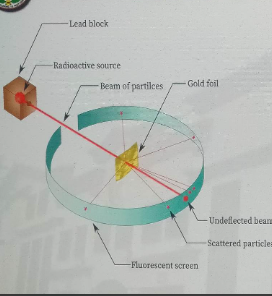
- Ernest Rutherford concluded that most of an atom is empty, which allowed most alpha particles to pass through a gold foil.
- The gold foil experiment established that the nucleus is very dense, very small, and positively charged which resulted in Ernest Rutherford discovering protons.
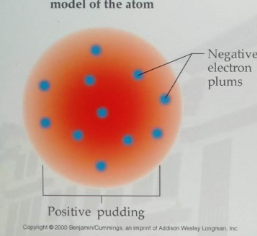
- Joseph John Thompson is a British Scientist who discovered electrons in 1897 which lead to his “plum pudding model”.
- The plum pudding model shows electrons being embedded in a sphere of positive electrical charge
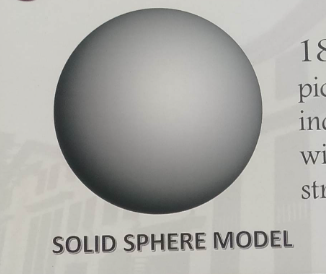
- John Dalton is known to be the pioneer in the development of modern atomic theory.
- In the year 1803, John Dalton pictures atoms as tiny, indestructible particles, with no internal structure.
- THE POSTULATES OF DALTON’S ATOMIC THEORY
1. Elements are made up of small indivisible particles called atoms and they can neither be created nor destroyed during a chemical change 2. In any given element, the mass and other properties of all the atoms are the same. Atoms of different elements differ in mass and other properties. 3. Compounds are composed of atoms of more than one element. 4. In a chemical reaction, atoms can neither be created nor destroyed. However, they can combine, separate, or rearrange.
- The Law of Definite Proportion states that “In each of their compounds, different elements combine in a simple numerical ratio”
- The Law of Conservation of Mass states that “mass is neither created nor destroyed during a chemical reaction”
- James Chadwick proved the presence of neutral subatomic particles in the year 1932 and they’re called neutrons.
- Chadwick concluded that the radiation consisted of neutral particles that are slightly heavier than the protons but are found with the protons inside the nucleus.
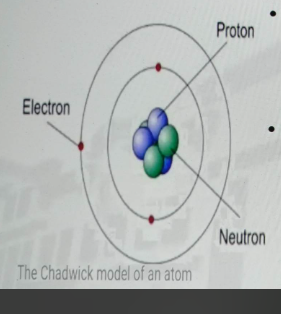
Edwin Schrodinger developed mathematical equations to describe the motion of electrons in atoms which resulted in the electron cloud model
- In the Edwin Schrodinger’s quantum mechanical model, instead of orbits, there were orbitals or regions of space with a high probability of finding electrons which are known as the electron clouds or electron subshells
Marie Curie proposed the term radioactivity.
- Radioactivity is the ability of a material to undergo spontaneous emission of particles or radiation.
- The three types of radioactive decay consist of alpha, beta, and gamma ray
- Alpha decay is deflected by a positively charged plate
- Beta decay is deflected by a negatively charged plate
- Gamma ray has high energy and has no charge nor is affected by a magnetic field
Antoine Becquerel started studying the fluorescent properties of substances after the discovery of X-rays in 1895 by Wilhelm Rontgen.
- Antoine Becquerel accidentally learned that the darkening of thickly-wrapped photographic plates occurs after exposing them to uranium compounds
Building of Periodic Table
- Dmitry Mendeleev arranged the elements according to atomic masses, he paved the way for the creation of the present periodic table
- Henry Gwyn Jeffreys Moseley argued and confirmed that the basis for the arrangement in the periodic table is the atomic no.
\n