Untitled Flashcards Set
Class Notes for Gluconeogenesis
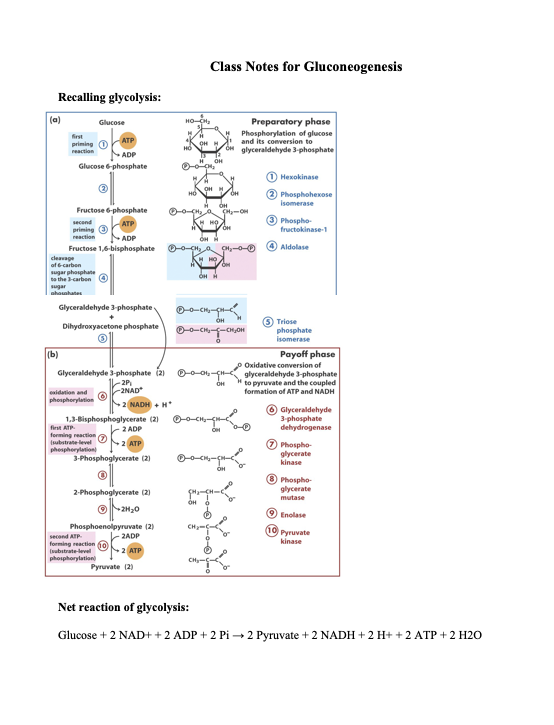
Recalling glycolysis:
Net reaction of glycolysis:
Glucose + 2 NAD+ + 2 ADP + 2 Pi → 2 Pyruvate + 2 NADH + 2 H+ + 2 ATP + 2 H2O
Gluconeogenesis is not the exact reverse of glycolysis:
Three bypass points:
glycolytic enzymes gluconeogenesis enzyme
Hexokinase Glucose-6-phosphatase
Phosphofructokinase-1 (PFK-1) Fructose-1,6-biphosphatase
pyruvate kinase a. Pyruvate carboxylase
b. Phosphoenolpyruvate carboxykinase (PEPCK)
Note: Biosynthesis is a reductive process, thus NADPH is also needed.
Synthesis of phosphoenoylpyruvate, via oxaloacetate, from pyruvate/lactate
 |
[compare with figure 16-20]
Action of pyruvate carboxylase (study page 547):
net reaction:
pyruvate + HCO3- + ATP {carboxyphosphate}/{carboxybiotin} oxaloacetate + ADP + Pi
requires coenzyme: biotin (biocytin or biotinyllysine on the enzyme)
think of oxaloacetate as an activated form of pyruvate
Action of PEPCK (phosphoenoylpyruvate carboxykinase)
net reaction:
oxaloacetate + GTP PEP + GDP + CO2
Mechanism:
[Thus, the overall bypass of pyruvate kinase requires ATP and GTP to drive the reaction; ∆G’o = 0.9 kJ/mol; ∆G = -25 kJ/mol)
Points of Regulation of Gluconeogenesis Enzyme Activity:
allosteric allosteric enzyme protein
Enzyme inhibitors activators phophorylation synthesis
PFK ATP, citrate AMP, F-2,6-BP
FBPase AMP, F-2,6-BP
PK alanine F-1,6-BP inactivates
Pyruvate acetyl CoA
Carboxylase
PEPCK stimulated
by glucagons
PFK-2 Citrate AMP, F6P, Pi inactivates
FBPase-2 F6P glycerol-3-P activates
What would happen to flux through the glycolysis or gluconeogenesis pathways?
Condition | Glycolysis | Gluconeogenesis | ||
Increase in Fructose-2,6-Bisphosphate | Increases (activates PFK-1) |
| ||
Increase in downstream metabolites (TCA intermediates) | Decreases (feedback inhibition) | Increases (signals need for glucose storage) | ||
Increase in glucagon |
| Increases (stimulates key gluconeogenic enzymes) | ||
Increase of insulin |
| Decreases (inhibits gluconeogenic enzymes) | ||
Increase in Epinephrine | Increases in muscles (prepares for energy demand) | Decreases in muscles; increases in liver (to provide glucose to blood) | ||
low cytosolic energy state (low ATP) | Increases (stimulates glycolysis to generate ATP) | Decreases (energetically expensive) |