ESS Standard Topic 3.2
Measuring biodiversity along a gradient
A transect is a systematic sampling method used to map change in biodiversity (DV) against a changing distance (IVIX)
Could be used for measuring zonation or human impact, eg:
As you move away from the path the effects of this human interference are reduced so we should see a direct correlation to the biodiversity.
Steps - (5 marks)
Place a transect starting at the site of human interference or zonation point, moving away perpendicular. Starting point should be random _along its
Place a quadrant at 10+ regular intervals along the transect to count/estimate the abundance of a/all species.
• Could use a species key
Repeat with 3 quadrants per distance to calculate an average abundance.
If measuring biodiversity (& not just one species abundance) then use Simpson's Diversity index
Check for a correlation over distance / use spearman's / plot a kite diagram
Estimating population size of plants in an area for comparison
A random sampling method is used to compare biodiversity
Could be used to measure the change since an event, eg:
What impact has a new motorway or a conservation initiative had on biodiversity?
Steps - (5 marks)
Sketch the area and add axis lines / lay 2 transects to create x & y axis.
Use a random sampling method to determine co-ordinates (e.g. random number generator)
Place 10+ quadrants at the random coordinates
Count / estimate species cover
° Could use a species key / could use ACFOR [Abundant, common, Frequent, Occasional, rare] scale for estimating
Calculate mean species abundance for species/each species
Multiply up for the total area to estimate total population size.
The use of quadrants should only be for Plants, not Animals
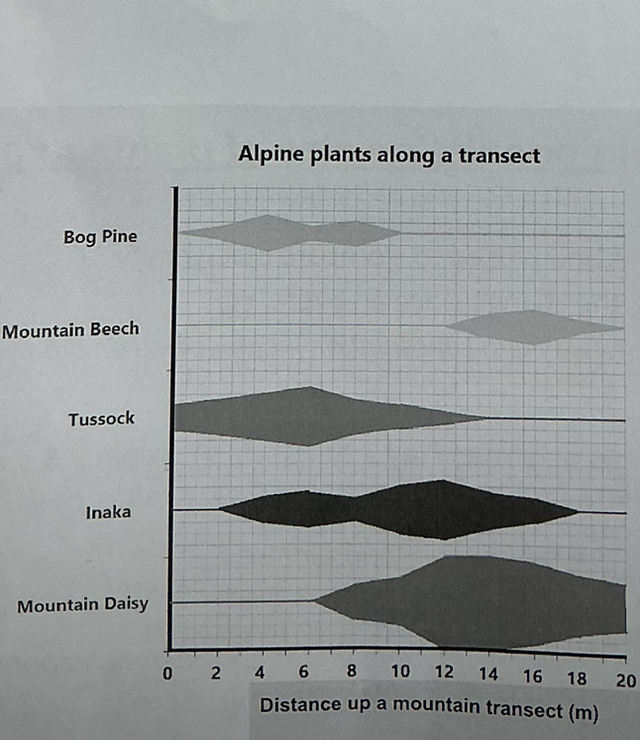
Kite Diagram - A Kite diagram can be used to display an organism distribution
What is the height tolerance for Mountain beech plant?
= 12 - 20m
Which mountain plant has the least tolerance for high altitudes?
= Bog Pine
At which height is Mountain daisy the most abundant?
= 12-13 m
What abiotic factors would be change at increasing heights up a mountain?
= Carbon Dioxide concentration, sunlight, water availability, soil variation, temperature
Suggest adaptations that plants at high altitudes may have?
= Resistance to harsh weather, wider roots