Wave Nature of Light
Spectrometer
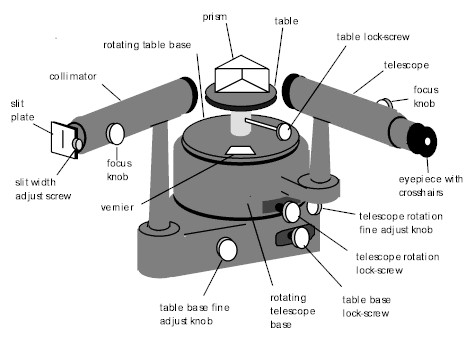
Used to demonstrate spectra.
Used to measure wavelength of light.
Light Source:
Provides the light to be analyzed. This can be a lamp or even the sun.
Heavy Base:
Where collimator is fixed.Slit:
A narrow opening that allows a limited, well-defined beam of light to enter the spectrometer.
Collimator:
A lens or mirror that takes the light from the slit and converts it into a parallel beam, so it travels in a straight, predictable way.
Prism or Diffraction Grating:
The core component for separating light.
Prism: Uses refraction to bend different wavelengths of light at different angles, separating them into a continuous spectrum.
Diffraction Grating: Has many fine lines that cause light to undergo diffraction and interference. This separates light into distinct spectral lines, or images, at specific angles.
Monochromatic Light
Light of only one wavelength
The colour of monochromatic light depends on its wavelength.
Light from a laser is monochomatic.
Young’s Slits

Monochromatic light from S shines onto first slit, undergoes diffraction and illuminates the slits and .
Diffraction occurs at and . Where the light overlaps, intereference occurs.
Interference pattern consists of intereference fringes (light and dark pattern).
Wavelength and Colour
If the wavelength of an electromagnetic wave is between 4×10⁻⁷m and 7×10⁻⁷m the wave effects the human eye and is called visible light.
A different colour is seen if a light of a different wavelength strikes the eye.
Diffraction Grating
Piece of transparent material on which a very large number of parallel lines are engraved. Light cannot pass through these lines. The spaces between these lines act like slits and allow the light to pass through.
Diffraction of light waves occurs when light passes through each slit.
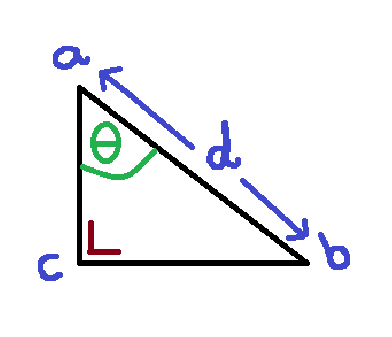
Grating Constant/Spacing (d)
Distance between 2 adjacent slits (one line + one slit).
is grating constant
is number of lines per metre.
Constructive interference occurs if the path difference between light from corresponding points on adjacent slits is a whole number of wavelengths.
At point a, the wave travels x distance to reach the point .
At point b, the wave travels a distance of , Therefore to reach As you move along each gap the further from ‘a’ you go, the greater the distance the wave travels. Each successive gap adds one wavelength to the distance compared to path ‘a’.
As the waves meet at , they will all meet at a crest in their cycle, so constructive interference occurs.
grating constant
th order
Light falls onto diffraction grating at right angles.
The fact that light can be polarised shows that light is a transverse wave.
Dispersion
Splitting up of white light into its constituent colours.
Spectrum
When light undergoes dispersion, the range of colours (or wavelengths) produced is called a spectrum.
Dispersion Through a Prism
Occurs because refractive index of the material in the prism is different for different wavelengths of light.
Thus different wavelengths are refracted through different angles and dispersion occurs.
When white light is dispersed by a prism, violet light is deviated the most and red the least. The opposite is the case with a diffraction grating.
A prism produces only one spectrum but a diffraction grating produces a number of spectra.
Recombination by a Prism
A second prism will recombine the dispersed constituents of white light to again form white light.
Dispersion is responsible for the colour of a rainbow. When white sunlight enters a raindrop, it is both refracted and internally reflected. The refraction causes the different wavelengths to be dispersed and the familiar colour is seen.
Primary Colours
White light can be produced by a combination of the coloured lights red, green, and blue of equal intensity.
Any other coloured light can be produced by mixing the same three colours in the right proportion.
Green, red, blue are primary colours.
Secondary Colours
When two primary colours are mixed in equal intensity the colour formed is a secondary colour.
Cyan, yellow, and magenta are secondary colours.
Complementary Colours
A primary colour and secondary colour that mix to give white are called complementary colours e.g. blue & yellow, green & magenta, red & cyan.
Ultraviolet Radiation
Electromagnetic radiation with wavelengths between 0.4nm and 1nm is called ultraviolet radiation or UV light.
UV light is just beyond the violet end of the visible spectrum and has shorter wavelengths than visible light.
UV light is emitted from the sun. An ordinary filament lamp emits a small amount of UV light. A UV lamp used in the laboratory is usually a mercury vapour lamp.
Properties of Ultraviolet Light
It causes certain substances to fluoresce, i.e the substance absorbs UV light and then re-emits this light as visible light.
It effects a photographic plate.
It causes sunburn and is harmful to the eyes.
Produces vitamin D in the skin.
Cannot pass through ordinary glass very well but can pass through quartz glass.
Can cause photoemission.
Fuorescence, the effect on a photographic plate or photoemission can be used to detect the presence of UV radiation.
Infrared Radiation
Properties of infrared light are:
It effects a photographic plate and can be used to take photographs in darkness.
It can pass through fog and mist and thus photographs can be taken in such conditions.
It causes substances on which it falls to heat up.
Infrared radiation can be detected by its heating effect using a blackened thermometer bulb or by the effect it has on a photographic plate.
Electromagnetic Waves
All electromagnetic waves travel with a speed of 3×10⁸ in a vacuum. In other media their speed is less.
Electromagnetic waves show all typical wave properties, in particular they will undergo interference and diffraction.
Their frequencies and wavelength are related by the equation , where ms-1.
Also known as electromagnetic radiation.