Resistance Training Study Notes
Importance of Creating a Safe Training Environment
Supervise- Monitoring exercise technique and form is critical for safety.
Teach- Provide clients with tools to continue exercising independently.
Demonstrate proper technique and form.
Do not assume that clients know how to perform exercises correctly.
Training Equipment
Three Main Categories
Constant Resistance- External resistive force does not change throughout the range of motion.
Variable Resistance- External resistive force changes throughout the range of motion. (elastic bands)
Constant Speed of Contraction- Involves special machines designed for this purpose.
Machine Types
Characteristics of Machines
Single or Multi-joint Movements: Can be designed for either.
No Need for a Spotter: They can be operated safely without assistance.
User Friendliness: Generally easy to use, especially for older or inexperienced clients, or those recovering from injuries.
Limitations: Might not be ideal for individuals who are significantly smaller or larger than average.
Types of Machines
Selectorized: Built-in vertical weight stack (e.g., lat pulldown, pulleys).
Plate Load: Utilizes free-weight plates.
Cam-Based: Greater resistance at the sticking point, aiding in strength gains.
Rod or Linear Guided: Ensures constant resistance along a linear path (e.g., Smith machine, leg press).
Hydraulic: Utilizes fluid-filled pistons and cylinders for concentric-only movements.
Air or Pneumatic: Uses compressed air for resistance, allowing high-velocity movements with lower injury risk.
Isokinetic: Computer-controlled machines that maintain constant speed of contraction.
Free Weights
Definition: Barbells, dumbbells, and kettlebells allowing unrestricted movement in all planes of motion.
Types
Barbells- Varied shapes, weights, lengths; requires proper fitting for safety and efficacy.
Dumbbells- Minimal space required, portable; suitable for unilateral exercises that address imbalances.
Kettlebells- Similar to dumbbells but designed with an offset center of mass; useful for momentum-based movements.
Alternative Equipment
Types and Functions
Tires: Introduce instability; used for building strength and power; requires proper deadlift technique due to size.
Weighted Bags: Commonly filled with sand; provides unequal weight distribution.
Ropes: Facilitate upper-body pulling movements; allow diverse ranges of motion in shoulder training.
Instability Devices: Includes BOSU balls, suspension trainers, and wobble boards.
Chains: Increase load as the bar passes the sticking point and reduces during the eccentric phase.
Medicine Balls and Slam Balls: Enable traditional and explosive power movements.
Resistance Bands: Resistance varies with stretch length, material, and thickness.
Wooden Clubs: Similar to baseball bats, with an offset center of mass.
Sleds: Used for pushing, pulling, or dragging weights across a surface.
Fundamentals of Exercise Technique
Handgrip Variations
Pronated Grip: Palm down, knuckles up.
Supinated Grip: Palm up, knuckles down.
Alternated Grip: One palm up and one palm down.
False Grip: Thumb does not wrap around the barbell.
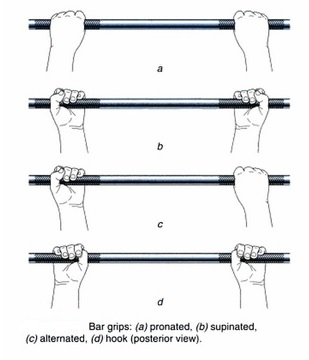
Grip Widths
General position is shoulder-width apart for most exercises; individual anatomical dimensions may necessitate adjustments for balance.
Five-Point Body Contact for Lifts
For Supine (lying face up) lifts:1. Back of head
Upper back and shoulders
Lower back and buttocks
Right foot
Left foot
For Prone (lying face down) lifts:1. Chin or side of cheek
Chest and stomach
Hip and front of thighs
Right hand
Left hand
Breathing Considerations
Recommendation: Exhale during the sticking point (most difficult) of the exercise and inhale during the easier part.- Eccentric Phase: Inhale
Concentric Phase: Exhale
Valsalva Maneuver
Definition: Breathing technique where the glottis is closed while abdominal and rib cage muscles contract, creating a "fluid ball" through increased intra-abdominal pressure, akin to a natural weightlifting belt.
Technique Options:1. Inhale during the eccentric phase, hold breath through the sticking point (1-2 seconds), then exhale.
Inhale before repetition, hold breath through the concentric sticking point (1-2 seconds), then exhale.
Advantages and Disadvantages of Valsalva Maneuver
Advantages:- Supports the vertebral column during structurally loaded heavy lifts (e.g., squats).
Disadvantages:- Decreased venous return.
Compressive forces on the heart can elevate blood pressure.
Risk of fainting or blacking out.
Not recommended for clients with known or suspected cardiovascular, metabolic, or respiratory issues.
Weightlifting Belt
Function: Increases intra-abdominal pressure, contributing to the "fluid ball" effect.
Appropriate Use: Specifically beneficial during ground-based structural lifts (e.g., squats, deadlifts) with maximal or near-maximal loads.
Caution: Wearing during submaximal lifts can impede deep abdominal muscle development.
SHOULD NOT BE USED FOR LIGHT EXERCISES
Spotting Techniques
Barbell Exercises
Procedure: Grasp the barbell using an alternated grip.- Maintain a neutral back, staggered stance, closely positioned to the client.
Dumbbell Exercises (at the wrist)
Procedure: Spot near the wrists to prevent weights from falling on or near the face.
Spotting Specific Positions
Bar on Back or Front Shoulder: Stand closely behind the client; ready to "hug and lift".
Spotting Olympic Weightlifting: Not spotted; should be taught how to drop the bar safely if needed.
Communication with the Client
Instruct the cliegnt to communicate readiness for lift-off and racking the bar to ensure safety.
Major Lifts
Back Squat
Deadlift
Bench Press
Lat Pulldown/Pull-Up
Shoulder Press
Descriptions of Major Lifts
Back Squat
Starting Position
Step under the bar; position it above the posterior deltoids at the base of the neck.
Grasp the bar with a grip slightly wider than shoulder-width.
Lift elbows, hold the chest up, and pull scapulae toward each other.
Extend hips and knees to lift the bar off the rack; step back 1-2 steps.
Feet shoulder-width apart, toes slightly out; maintain elbow lift.
The Movement
Hips and knees flex slowly while keeping torso stable and spine neutral.
Heels should remain on the floor; knees aligned over feet.
Continue Squating to:- Thighs parallel to the floor,
Trunk beginning to round,
Heels rising from the floor.
Extend hips and knees at the same rate to keep torso angle consistent.
Common Errors
Heels lifting off the floor.
Excessive forward flexion of the torso.
Knees moving inward/outward.
Arms relaxing, elbows dropping.
Knee Movement Study Documented
Study by Fry et al. (2003): Reviewed differences in knee flexion.- Conclusion: Allowing respect for knee movement (bringing them slightly past toes) might impose less overall back stress compared to strict restrictions.
Romanian Deadlift (RDL)
Starting Position
Grasp barbell with a closed, pronated grip.
Position feet shoulder-width apart, slightly bend knees, barbell resting at mid thigh height.
The Movement
Flex hips back to perform a hip hinge; torso moves forward.
Maintain knees slightly bent throughout; aim for a neutral spine.
Extend hips to return to standing position.
Common Errors
Hyperextending the lower back at the start.
Not keeping the bar in contact with thighs.
Incorrect torso movement (flexing forward instead of hip hinging).
Barbell Bench Press
Starting Position
Assume a supine position in five-point contact; eyes below the bar.
Grasp bar with a grip slightly wider than shoulder-width.
Lift bar to over the chest position.
The Movement
Lower bar to chest at nipple level; maintain rigid wrists directly above elbows.
Push the bar back to full extension; stabilize until re-racked.
Common Errors
Bouncing the bar on the chest.
Lifting buttocks or head off the bench.
Lat Pulldown
Starting Position
Grasp the bar with a closed, pronated grip wider than shoulder-width.
Sit facing machine stack; adjust legs under pads.
Lean torso back slightly for bar path clearance.
The Movement
Pull down to upper chest; keep feet, legs, and torso fixed.
Allow elbows to extend back to starting position gradually.
Common Errors
Using torso flexion to pull down.
Not fully extending elbows.
Pulling bar behind head.
Shoulder Press
Starting Position
Sit on shoulder press bench, maintain five-point contact.
Grasp bar, positioned slightly wider than shoulder-width above head.
The Movement
Lower elbows slowly; ensure rigidity throughout wrists and push up until fully extended.
Maintain grip until re-racking.
Common Errors
Pushing legs off the seat while lifting.
Excessive lower back arching.
Other Useful Exercises
Curl-Up
Starting Position
Supine on a mat, knees flexed to bring heels near the buttocks; arms crossed over chest.
Upward Movement Phase
Flex neck, curl torso to thighs with stationary feet and back.
Downward Movement Phase
Extend back to start while keeping stationary.
Common Errors
Raising feet or hips off the mat.
Primary Muscle Trained
Rectus abdominis.
Bent-Over Row
Starting Position
Grasp bar with closed grip wider than shoulder width; neutral spine, knees slightly flexed.
Upward Movement Phase
Pull bar to upper abdomen, elbows away from body, while keeping the torso parallel.
Downward Movement Phase
Return bar close to the body while maintaining the position.
Common Errors
Jerking body, shrugging shoulders, arching back.
Primary Muscles Trained
Latissimus dorsi, teres major, trapezius, rhomboids, posterior deltoid.
One-Arm Dumbbell Row
Starting Position
Stand beside a bench, flex hips forward, maintain neutral back; grip dumbbell.
Upward Movement Phase
Lift dumbbell towards body, keep the upper arm tight.
Downward Movement Phase
Extend elbow back to start while keeping back neutral.
Common Errors
Jerking upper body or rounding upper back.
Primary Muscles Trained
Latissimus dorsi, teres major, trapezius.
Dumbbell Lateral Raise
Starting Position
Grasp dumbbells at thighs with neutral grip; feet hip-width, knees flexed, torso upright.
Upward Movement Phase
Raise dumbbells laterally until parallel to floor.
Downward Movement Phase
Lower dumbbells slowly to start.
Common Errors
Using elbows or torso helping to lift.
Primary Muscles Trained
Deltoids, primarily lateral deltoid muscle.