GEOL202 - Fossil Record
What is a fossil?
Structures preserved in the geological record that provide evidence of ancient life.

(Archean)
Life began early in Earth’s history, simple organisms found in rocks 3.4 Ga old.
These organisms modified the atmosphere by producing oxygen.
(Proterozoic)
The great oxidation event (GOE) 2.5Ga, marking the beginning of the Proterozoic Eon.
Slow rates of evolution until the onset of more complex physiologies, notably sexual reproduction (~700 Ma) increased the rate of evolution.
(Phanerozoic (means visible life, no longer only microscopic organisms))
Cambrian explosion (cambrian)
Fossilization
Requires burial (faster the better)
Quality of preservation:
structure and composition original body
Nature and grain size of sediment
Chemical composition at time of burial
Taphonomy - The study of the processes (biological and geological) leading from death, through fossilization, and to discovery as part of the fossil record.

Cambrian explosion
Biological hypothesis - The evolution of hard parts allowed opened up new ecological opportunities
Taphonomic hypothesis - The evolution of hard parts increased preservation potential allowing more forms to enter the record.
Biological vs Taphonomic hypothesis argue whether the Cambrian explosion was due to the evolution of hard parts like exoskeletons which allowed more species to arise, evolve and live (biological hypothesis). Or whether those species already pre-existed but we can only trace them from the start of the Cambrian explosion as a result of the hard parts as it is much easier for fossils to form from hard parts like bones rather than the soft organisms prior.
(In)completeness of the fossil record -
Anatomic filters (body parts): Preferential preservation of certain body parts, namely the hard parts (bones, shells, etc. are much easier to fossilize than soft tissue)
Biological filters (behavioral): common organisms, with shorter lifespans and high reproductive outputs have a high preservation potential.
Ecological filters (habitat): animals living in or around shallow water have a great chance to be buried by sediment following their death.
Sedimentary filters (environment): Sites of erosion wont produce fossils, whereas sites of deposition will. Sedimentation is not continuous.
Preservation filters (biostratinomy): Acidic and highly dynamic conditions will disturb and damage body remains.
Diagenetic filters (time): Newer fossils are more likely to be found. Older fossils are more likely to be affected by changes to the rock.
Metamorphic filters (earth dynamics): Fossils in metamorphic environments will be destroyed.
Vertica movement filters (accessibility): In order to be discovered fossiliferous rocks need to be exposed near the surface.
Human filters (collection biass): Someone has to see and recognise a fossil’s significance. Ideally it ends up in a public repository rather than someone’s bedroom.
Types of preservation - Body fossils
Whole or part of their bodies (body fossils)
Altered remains: carbonization, permineralization, replacement, moulds and casts
Unaltered remains: called preservation in toto, preservation of soft tissues.
Preservation in toto:
In toto - part of entire organism fully preserved (including soft tissues)
Frozen mummified - only recent organisms (few 10,000s of years). Decay rapidly starts again if warmer/more humid conditions.
Amber - usually external envelope only, organic matter altered.
Types of preservation - Altered fossils
Carbonisation -
After burial, volatile organic components disperse, leaving a thin carbon-rich film
Reducing, low O2 environment
Typical for plants (coal), graptolites, soft bodied arthropods

Permineralisation -
Saturated solution fills cavities of an organism.
Mineral precipitation within these cavities
Original material composing hard parts may remain.
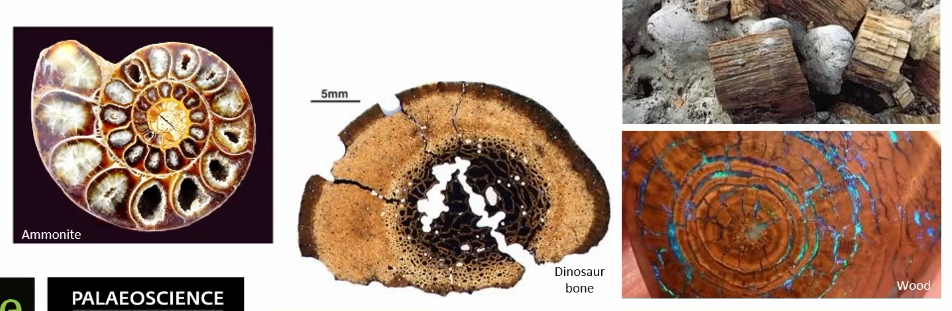
Replacement -
Biomineralizad tissue dissolves, leaving a void later filled with another mineral.
Or replacement can occur molecule-by-molecule

Pyritisation -
Permineralisation or coating or replacement by pyrite.
Usually induced by bacterial activity in Iron-rich, O2-poor and organic matter-poor sediment

Moulds and Casts

Trace fossils -
Formed as a result of physical interaction between an organism and a substrate (typically sediment).
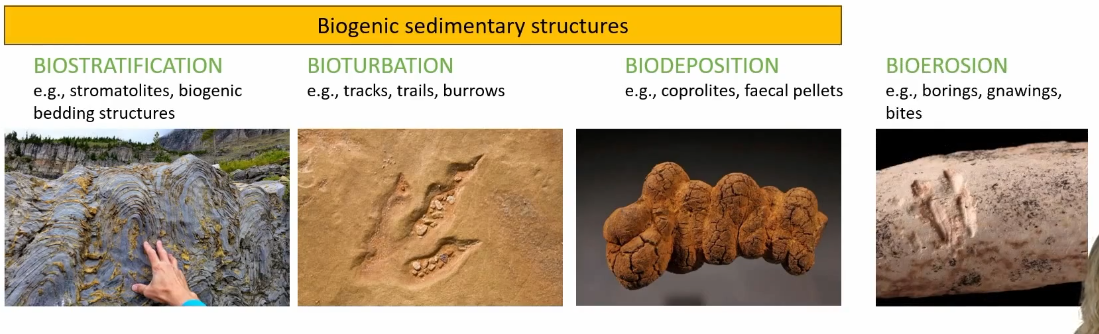
Records behaviour of the fauna/fauna like: feeding (coprolite), movement, speed, herding and hunting.
Trace fossils are much more common than body fossils
The fossils record provides evidence of changes and development of life over time…