Previous Exam Repeat Questions
Exam 1
The questions posted here soon will be asked again on the final exam. Please review them for the final exam. There will be no other questions from your midterm Exam 1 on future exams (final exam) besides the ones listed below
Exam 1 Questions that will be on the final exam. These questions were asked in Exam 1 but everyone received full credit (even if you chose the incorrect answer or there was no correct answer). Please review the questions below since they will be on the final exam (*NOT all questions posted yet!
1) I gave the incorrect directions of where the breaks were during the exam based on your MMB homework question. The picture above or a similar picture will be included in the final exam.

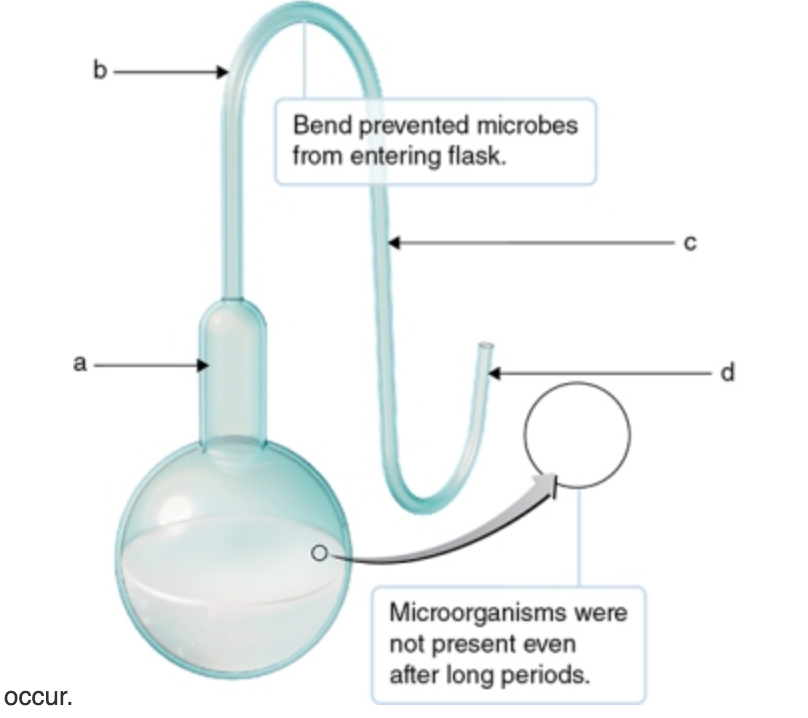
Predict which scenarios would most likely produce growth/airborne microbial contamination of sterile beef broth if Pasteur's S-shaped neck flask were cut. Scenario a: break near flask, Scenario b: break before the first curve, Scenario c: beak between the first and second curve in the S-shaped neck, Scenario d: break after the second curve in the S-shaped flask.
Answer: A, B
2) Which of the following statements are TRUE? 1. Electron carriers are located at ribosomes. 2. ATP is a common intermediate between catabolic and anabolic pathways. 3. ATP is used for long-term storage of energy and so is often found in storage granules. 4. Anaerobic organism can generate ATP via respiration. 5. ATP can be generated by the flow of protons across protein channels.
Answer: 2,4,5
3) What is defining about fermentation?
Answer: Anaerobic, regenerates NAD+ from NADH to allow continued glycolysis which produces ATP w/o O2 or electron transport chain (ETC).
4) What organism type has a carbon source of CO2 with inorganic molecules as energy source?
Answer: Chemoautotroph
5) Which of the structures is NOT a functionally analogous pair? (hint: compare structures outside of the cell wall)
Answer: Fimbriae vs flagella (fimbriae aren’t for motility while flagella are), Ribosomes vs pili (protein synthesis vs adhesion), cell wall vs flagella (support vs motility)
Exam 2
The four questions below were on Exam 2 but all were given credit for them. These will also be on the final exam.
1) (picture originally provided may have been misleading) The enzyme used to create cDNA without introns AFTER an initial cDNA strand is transcribed from mRNA is called:
Answer: DNA polymerase?
2) One advantage of a viral vector over a plasmid vector is that: (review pg 248)
Answer: more efficient at delivering DNA to host cells?, i think it was holds more dna
3) If an F+, Cys+ cell recombines with an F-, Cys- cell, what might happen to the F-,Cys- cell?
Answer: becomes F+, Cys+ (might be just F+. Cys- since there wasn’t hfr mentioned)
4) During PCR, instead of using DNA polymerase from Thermus aquaticus, human DNA polymerase is used. Starting with 1 molecule of DNA, after 3 full cycles are completed (assume all other conditions remain the same), how many DNA molecules do you expect to see? *slightly reworded from exam 2 question
Answer: 8 DNA molecules
Exam 3
1) There have been several changes in taxonomy over the years. Who proposed the current taxonomy described in your text with three Domains (1978):
Answer: Carl Woese
2) Use of culture independent techniques like rRNA sequencing and FISH increased our understanding of microbial diversity. Why should microbiologists still attempt to grow new species?
Answer: To study physiology, metabolism, and interactions of organisms
3) In specialized transduction, what may occur?
Answer: Specific bacterial genes near the prophase insertion site are transferred to another bacterium
4) In what ways has PrPSc NOT been transmitted?
Answer: Airborne? i put genetic which im pretty sure is right