Head and Neck Injuries
Layers of the Brain
Meninges - 3 layers b/w the skull and brain
Dura mater - durable mother
Arachnoid - soft membrane
Pia mater - delicate inner layer with numerous tiny blood vessels
Conditions involving the layers
Hematoma - Brian bleed b/w layers. Very serious
Epidural - Bleed b/w skull and dura
Subdural - Bleed b/w dura and arachnoid
Closed head injuries
Mechanism of Injuries
Brain Injuries
concussion (brain bruise)
Cerebral hematoma (brain bleed)
Cushing’s reflex (brain injury resulting in numerous conditions)
Concussion
it is a TBI
There are 3 types
direct impact
Acceleration-deceleration
blast
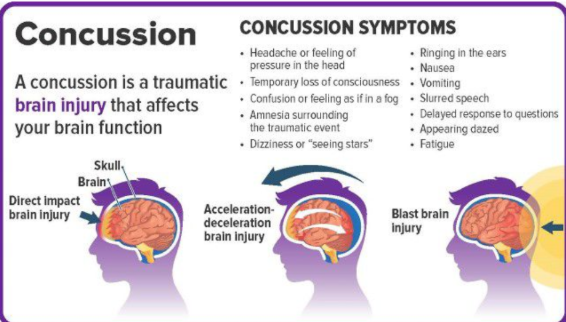
S/S | T |
tinnitus headache vomiting neasua slurred speach dizziness light sensitivity blown pupils temp loss of consciousness confusion amnesia fatigue | SMR if warranted O2 if needed Supportive care consider pain management Transport Limit light and loud noises |
Cushing’s Reflex
Cushing’s Reflex (Cushing’s Triad) – a traumatic brain injury, tumor, or infection resulting in increased ICP (intracranial pressure). ICP causes the following to occur:
Hypertension (High BP)
Bradycardia (High pulse rate)
Irregular breathing (referred to as Cheyne-Stokes breathing)
Rapid breathing followed by apnea (no resps)
Skull Fractures
Closed location names
Orbit (eye)
Jaw (mandible)
Basilar (temporal to back of skull)
Malar (triangle - Facial/nose)
Basic Types skull Fractures
Closed - no need to apply direct pressure, protect the area
Open - gently apply pad to opening, apply pressure to surrounding area but NOT directly on the opening, do not move bones
*Never apply pressure directly to a skull fracture. If it is open and has moderate to major bleeding apply pressure. ensuring not to press directly on the fracture itself.
Spinal Injuries
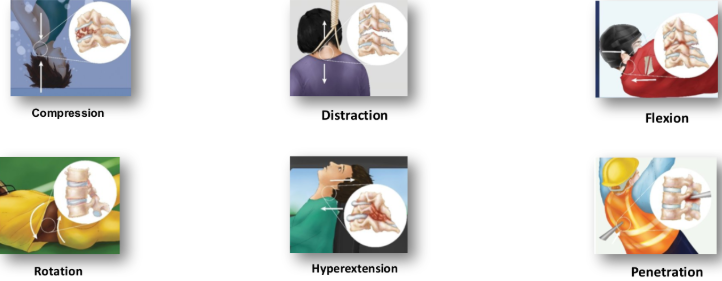
MOI
Compression
Distraction
Flexion
Rotation
Hyperextension
Penetration
S/S | T |
Visible damage to the skull, neck or back Fluid coming from the ears Battle’s Sign or raccoon eyes Unequal pupil sizes (anisocoria) Changes in responsiveness Paresthesia (loss of sensation/tingling) Paralysis (loss motion) Irregular respirations (Cheyne-Stokes) High blood pressure and slow pulse Amnesia | Spinal motion restriction Oxygen based on patient condition Supportive care Consider pain management (Entonox) (no Ento for lung puncture! Pneumothorax) |
SMR - Spinal Motion Restirction
Simple SMR - Collar only (30 degree elevation of cot for head injuries)
Full SMR - Collar, Clamshell, rollers/foam blocks
Nexus
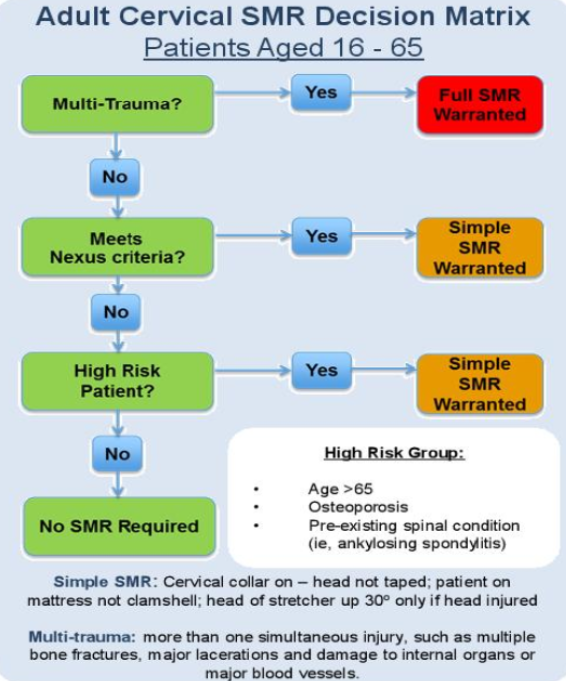
Modifies Nexus
is there midline tenderness?
Is there an altered LOC (must be alert and oriented x3)
are there new focal neurologial deficits?
Are they intoxicated (judgement and pain sensation must be intact)
is there a major distractin injury? (significant enough to interfere with their ability to assess pain response when palpating the spine)
* No to all five questions = no SMR warranted
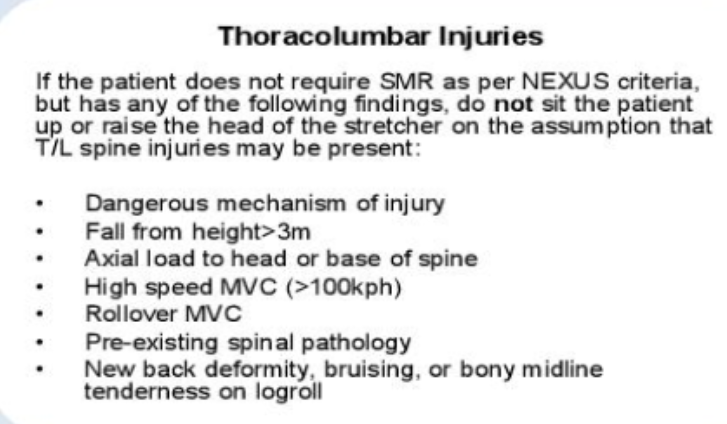
ALWAYS EXPOSE AND ASSESS THE BACK FOR ALL SMR PTS.
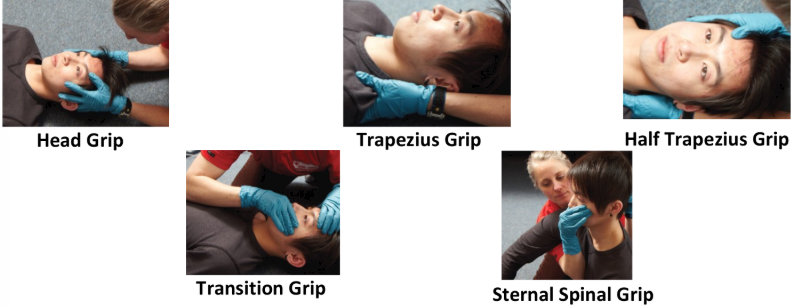
SMR Grips
Movements for SMR
Prone to supine
¾ prone to supine
standing takedown
Ked
Rapid extraction