Social Psychology
What is Social Psychology’s Focus
Social Psychology - the scientific study of how we think about, influence, and relate to others.
Why people act as they do, the difference between people, why the same persons act different in different circumstances
Personality psychologists study personal traits and processes that explain why different people may act differently in a given situation
Social psychologists study social forces that explain why the same person may act differently in the same situation
Social Thinking
We often face two choices:
Attributing behavior to person’s stable traits
Attributing behavior to the situation
Our attributions (explanations) affect our feelings and actions
Our attributions to someone’s personal traits or to the situation have real consequences
The Fundamental Attribution Error
Fundamental Attribution Error - the tendency, when analyzing others’ behavior, to overestimate the influence of personality and underestimate the influence of the situation. Affected by culture
First demonstrated in an experiment with college students.
students talked with a woman who was either cold or friendly. Before the talks, the researchers told the students that the woman was acting natural/authentic. They told the other half that the woman was acting friendly or unfriendly.
Did knowing the truth affect students’ impressions of the woman? Not at all! If the woman acted friendly, both groups decided she was a warm person. If she acted unfriendly, both decided she really was a cold person.
Culture affects our attributions
Westerners more often attribute behavior to people’s personal traits. People in China and Japan are more sensitive to the power of situations
Whose behavior also matters
When discussing our own behavior, we think about how the situation affects us
We also are sensitive to the power of the situation when we explain the behavior of people we have observed in many different contexts.
When analyzing other’s behavior the tendency to:
attribute behavior to the individual’s personality traits
See behaviors more often in some cultures than in others
Most likely to occur when a stranger acts badly
We are most likely to commit the fundamental attribution error when dealing with a stranger who acts badly
Can we understand our own behavior better by taking another persons point of view?
Researchers filmed two people interacting, and then showed each person a replay of their interaction — filmed from the other person’s perspective. Sure enough, this reversed participants’ attributions of the behaviors. Seeing the world from the actor’s perspective, the observers credited their own behavior more to their disposition (personal character), much as an observer typically would
Two important exceptions:
We attribute our deliberate and admirable actions to our own good reasons, not to the situation
Younger selves behavior is attributed to traits as we age
Political conservatives have tended to attribute responsibility to the personal traits of people who are unemployed or experiencing poverty
Political liberals are more likely to blame past and present situations rather than the person. They assume that people who lack access to quality education and other opportunities, and face discrimination, may struggle to get ahead no matter how hard they work.
Attitudes and Actions
Attitudes - feelings, often based on our beliefs, that predispose us to respond in a particular way to objects, people, and events.
If we believe someone is mean, we may feel dislike for the person and act unfriendly.
Our actions affect our attitude
Our attitude affects our actions
Cooperative actions (such as those preformed by people on sports teams) feel mutual liking
such attitudes, in turn, promote positive behavior
Attitude affects Actions
Regions of the US that promote hateful attitudes towards woman have higher rates of domestic abuse
Politicians may vote as their supporters demand, despite privately disagreeing
Situations affect actions
What attitudes affect behavior:
External influences are minimal.
The attitude is stable.
The attitude is specific to the behavior.
The attitude is easily recalled. The more vivid, the better
Actions Affect Attitude
Foot-in-the-Door Phenomenon - the tendency for people who have first agreed to a small request to comply later with a larger request.
In Chinese communist camps, they would get prisoners to agree to small tasks, then work up to larger ones
Proven in multiple experiments
Works for both negative and positive deeds
Experiments confirm the observation that moral action strengthens moral convictions
Role-Playing Affects Attitude
Role - a set of expectations (norms) about a social position, defining how those in the position ought to behave.
How many different roles do we have?
College student, daughter, friend, sister
Pulling on scrubs for the first time can feel like playing dress-up
But over time that role defines the players, as they jump into the day-to-day work and follow the social cues in their new environment
Cognitive Dissonance: Relief from Tension
Cognitive Dissonance Theory - the theory that we act to reduce our own discomfort (dissonance) when two of our thoughts (cognitions) clash. For example, when we become aware that our attitudes and our actions don’t match, we may change our attitudes so that we feel more comfortable.
Mismatch between attitude and actions
People tend to bring their attitudes into line with their actions to relieve tensions
Experiments show that you can write something you don’t believe in for some cash
Benefits
Can help us to become better people
If we are depressed, we can change our negative attributions and explain events in more positive terms, with more self-acceptance and fewer self-put-downs
We can think ourselves into action and also act ourselves into a way of thinking
Persuasion
Peripheral route persuasion - occurs when people are influenced by attention-getting cues, such as a speaker’s attractiveness.
When people were shown the physical pictures of disease effects, they were more likely to believe in vaccines
Central route persuasion - occurs when interested people’s thinking is influenced by considering evidence and arguments.
Effective arguments to act on climate change have focused on the accumulating greenhouse gases, melting arctic ice, rising world temperatures and seas, and increasing extreme weather
Aim is to trigger careful thinking
When trying to persuade:
Do | Do Not |
Identify shared values or goals | Loudly Argue |
Appeal to others admirable motives | Humiliate |
Make your message vivid | Bore |
Repeat your message | |
Engage your audiences in restating your message |
Social Influence
Norms - understood rules for accepted and expected behavior. Norms prescribe “proper” behavior.
Suits are expected at wall street
Cultural Influences
Culture - the enduring behaviors, ideas, attitudes, values, and traditions shared by a group of people and transmitted from one generation to the next.
we absorb the wisdom from our parents and improve on it
Humans are cultural animals
The human species is born with the collective wisdom of ancestors that support the ability to imitate, invent, and improve
Social living, imitation, and language have ensured the preservation of innovation. Culture also enables division of labor.
Cultures differ but there is one great similarity - our capacity for culture
Variations Across Culture
Humans imitate and invent more than any other species
Cultural variations in our belief and values
how we raise our kids
How we burry our dead
Practices in many Asian, African, and Latin American countries, for example, place a higher value on collectivism.
Cultural variations exists among wide range of beliefs and values
collectivism; individualism
Gender Equality
Western European and English-speaking countries tend to prioritize individualism.
Tight Cultures - Places with clearly defined and reliably imposed norms.
A pedestrian might wait for the light to say “WALK,” even on a deserted corner at midnight
coordinate their actions well, ensuring outstanding public transportation, clean streets, and, during the pandemic, fewer Covid-19 cases and deaths
Loose Cultures - Places with flexible and informal norms.
People tolerate some jaywalking, late arrivals, littering, and public affection.
allow for creativity, innovation, and self-expression.
When we move with the culture, we hardly notice it. When we move against the culture, we feel it
Variation Over Time
Cultural groups vary, compete for resources, and, over time, evolve
Cultures change when many people copy the innovations of a few
Can change rapidly
Technology, accents, clothes
Not all changes are positive
Tattoos:
yesterday’s nonconformity; todays conformity?
More present in different cultures
Conformity and Obedience
Humans tend to go with the flow
Social Contagion
When behaviors spread through culture
When one person yawns, checks their phone, other people do it to
Referred to the chameleon effect
Also effects emotions
Reading a text in a happy voice makes you happy
Enables us to empathize
why we feel happy around happy people
Group Pressure and Conformity
Conformity - Adjusting our behavior or thinking to coincide with a group standard.
Answering questions alone, they were wrong less than 1 percent of the time. But what happened when several others — accomplices of the experimenter — answered incorrectly? More than one-third of the time, these “intelligent and well-meaning” college students would agree with objectively false information by going along with the group
are made to feel incompetent or insecure.
are in a group with at least three other people.
are in a group in which everyone else agrees. (If just one other person disagrees, we will almost surely disagree.)
admire the group’s status and attractiveness.
have not already committed ourselves to any response.
know that others in the group will observe our behavior
are from a culture that strongly encourages respect for social standards.
Normative Social Influence - influence resulting from a person’s desire to gain approval or avoid disapproval.
People are most conforming to social norms in collectivist and tight cultures, which prize group harmony
Culture affects our values
Informational Social Influence - influence resulting from a person’s willingness to accept others’ opinions about reality.
Conformity can be bad — leading people to agree with falsehoods or go along with bullying. Or it can be good — leading people to give more generously after observing others’ generosity
Obedience
Stanley Milgram wanted to find out if people would give into commands.
Imagine:
You have responded to an ad for participants in a Yale University psychology study of the effect of punishment on learning. Professor Milgram’s assistant asks you and another person to draw slips from a hat to determine who will be the “teacher” and who will be the “learner.” You draw the “teacher” slip (unknown to you, both slips say “teacher”). The supposed “learner” is led to a nearby room and strapped into a chair. From the chair, wires run through the wall to a shock machine. You sit down in front of the machine and are given your task: Teach and then test the learner on a list of word pairs. If the learner gives a wrong answer, you are to flip a switch to deliver a brief electric shock. For the first wrong answer, you will flip the switch labeled “15 Volts — Slight Shock.” With each additional error, you will move to the next higher voltage. The researcher demonstrates by flipping the first switch. Lights flash and an electric buzzing fills the air.
The more shocks you give, the more pain the “learner” is in. Eventually the learner starts begging for the shocks to stop.
Would you follow an experimenter’s commands to shock someone? At what level would you refuse to obey
When Milgram asked nonparticipants what they would do, they said they would stand up against the experiment.
In the actual experiment, more than 60% followed orders
This was not just a part of the 1960s mindset
Obedience was highest when:
the person giving the orders was close at hand and was perceived as a legitimate authority figure.
a powerful or prestigious institution supported the authority figure.
the victim was depersonalized or at a distance, even in another room. Similarly, many soldiers in combat either do not fire their rifles at an enemy they can see or do not aim them properly. Such refusals to kill are rarer among those who kill from a distance. (Veterans who operated remotely piloted drones have also experienced stress, though much less posttraumatic stress than have veterans of on-the-ground conflict in Afghanistan and Iraq [G. Miller, 2012].)
there were no role models for defiance. (“Teachers” did not see any other participant disobey the experimenter.)
Obedience is not the only factor that explained the holocaust, but it is a factor
Lessons From the Conformity and Obedience Studies
How does this affect our everyday life?
Those who just follow orders (Nazis soldiers)
Psychology’s experiments aim not to re-create the actual, complex behaviors of everyday life but to explore what influences them.
With kindness and obedience on a collision course, obedience usually won.
Great evils often stem from people’s acceptance of lesser evils
Social control (the power of the situation) and personal control (the power of the individual) interact.
Minority influence - power of one or two individuals to sway majorities
most effective if a position is taken firmly
Example is Greta Thunberg
She sat alone outside the Swedish parliament for climate change
13 months after, a movement started with 4 million people
Time magazine honored her as their 2019 Person of the Year
Group Influence
Do other people’s presence affect your own performance
Social Facilitation
Social Facilitation - in the presence of others, improved performance on simple or well-learned tasks, and worsened performance on difficult tasks.
Because when others observe us, we become aroused, and this arousal amplifies our reactions.
Explains the home field advantage
Social Loafing
Does the presence of others have the same arousal effect when we perform a task as a group?
Social Loafing - the tendency for people in a group to exert less effort when pooling their efforts toward attaining a common goal than when individually accountable.
Every culture has found social loafing
but it was especially common among men in individualist cultures
What causes it? When people are in a group, they:
Feel less accountable
view individual contributions as unneeded
overestimate their own contributions
Downplay the efforts of others
free ride on others’ efforts
Deindividuation
But sometimes the presence of others does both, triggering behavior that can range from a food fight to vandalism or rioting.
Deindividuation - the loss of self-awareness and self-restraint occurring in group situations that foster arousal and anonymity.
Thrives in different environments
online hate
Tribal warriors wearing face paint
Phenomenon | Social Context | Psychological effect of others’ presence | Behavioral Effect |
Social Facilitation | Individual being observed | Increased arousal | Amplified dominant behavior, such as doing better what one does well, or doing worse what is difficult |
Social Loafing | Group projects | Diminished feelings of responsibility when not individually accountable | Decreased effort |
Deindividuation | Group setting that fosters arousal and anonymity | Reduced self-awareness | Lowered self-restraint |
Group Polarization
Democrats and Republicans viewed those in the other party as “dishonest” and “immoral.”
Group-Polarization - strengthening of a group’s preexisting attitudes through discussions within the group.
Poses positive and negative results
Feeds extremism and terrorism
Creates an “us” against “them” mentality
Can help low-prejudice individuals
The internet is a great tool for polarization
connects like-minded people and strengthens their ideas
Can bring emotional healing
can strengthen social movements
Can encourage people too isolate themselves from those with different options
If a group is like-minded, discussion strengthens its prevailing opinions
talking over racial issues increases prejudice in a high-prejudice group of high school students and decreased it in a low-prejudice group
Groupthink
Does group influence ever distort important national decisions?
Groupthink - the mode of thinking that occurs when the desire for harmony in a decision-making group overrides a realistic appraisal of alternatives.
To preserve the good vibes, members who oppose keep quiet
Later studies showed that groupthink — fed by overconfidence, conformity, self-justification, and group polarization — contributed to other fiascos.
Groupthink prevention strategies:
welcome open debate
Invite experts critiques of developing plans
Assign people to identify possible problems
Social Relations
How we relate to one another
Prejudice
Prejudice - an unfair and usually negative attitude toward a group and its members. Prejudice generally involves negative feelings, stereotyped beliefs, and a predisposition to discriminatory action.
Negative Feelings such as fear or disgust
Stereotypes - a generalized (sometimes accurate but often overgeneralized) belief about a group of people.
Discriminate - unfair negative behavior toward a group or its members. Can be obvious or subtle (microaggression). In experiments, people seeking Airbnb reservations received worse treatment when calling themselves Jamal rather than John, or Lakisha rather than Emily
People can experience prejudice due to their weight, age, physical appearance,
Explicit and Implicit Prejudice
Implicit Bias - unconscious favoritism toward or prejudice against people of a particular race, gender, or other social group.
Psychologists study implicit prejudice by:
testing for automatic group associations
evaluating bodily responses
Targets of Prejudice
Racial and Ethnic Prejudice
American’s racial prejudice has changed
Racial prejudice exists:
Adoption. States with greater implicit bias against Black children had lower adoption rates of Black foster children
Criminal Stereotypes. Black men have been judged more harshly than White men when they commit “stereotypically Black” crimes
Medical Care. Health professionals have allocated more resources to treat White patients than to treat equally unhealthy Black patients
One reason prejudice persists is that few people muster the courage to challenge prejudicial or hate speech.
People say that they would stand up against racist speech, but are often indifferent to it
The bottom line: If you disapprove of prejudice, ask yourself, “What message am I sending when I remain silent while others make racist, homophobic, sexist, or other prejudicial remarks?”
Implicit bias can get under the skin with good meaning people and it has physical harm
Some police departments have implicit bias training
Gender Prejudice
Ninety-four percent of people surveyed across 34 countries now agree “it is important for women to have the same rights as men”
Gender Prejudice exists:
Work and pay
Leadership
Masculine Norms - Organizations often value and reward masculine ideas, values, and interaction styles
LGBTQ Prejudice
In most of the world, gay, lesbian, and transgender people cannot openly and comfortably disclose who they are and whom they love.
Explicit anti-LGBTQ prejudice persists, even in countries with legal protections in place.
Do attitudes and practices that label, disparage, and discriminate against gay, lesbian, and transgender people increase their risk of psychological disorder and ill health? Yes.
So do laws that promote acceptance of gay, lesbian, and transgender people reduce bias? Again, Yes.
Roots of Prejudice
Prejudice springs from a culture’s divisions, the heart’s passions, and the mind’s natural workings.
Social Inequalities and Divisions
Just-World Phenomenon - the tendency to believe that the world is just and people therefore get what they deserve and deserve what they get.
Good is rewarded and evil is punished
Dividing the world into a “us” vs “them” mentality
Ingroup - “us” — people with whom we share a common identity.
Outgroup - “them” — those perceived as different or apart from our ingroup.
Ingroup Bias - the tendency to favor our own group.
Across 17 countries, ingroup bias — “the power of us” — appears more as ingroup favoritism than as intended harm to the outgroup
Negative Emotions
Scapegoat Theory - the theory that prejudice offers an outlet for anger by providing someone to blame.
From 2015 to 2023, as political polarization and identity politics surged, FBI-reported U.S. hate crimes increased considerably
Leaders cater to their audiences. And when prominent leaders voice prejudices, it becomes more acceptable for their followers to do the same
political leaders in White-majority countries referred to the virus as the “Chinese” or “China virus.” Associating the virus with a country fueled prejudice and discrimination, with 1 in 3 Asian Americans experiencing racial or ethnic slurs since the outbreak, and 1 in 4 fearing physical attack
Evidence:
Social Trends - Economically frustrated people often express heightened prejudice, and during economic downturns, racial prejudice intensifies
Experiments - Temporarily frustrating people intensifies their prejudice.
Cognitive Shortcuts
Other-Race Effects - the tendency to recall faces of one’s own race more accurately than faces of other races.
We thing that our own (current) age is the best
Remembering Vivid Cases
We also simplify our world by employing heuristics — mental shortcuts that enable snap judgments.
Availability bias
Victim Blaming
People often justify their prejudice by blaming the victims
Hindsight bias amplifies this
There is a tendency to justify our own culture’s social system (system justification)
Aggression
Aggression - any act intended to harm someone physically or emotionally.
Emerges when biology meets experiences
The Biology of Aggression
Is aggression an unlearned instinct?
Genetic Influences
Shows through studies
Dogs can be bred for aggression
Men are four times more likely than women to commit violent crime
Y chromosome is a genetic marker for violence
Biochemical Influences
A raging bull becomes a gentle giant when castration reduces its testosterone level.
In humans, high testosterone is associated with irritability, assertiveness, impulsiveness, and low tolerance for frustration.
Alcohol increases aggressive response to frustration and numbs people’s physical pain
Neural Influences
There is no one spot in the brain that controls aggression. But animal and human brains have neural systems that, given provocation, will either inhibit or facilitate aggression
Complex behavior occurring in particular contexts; frontal lobe
Psychological and Social-Cultural Influences on Aggression
Aversive Events: Hurt People Hurt People
Suffering sometimes builds character.
Frustration-Aggression Principle - the principle that frustration — the blocking of an attempt to achieve some goal — creates anger, which can generate aggression.
Pitchers were most likely to hit batters when the previous batter had hit a home run, the current batter had hit a home run the last time at bat, or a pitch had hit the pitcher’s teammate in the previous half-inning.
higher temperatures have predicted increased violent crime, spousal abuse, prison violence, profanity, and even wars and revolutions
other things include physical pain/personal insults; foul odors, cigarette smoke, crowding
Reinforcement and Modeling
Aggression may naturally follow aversive events, but learning can alter natural reactions.
Parent-training programs often advise parents to avoid screaming and hitting when frustrated by their children’s bad behavior. Instead, they can reward desirable behaviors and frame statements positively
Different cultures model, reinforce, and evoke different tendencies toward violence
Media Models for Violence
Social Scripts - a culturally modeled guide for how to act in various situations.
Watching media depictions of risk-glorifying behaviors (dangerous driving, extreme sports, unprotected sex) increases real-life risk-taking
Porn consumptions contributes to sexual aggression; heightens risk of sexual aggression
TV, films video games, internet
Video Games:
Research suggests that active role-play aggression in video games can:
Prime aggressive throughts
Decrease empathy and sensitivity to cruelty
Increase hostile world view, arguments ,and fights
Some researchers dispute this finding and note that other factors better predict aggression:
Depression
Family Violence
Peer Influence
Gun-toting culture
Attraction
What led you to become close friends with someone, or stirred your romantic feelings for someone else?
While what is seen as attractive varies by culture and over time. yet some adult physical features, such as a healthy appearance and symmetrical face, seem attractive everywhere
The Psychology of Attraction (3 steps)
Proximity
Mere-Exposure Effect - the tendency for repeated exposure to novel stimuli to increase our liking of them.
Within certain limits
Modern Matchmaking
Using dating sites and apps involves some risks, including receiving unwanted sexual messages and even experiencing sexual assault
Expands the pool of potential partners, especially for same-sex couples
Internet-formed friendships and relationships
Speed dating
Physical Attractiveness
Affects first impressions for both sexes
Across 93 countries, nearly all men and women reported engaging in daily behaviors aimed at increasing their physical attractiveness
Physical attractiveness also predicts how often people date and how popular they feel.
People’s attractiveness seems unrelated to their self-esteem, their later happiness, and their relationship success
Very attractive people are sometimes suspicious that praise for their work is simply a reaction to their looks.
For couples who were friends before lovers — who became romantically involved long after first meeting — looks matter less
Similarities
People are attracted to people similar to them
More likely includes friends and couples
Includes shared attitudes, beliefs, and interests
age, religion, race, education, intelligence, smoking behavior, economic status
Romantic Love
If love endures, passionate love will mellow into a lingering companionate love
Passionate Love
Passionate Love - an aroused state of intense positive absorption in another, usually present at the beginning of romantic love.
Two Factory theory of emotion
Emotions have two ingredients — physical arousal plus cognitive appraisal.'
Arousal from any source can enhance an emotion, depending on how we interpret and label the arousal.
Compassionate Love
Compassionate Love - the deep affectionate attachment we feel for someone with whom our life is intertwined.
Oxytocin remains and supports feelings of trust, calmness, and bonding
Passion subsides and commitment grows (Sorokowski et al., 2021). Like a passing storm, the flood of passion-feeding hormones (testosterone, dopamine, adrenaline) gives way. But another hormone, oxytocin, remains, supporting feelings of trust, calmness, and bonding with the mate. This shift from passion to attachment is adaptive (Reis & Aron, 2008).
In the most satisfying of marriages, attraction and sexual desire endure, minus the obsession of early romance
Equity - a condition in which people receive from a relationship in proportion to what they give to it.
Key to a successful marriage
Self-Disclosure - revealing intimate aspects of ourselves to others.
Helps deepen intimacy
A third key to a successfully marriage is positive support
Altruism
Outraged by Russia’s violence against Ukraine, people from 165 countries booked more than 430,000 nights at Ukrainian Airbnb’s, most belonging to people they did not know (Friedman, 2022). The purchasers had no intention of using the reservation; they simply wanted to donate money to people who were hurting.
Altruism - unselfish concern for the welfare of others.
not all altruism stories have happy endings
Bystander Intervention
bystanders’ inaction not to character flaws or moral choices, but to an important situational factor — the presence of others.
Three conditions were necessary for bystanders to help. They must notice the incident, interpret it as an emergency, and assume responsibility for helping
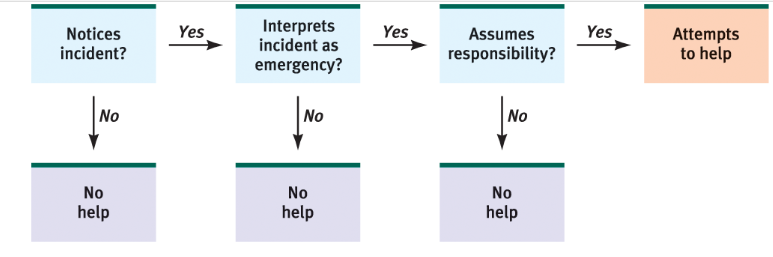
those who believed only they could hear the victim — and therefore thought they alone were responsible for helping him — usually went to his aid
When more people shared responsibility for helping — when no one person was clearly responsible — each listener was less likely to help
Bystander Effect - the tendency for any given bystander to be less likely to give aid if other bystanders are present.
The odds of helping are highest when:
the person appears to need and deserve help.
the person is in some way similar to us.
the person is a woman.
we have just observed someone else being helpful.
we are not in a hurry.
we are in a small town or rural area.
we are feeling guilty.
we are focused on others and not preoccupied.
we are in a good mood.
People who give money away are happier than those who spend it almost entirely on themselves.
Happiness breeds helpfulness, and vice versa
Norms for Helping
Reciprocity Norm - an expectation that people will help, not hurt, those who have helped them.
Those for whom we do favors will often return favors.
Social Responsibility Norm - an expectation that people will help those needing their help.
During the Covid-19 pandemic, many people — despite the risk of infection — cared for the sick, shopped for older neighbors, and donated money to help those in need.
The highly religious, despite having lower incomes, were about 50 percent more likely to report having “donated money to a charity in the last month” and to have volunteered time to an organization
From Conflict to Peace
Conflict - a perceived incompatibility of actions, goals, or ideas.
Enemy Perspectives
Mirror-Image Perceptions - mutual views often held by conflicting parties, as when each side perceives itself as ethical and peaceful and views the other side as evil and aggressive.
Feeds into hostility
Self-Fulfilling Prophecy - a belief that leads to its own fulfillment.
Both individuals and nations tend to perceive their own actions as responses to provocation, not as the causes of what happens next.
Promoting Peace
Contact
Does it help to put two conflicting parties into close contact? It depends.
Across a quarter-million people studied in 38 nations, friendly contact with ethnic minorities, older people, LGBTQ people, and people with disabilities has usually led to more positive and empathic attitudes and reduced dehumanization
Prejudice is a learned behavior that can be unlearned
Most effective when it is noncompetitive and between parties with equal status
Cooperation
Superordinate Goals - shared goals that override differences among people and require their cooperation
At such times, cooperation can lead people to define a new, inclusive group that dissolves their former subgroups
In the classroom as in the sports arena, members of multiethnic groups who work together on projects typically come to feel friendly toward one another