Factors Affecting National Energy
Supply: determined by the availability of energy resources in a country, its ability to harness these and its ability to purchase energy resources from abroad
Management: ensuring supplies are sufficient to meet demand. May be achieved by investing in renewables
Demand: most influenced by the size of a country’s population and its economic development
Management: decreasing demand to match supply
Physical Factors
Resource endowment: the natural resources within the borders of a country. Energy resources are not evenly distributed around the world
A country with a richer supply of fossil fuels is likely to use those as their primary resource supply
Russia: 177 billion tons of proven coal reserves
Middle East: 836 billion barrels of oil reserves
Climate: the weather conditions for an area over a long period
Countries with windier, sunnier or wetter climates are more likely to harness energy from respective renewables
New Zealand: 27mph average winds in Wellington so have installed 62 turbines for 73,000 homes
Canada/Scandinavia: very cold countries use more energy than warmer HICs to keep warm in winter
Economic Factors
Level of development: there is a global imbalance in energy demand that correlates with development
HICs use at least 5 equivalent oil tonnes more than LICs
HICs: can afford high energy use (cars, heating…)
MICs: have rapidly increasing demand (manufacture)
LICs: have little demand
Income: to meet demand by producing energy from supplies, heavy investment is required
HICs have this income available so are able to maintain control of their energy policy and develop the energy supplies they need
LICs lose freedoms to Trans-National companies who produce energy for them
Oil: offshore rigs cost at least $500 million
Coal power stations: around $2 billion
Wind turbines: around $5 million per turbine
Technology available: required to exploit resources, involved in production and use of energy over time
Supply: creation of nuclear plants, discovery technology, fracking methods and advanced coal mining techniques in 20th century meet demand
Demand: invention of internal combustion engine has increased petrol demand and online world requires lots of power
Environmental Factors
Sustainability: meeting the current energy demands without compromising the needs of the future generations’ demands, or the natural environment
Supply: to achieve sustainable supply, non-renewables will be used sparingly, and there will be investment into renewable energies
Demand: can be sustainably managed by advising locals on their usage, and opting for more efficient energy using devices
Energy conservation: 56% of UK’s usage could be cut by using available strategies and technologies
Pollution: the critical role of energy in economic development is more important than pollution consequences
CO2 is to blame for much of the Global Warming Effect
As a country develops, the environmental consequences of energy production become more important to locals and therefore the political agenda
West Virginia, USA: whole mountains destroyed for coal
Northern Russia: covered in oil spills from pipe leaks and oil tankers running aground. Kills wildlife
Gulf of Mexico, Deepwater: 2010 oil disaster
Political Factors
Energy policy: legislation, treaties, taxation and investment incentives to either increase supply (more power stations etc.) or decrease demand (focus on efficiency, sustainability and pollution reduction)
Kyoto Protocol: 192 countries agreeing to reduce greenhouse gas emissions, an extension of the 1992 ENFCCC agreement. Superseded by Paris 2020
Energy security: uninterrupted availability of energy sources at a price that people and industry can afford
Short term: ability to react promptly to sudden demand changes
Long term: future energy supply deals are inline with future economic development and environmental needs
In a capitalist economy, energy supply is dictated by demand and the production companies. However, governments step in to ensure security and prices
Is required for solid environmental growth. Some countries may interfere with the market to secure supplied
LIC/MIC/HIC Consumption
2012
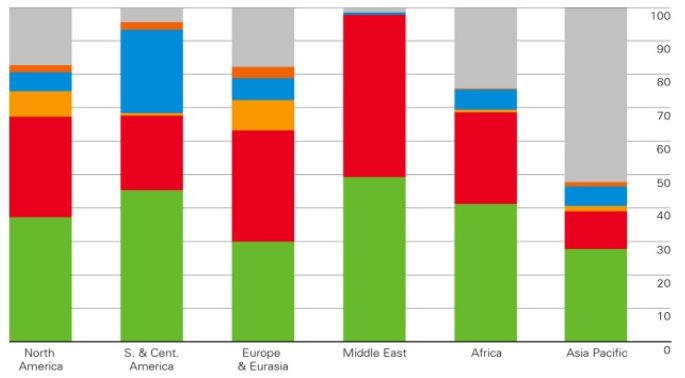
2019: renewables and natural gas increased. Coal consumption reduced in HICs, constant in LICs/MICs
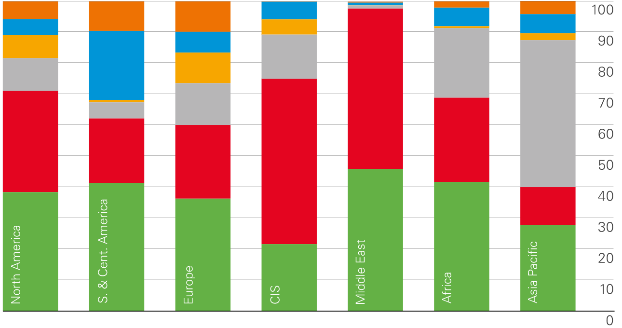
Fossil fuel trends
Coal: used least in the Middle East, most in Asia Pacific (55%), about 25% in Europe, Africa, N.America
Oil: used most in the Middle East (45%), > 30% in 5/7 countries
Natural Gas: 5% increase in the middle east
Nuclear power trends: significantly greater share in South/Central America (despite N.America being big producer) and Europe than rest of the world
Renewables trends: small increase 7 years on, but still <5% in all countries. None in Middle East or CIS
HEP trends: huge 25% in S.America, around 10% in all other countries except the Middle East
local Effects of Energy
Dry deposition
Gasses and particles never mix with water
NOx, SO2, CO2 cause the air to become acidic – absorbed by plants and trees
Larger particles deposit directly onto the ground or in bodies of water, causing acidic effects on limestone
Nuclear disaster: see Chernobyl example
Examples included in energy production descriptions indicate local environmental and economic effects
Global Effects of Energy
Wet deposition (acid rain)
Gasses and particles mix with water vapour in the sky
NOx, SO2, CO2 cause the precipitation to become acidic – causing erosion of alkaline rocks and structures such as Limestone
Carried by wind – eg. UK greenhouse gasses cause acid rains in Germany and The Netherlands
Ocean acidity increased by 0.05pH over 40 years
Soil acidification
Global warming
Burning fossil fuels causes an increase in the concentration of greenhouse gasses (methane, CO2, SO2 etc…)
Cause the enhanced greenhouse effect. More insolation trapped inside the atmosphere, causing warming that if there were no additional gasses
Temperature has risen by 0.5°C over the last 40 years
Increased CO2 (340ppm to 410ppm over 40 years) increases ocean acidity
Ozone depletion
Ozone is a protective layer of O3, 90% between 10 and 50km from Earth’s surface, absorbs UV radiation
Destroyed by CFCs, that react with O3 causing it to decrease
Reached a maximum size of 28.4km2 in 2000, now decreased to 9.3km2
Causes increased cancer rates, eye cataracts and effects aquatic/agricultural ecosystem