Unit 6 Vocab Lists: Cities and Urban Land-Use
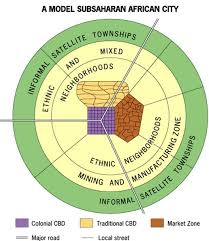
1. African City Model
Definition: A model of African urban structure with three CBDs (colonial, traditional, and market zone) and ethnic neighborhoods; squatter settlements are often on the outskirts.
Example: Nairobi, Kenya.
2. Blockbusting
Definition: When real estate agents encourage white homeowners to sell at low prices by stoking fears of racial integration.
Example: Occurred widely in U.S. cities like Chicago during the 1950s–1970s.
3. Boomburbs
Definition: Rapidly growing suburban cities that aren't the largest in their region but have large populations.
Example: Irvine, California.
4. Brownfields
Definition: Abandoned or underused industrial/commercial properties with potential environmental contamination.
Example: Detroit’s Packard Plant.
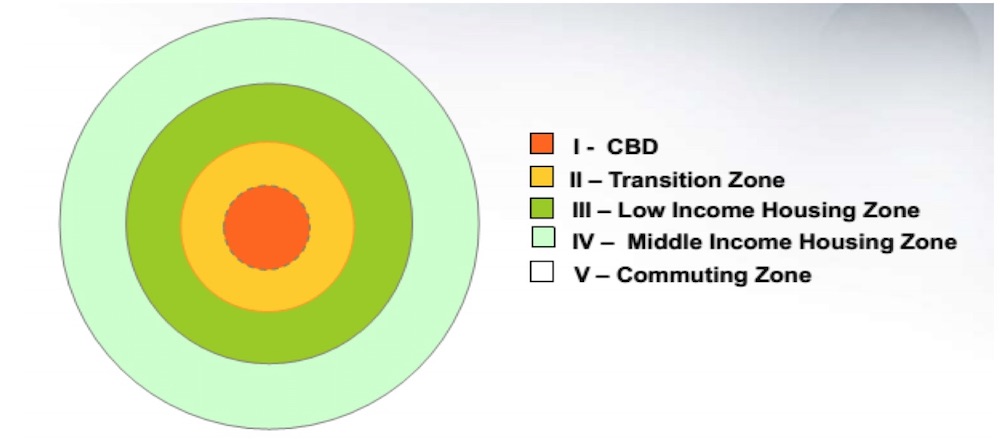
5. Burgess Concentric-Zone Model
Definition: A model showing cities as concentric rings: CBD at center, then transition zones, working-class, better housing, and commuters' zone.
Example: Early 20th-century Chicago.
6. Central Business District (CBD)
Definition: The commercial and business center of a city, often with high land values and skyscrapers.
Example: Manhattan, New York City.
7. Christaller's Central Place Theory
Definition: Explains the size and spacing of cities based on services provided, population thresholds, and range.
Example: Explains settlement patterns in southern Germany.
8. Combined Statistical Area (CSA)
Definition: Two or more adjacent metropolitan or micropolitan areas with economic or social ties.
Example: Washington-Baltimore-Arlington CSA.
9. Conurbation
Definition: An extended urban area formed by the merging of multiple cities or metropolitan areas.
Example: BosWash Corridor (Boston to Washington, D.C.).
10. Counterurbanization
Definition: Movement of people from urban areas to rural or less dense areas.
Example: Migration to rural Colorado during the COVID-19 pandemic.
11. Council of Government
Definition: Regional organizations composed of local governments to address regional issues.
Example: Atlanta Regional Commission.
12. De Facto Segregation
Definition: Racial or ethnic segregation resulting from social practice, not law.
Example: Predominantly Black neighborhoods in St. Louis.
13. Disamenity Zone
Definition: Areas not connected to city services; often very poor.
Example: Informal settlements in Rio de Janeiro.
14. Economic Base (Basic/Nonbasic)
Definition: Basic industries export goods/services; nonbasic serve local needs.
Example: Tech industry in San Jose (basic); grocery stores (nonbasic).
15. Edge City
Definition: A large node of office and retail activity on the edge of a metropolitan area.
Example: Tysons Corner, Virginia.
16. Ethnic Neighborhood
Definition: An area with a high concentration of a specific ethnic group.
Example: Little Italy in New York City.
17. Environmental Injustice
Definition: The unfair exposure of poor or minority communities to environmental hazards.
Example: Flint, Michigan water crisis.
18. Exurbs
Definition: Areas beyond the suburbs, often semi-rural but tied economically to a city.
Example: Parts of Loudoun County, Virginia.
19. Favela
Definition: Informal settlements or slums in Brazil.
Example: Rocinha in Rio de Janeiro.
20. Galactic City Model
Definition: A model showing a decentralized city with edge cities connected by ring roads.
Example: Atlanta, Georgia.

21. Gentrification
Definition: The process of middle-class people moving into deteriorated urban neighborhoods, displacing low-income residents.
Example: Brooklyn, New York.
22. Greenbelt
Definition: A ring of open land around cities where development is restricted.
Example: Greenbelt around London, UK.
23. Greyfields
Definition: Economically obsolete or outdated retail areas like empty shopping malls.
Example: Abandoned mall in Akron, Ohio.
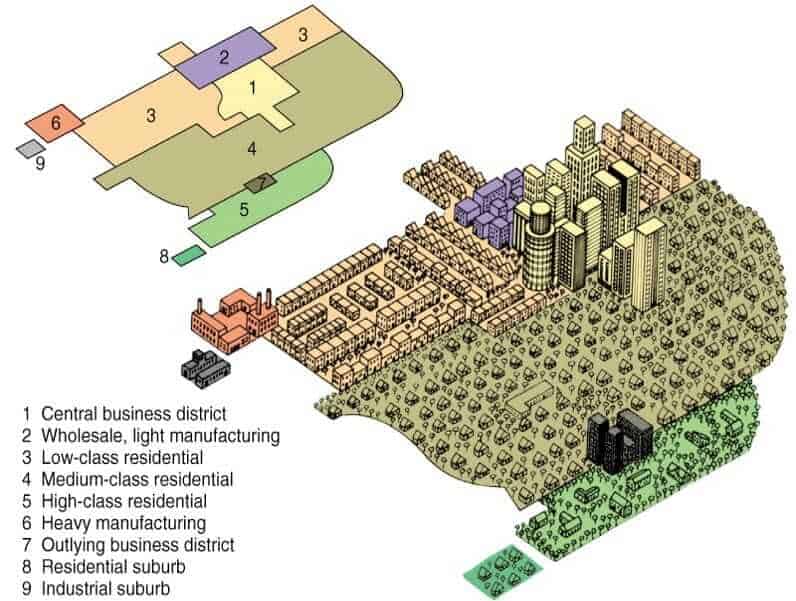
24. Harris and Ullman Multiple Nuclei Model
Definition: Cities grow around multiple nodes, not just a single CBD.
Example: Los Angeles.
25. Hoyt Sector Model
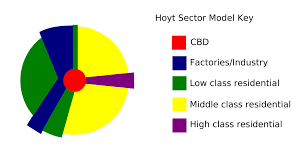
Definition: Urban model where cities develop in sectors radiating from the CBD.
Example: Chicago’s industrial corridor.
26. In-Filling
Definition: Development that fills in vacant or underused land in urban areas.
Example: Building new housing on empty lots in Detroit.
27. Infrastructure
Definition: The basic physical and organizational structures for a city’s functioning.
Example: Roads, water systems, power grids.
28. Latin American City Model
Definition: A model with a CBD and spine leading to a mall, with squatter settlements on the periphery.
Example: Mexico City.

29. Market Area (Hinterland)
Definition: The area a service or good draws customers from.
Example: Target store's customer base in a suburb.
30. Megacity
Definition: A city with over 10 million people.
Example: Jakarta, Indonesia.
31. Metacity
Definition: A sprawling urban area with over 20 million people.
Example: Delhi, India.
32. Megalopolis
Definition: A chain of closely linked metropolitan areas.
Example: Northeast U.S. corridor.
33. Metropolitan Statistical Area (MSA)
Definition: A city and its surrounding suburbs with economic and social ties.
Example: Los Angeles–Long Beach–Anaheim MSA.
34. Micropolitan Statistical Area (μSA)
Definition: Urban areas with 10,000–50,000 residents.
Example: Bozeman, Montana.
35. Mixed Land Use
Definition: Combining residential, commercial, and recreational uses in one area.
Example: Portland’s Pearl District.
36. New Urbanism
Definition: Planning movement promoting walkable, mixed-use communities.
Example: Seaside, Florida.
37. Placelessness
Definition: Homogenization of the landscape; loss of local identity.
Example: Chain stores dominating downtowns.
38. Planned Communities
Definition: Communities designed before construction with pre-determined layouts.
Example: Reston, Virginia.
39. Postindustrial City
Definition: A city with an economy based more on services than manufacturing.
Example: Pittsburgh, Pennsylvania.
40. Post-modern Architecture
Definition: Style rejecting strict modernist forms, often eclectic or decorative.
Example: Disney Headquarters in Burbank, CA.
41. Primate City
Definition: A city that is disproportionately large and dominant in a country.
Example: Bangkok, Thailand.
42. Public Housing
Definition: Government-provided housing for low-income residents.
Example: Cabrini-Green in Chicago (now demolished).
43. Rank-Size Rule
Definition: The nth largest city is 1/n the size of the largest city.
Example: Applied in the U.S., where the 2nd city is ~½ of the largest.
44. Redlining
Definition: Denying services to residents in certain areas based on race or ethnicity.
Example: Historic policies in U.S. inner cities.
45. Rural
Definition: Areas with low population density and more open space/agriculture.
Example: Farmland in Iowa.
46. Site
Definition: The physical characteristics of a place.
Example: Paris is located on an island in the Seine River.
47. Situation
Definition: The location of a place relative to other places.
Example: Singapore’s situation along major trade routes.
48. Slum
Definition: Densely populated urban area with poor housing and services.
Example: Kibera in Nairobi.
49. Smart Growth
Definition: Policies encouraging sustainable urban development.
Example: Portland’s urban growth boundary.
50. Slow-Growth Cities
Definition: Cities that deliberately limit growth to prevent sprawl.
Example: Boulder, Colorado.
51. Southeast Asian City Model
Definition: Features a port at the center, no strong CBD, and sectors radiating out.
Example: Ho Chi Minh City.

52. Specialization
Definition: Concentration of specific industries in a city.
Example: Detroit and the auto industry.
53. Squatter Settlement
Definition: Informal housing lacking legal claim and services.
Example: Dharavi in Mumbai.
54. Suburban Sprawl
Definition: Spread of suburbs over large areas with low-density development.
Example: Phoenix, Arizona.
55. Suburbanization
Definition: Movement of people from cities to suburbs.
Example: Post-WWII growth around American cities.
56. Tenement
Definition: Low-income, often overcrowded urban apartment buildings.
Example: 19th-century Lower East Side, NYC.
57. Threshold
Definition: Minimum population needed to support a service.
Example: A luxury boutique needs a wealthy customer base.
58. Range
Definition: The maximum distance people will travel for a service.
Example: A concert venue has a large range.
59. Urban Renewal
Definition: Redevelopment of urban areas, often displacing poor residents.
Example: 1950s projects in Boston’s West End.
60. Urbanization
Definition: The increasing population concentration in cities.
Example: Rapid growth of Lagos, Nigeria.
61. Walkability
Definition: How friendly an area is to walking.
Example: Downtown Portland.
62. World City
Definition: A city with global economic influence.
Example: Tokyo.
63. Zone of Abandonment
Definition: Areas in a city with little to no investment or use.
Example: Some neighborhoods in Detroit.
64. Zoning Practices
Definition: Regulations controlling land use.
Example: Residential vs. commercial zoning in suburban areas.