Untitled document
Tab 1
2 Week Study Timetable Year10
2-Week Study Timetable
Subjects
English
Digital Computer Technology
Mathematics
Science
Social Studies
Study Rules
3 subjects per day
2 hours per subject
Take a 15–20 minute break between sessions
Try to study at the same times daily for consistency
Week 1
Day | 4:00pm – 6:00pm | 6:20pm – 8:20pm | 8:40pm – 10:40pm |
|---|---|---|---|
Monday | English | Mathematics | Science |
Tuesday | Digital Computer Technology | Social Studies | English |
Wednesday | Mathematics | Science | Digital Computer Technology |
Thursday | Social Studies | English | Mathematics |
Friday | Science | Digital Computer Technology | Social Studies |
Saturday | English | Science | Mathematics |
Sunday | Digital Computer Technology | Social Studies | English1 |
Week 2
Day | 4:00pm – 6:00pm | 6:20pm – 8:20pm | 8:40pm – 10:40pm |
|---|---|---|---|
Monday | Mathematics | Science | English |
Tuesday | English | Digital Computer Technology | Mathematics |
Wednesday | Science | Social Studies | English |
Thursday | Digital Computer Technology | Mathematics | Science |
Friday | Social Studies | English | Digital Computer Technology |
Saturday | Mathematics | English | Science |
Sunday | Social Studies | Digital Computer Technology | Revision / Weakest Subject |
Math Term 2
MATH TERM 2 MILESTONE REVISION
Algebra 1
MATH TERM 2:
ALGEBRA 1
Outcome 1
Forming algebraic expressions from word situations
This means reading a sentence or story and turning it into maths using letters. The letter (variable) stands for the unknown number. You are NOT solving — just writing the expression.
Question: A box holds some chocolates. Sam eats 3 and then the remaining amount is multiplied by 4. Write an expression for the number of chocolates left if the box started with x chocolates.
Let x = the starting number of chocolates
Sam eats 3, so we subtract: x − 3
That amount is multiplied by 4: 4(x − 3)
Expand to simplify: 4x − 12
Answer: 4x − 12
Outcome 2
Substituting multiple numbers into mixed expressions
You are given an expression with one or more letters and told what each letter equals. Replace every letter with its number, then use BEDMAS to calculate the answer.
Question: Find the value of 2a² + 3b − c when a = 4, b = 5, c = 2.
Write the expression: 2a² + 3b − c
Replace every letter: 2(4)² + 3(5) − 2
Work out the power first: 2(16) + 3(5) − 2
Multiply: 32 + 15 − 2
Add and subtract left to right: 47 − 2 = 45
Answer: 45
Outcome 3
Using substitution to answer contextual situations
A real-life formula is given (e.g. cost, distance, temperature). You substitute known values into the formula to find the answer. Always include the units in your answer.
Question: The cost of a taxi ride is C = 2.5d + 4, where d is the distance in km. Find the cost of a 12 km ride.
Write the formula: C = 2.5d + 4
Substitute d = 12: C = 2.5(12) + 4
Multiply: C = 30 + 4
Add: C = 34
Answer: $34
Outcome 4
Simplifying by adding and subtracting like terms
Like terms have exactly the same letter part (including the same power). You can only combine terms that match. Numbers on their own are also like terms with each other.
Question: Simplify 7x² + 3x − 2x² + 5 − x + 8.
Group x² terms: 7x² − 2x² = 5x²
Group x terms: 3x − x = 2x
Group number terms: 5 + 8 = 13
Write the simplified answer in order
Answer: 5x² + 2x + 13
Outcome 5
Simplifying by multiplying and dividing terms
When multiplying terms, multiply the numbers together and add the powers of matching letters. When dividing, divide the numbers and subtract the powers of matching letters.
Question: Simplify (a) 5x² × 3x³ (b) 20a⁴b ÷ 4ab
(a) Multiply numbers: 5 × 3 = 15
(a) Add powers of x: x² × x³ = x⁵
(a) Answer: 15x⁵
(b) Divide numbers: 20 ÷ 4 = 5
(b) Divide a: a⁴ ÷ a = a³
(b) Divide b: b ÷ b = 1
(b) Answer: 5a³
Answers: (a) 15x⁵ (b) 5a³
Outcome 6
Simplifying indices using multiplication, division and brackets
The index laws are: multiply → add powers, divide → subtract powers, power to a power → multiply powers. Any base to the power of 0 = 1.
Question: Simplify (a) m⁶ × m² (b) p⁹ ÷ p³ (c) (3y²)³
(a) Add powers: m⁶⁺² = m⁸
(b) Subtract powers: p⁹⁻³ = p⁶
(c) Cube the number: 3³ = 27
(c) Multiply the index by 3: y²ˣ³ = y⁶
(c) Answer: 27y⁶
Answers: (a) m⁸ (b) p⁶ (c) 27y⁶
Outcome 7
Simplifying basic algebraic surds
A surd is a square root that does NOT simplify to a whole number (e.g. √2, √3, √5). To simplify, find the largest perfect square factor, take its root outside, and leave the rest inside.
Question: Simplify (a) √72 (b) 3√50
(a) Largest square factor of 72: 36 × 2 = 72
(a) Split: √36 × √2
(a) Simplify √36 = 6: answer is 6√2
(b) Largest square factor of 50: 25 × 2 = 50
(b) Split: 3 × √25 × √2 = 3 × 5 × √2
(b) Multiply: 15√2
Answers: (a) 6√2 (b) 15√2
Outcome 8
Simplifying algebraic fractions — addition and subtraction
Just like number fractions, you must find a common denominator before adding or subtracting. Rewrite each fraction over the common denominator, then add or subtract the numerators only.
Question: Simplify (2x/3) + (x/4).
Find the LCD of 3 and 4: LCD = 12
Convert first fraction: 2x/3 = 8x/12
Convert second fraction: x/4 = 3x/12
Add the numerators: 8x + 3x = 11x
Write over common denominator: 11x/12
Answer: 11x/12
Outcome 9
Simplifying algebraic fractions — multiplication and division
To multiply fractions: multiply top × top and bottom × bottom, then simplify by cancelling. To divide fractions: flip the second fraction (find its reciprocal) and then multiply.
Question: Simplify (5x/6) ÷ (10x²/3).
Flip the second fraction: 10x²/3 becomes 3/10x²
Change to multiplication: (5x/6) × (3/10x²)
Multiply tops: 5x × 3 = 15x
Multiply bottoms: 6 × 10x² = 60x²
Simplify the fraction: 15x/60x² = 1/4x
Answer: 1/4x
Outcome 10
Expanding single brackets
Expanding removes a bracket by multiplying the term outside by every single term inside. Remember to carry the sign (+ or −) of each term inside the bracket.
Question: Expand 4x²(3x³ − 2x + 5).
Multiply 4x² by each term inside
4x² × 3x³ = 12x⁵
4x² × −2x = −8x³
4x² × 5 = 20x²
Write the full expansion
Answer: 12x⁵ − 8x³ + 20x²
Outcome 11
Expanding and simplifying two brackets connected by + or −
Expand each bracket separately, then collect like terms. Be extra careful when there is a minus sign in front of a bracket — it changes the sign of every term inside.
Question: Expand and simplify 5(2x + 3) − 4(x − 1).
Expand first bracket: 5(2x + 3) = 10x + 15
Expand second bracket (mind the minus!): −4(x − 1) = −4x + 4
Write all terms: 10x + 15 − 4x + 4
Collect x terms: 10x − 4x = 6x
Collect number terms: 15 + 4 = 19
Answer: 6x + 19
Outcome 12
Factorising an expression
Factorising is the reverse of expanding. Find the highest common factor (HCF) of all the terms — both the numbers AND the letters — take it outside a bracket, and divide each term by it to find what goes inside.
Question: Factorise 15x³y² − 10x²y.
HCF of 15 and 10 is 5
HCF of x³ and x² is x²
HCF of y² and y is y
Overall HCF = 5x²y
Divide term 1: 15x³y² ÷ 5x²y = 3xy
Divide term 2: 10x²y ÷ 5x²y = 2
Write in factorised form: 5x²y(3xy − 2)
Answer: 5x²y(3xy − 2)
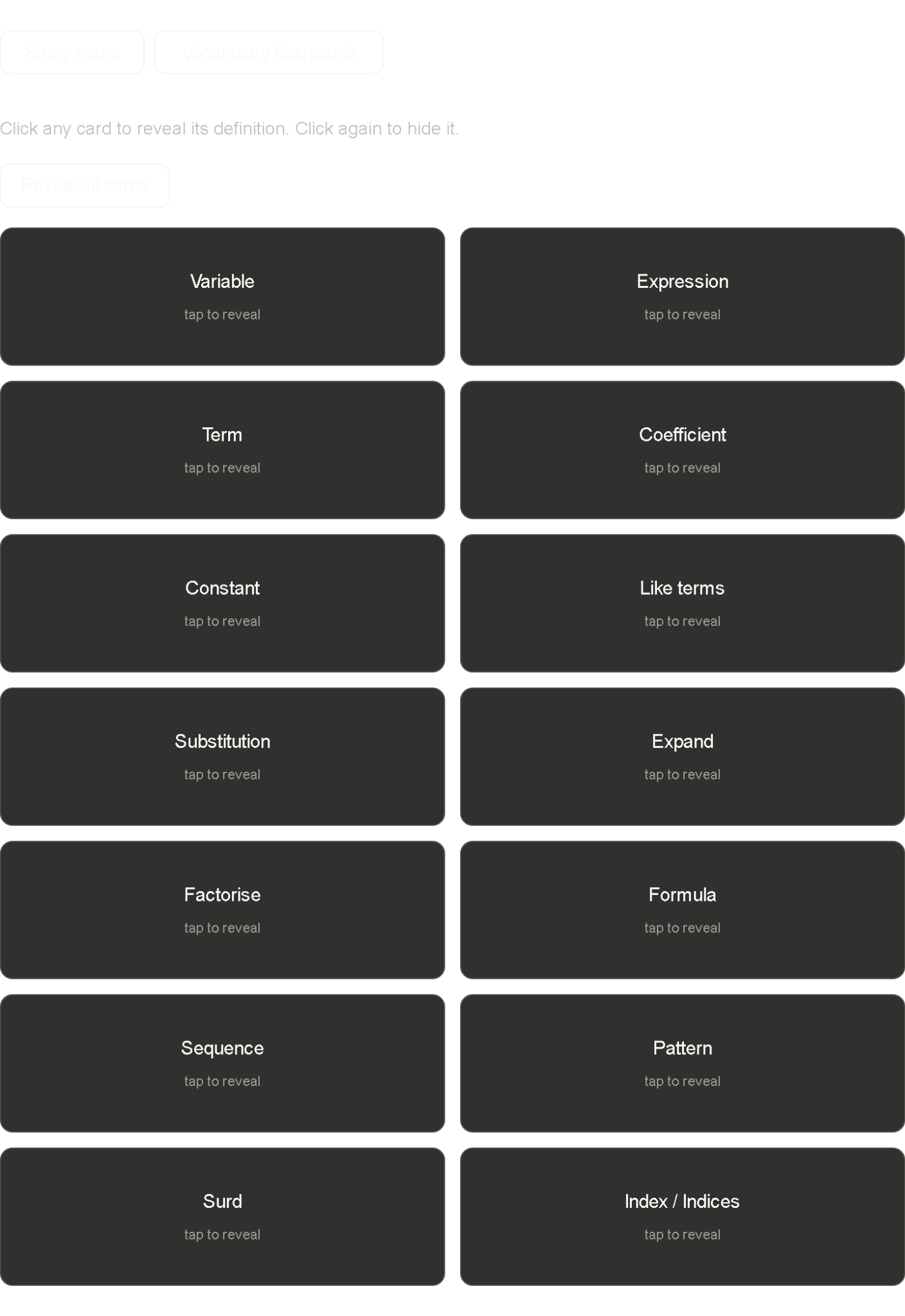
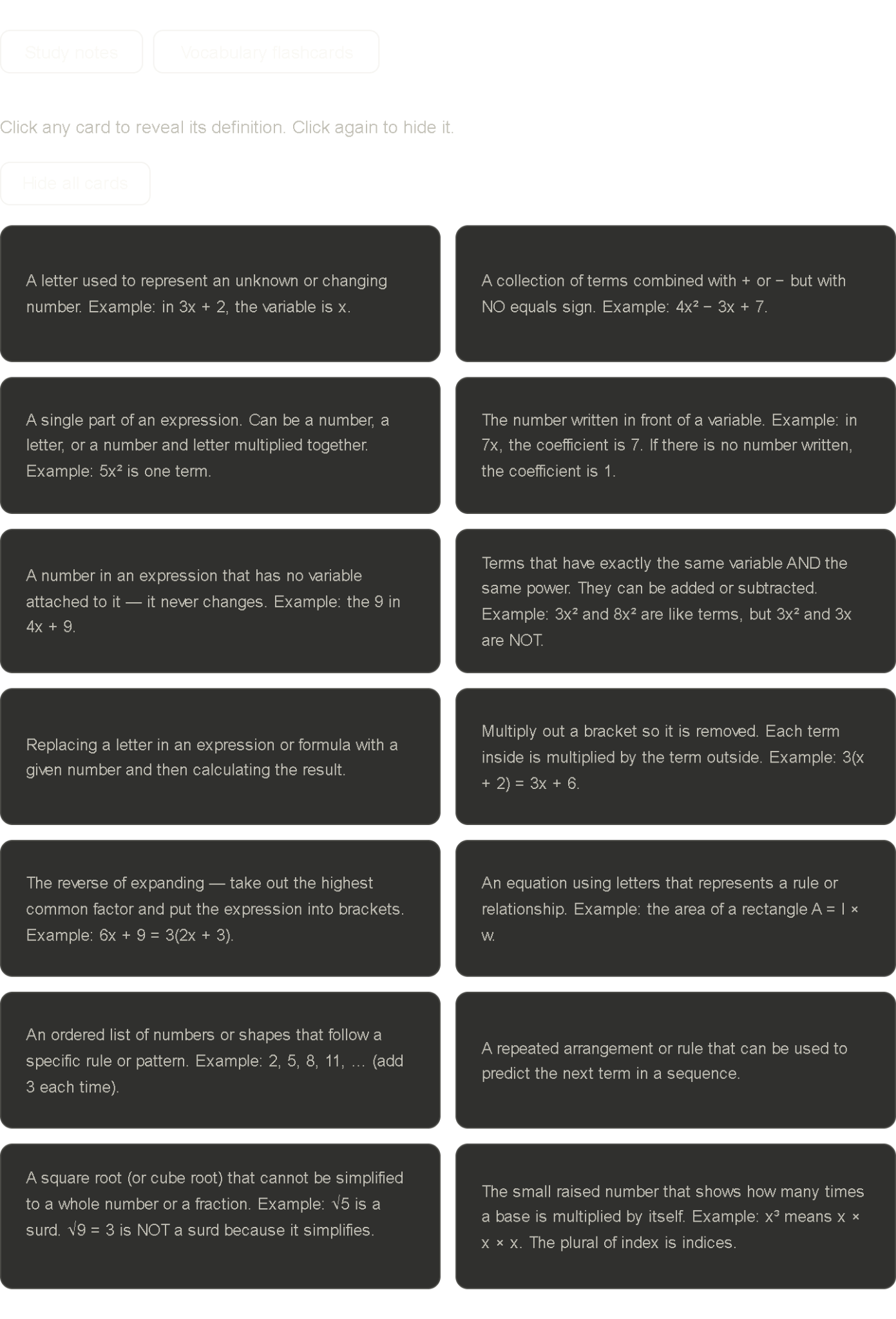
VOCAB:
Algebra 2
ALGEBRA 2
Outcome 1
Applying substitution to solve real-life problems
A real-world formula is given with letters. You swap the letters for the numbers you are told, then calculate the answer. Always include units and make sure your answer makes sense in the situation.
Question: A builder charges C = 85h + 60, where h is the number of hours worked. How much does it cost for 6 hours?
Write the formula: C = 85h + 60
Substitute h = 6: C = 85(6) + 60
Multiply: C = 510 + 60
Add: C = 570
Answer: $570
Outcome 2
Solving equations with one and two steps
An equation has an equals sign. To solve it, you find the value of the letter that makes both sides equal. Do the inverse (opposite) operation to move terms across the equals sign — what you do to one side you must do to the other.
Question: Solve 4x − 9 = 19.
Add 9 to both sides: 4x = 19 + 9 = 28
Divide both sides by 4: x = 28 ÷ 4
x = 7
Answer: x = 7
Outcome 3
Solving equations with x on both sides
When x appears on both sides of the equals sign, collect all the x terms onto one side first by adding or subtracting. Then solve as normal.
Question: Solve 7x + 2 = 3x + 18.
Subtract 3x from both sides to get x on one side: 4x + 2 = 18
Subtract 2 from both sides: 4x = 16
Divide both sides by 4: x = 4
Answer: x = 4
Outcome 4
Solving equations with brackets on one side
Expand the bracket first using the distributive law — multiply the term outside by every term inside. Once the bracket is gone, solve the equation as normal using inverse operations.
Question: Solve 5(3x − 4) = 25.
Expand the bracket: 15x − 20 = 25
Add 20 to both sides: 15x = 45
Divide both sides by 15: x = 3
Answer: x = 3
Outcome 5
Solving equations with brackets on both sides
Expand both brackets separately first. Then collect all x terms on one side and all number terms on the other. Be careful with minus signs in front of brackets — they change all signs inside.
Question: Solve 4(x + 5) = 2(2x − 3).
Expand left bracket: 4x + 20
Expand right bracket: 4x − 6
Equation: 4x + 20 = 4x − 6
Subtract 4x from both sides: 20 = −6
This is a contradiction — no solution exists
Answer: No solution (the lines are parallel)
Outcome 5b — typical version
Solving equations with brackets on both sides (with a solution)
Same process as above. Expand, collect, solve. Most questions will give a unique solution.
Question: Solve 3(2x + 1) = 2(x + 9).
Expand left: 6x + 3
Expand right: 2x + 18
Equation: 6x + 3 = 2x + 18
Subtract 2x: 4x + 3 = 18
Subtract 3: 4x = 15
Divide by 4: x = 15/4 = 3.75
Answer: x = 3.75
Outcome 6
Solving equations with fractions on one side
Multiply both sides by the denominator to clear the fraction completely. This leaves a normal equation you can solve. If the numerator contains an expression, keep it in brackets until it is expanded.
Question: Solve (3x + 5) / 4 = 7.
Multiply both sides by 4: 3x + 5 = 28
Subtract 5 from both sides: 3x = 23
Divide by 3: x = 23/3
Answer: x = 23/3
Outcome 7
Solving equations with fractions on both sides
Find the lowest common multiple (LCM) of all the denominators. Multiply every term on both sides by this LCM to clear all fractions at once. Then solve the resulting equation.
Question: Solve (2x + 1) / 3 = (x − 2) / 2.
LCM of 3 and 2 is 6
Multiply every term by 6: 2(2x + 1) = 3(x − 2)
Expand left: 4x + 2
Expand right: 3x − 6
Equation: 4x + 2 = 3x − 6
Subtract 3x: x + 2 = −6
Subtract 2: x = −8
Answer: x = −8
Outcome 8
Rearranging equations to make a given letter the subject
The subject is the single letter on its own on one side of the equation. To make a different letter the subject, use the same inverse operations as solving — just treat every other letter as if it were a number.
Question: Make u the subject of v² = u² + 2as.
Subtract 2as from both sides: v² − 2as = u²
Square root both sides: u = √(v² − 2as)
Answer: u = √(v² − 2as)
Outcome 9
Creating and solving equations from contextual situations
Read the word problem, choose a letter for the unknown, write an equation using the information given, solve it, then write the answer back in words making sure it answers the question.
Question: A rectangle has a length that is 5 more than twice its width. The perimeter is 58 cm. Find the width.
Let width = w, so length = 2w + 5
Perimeter formula: 2(length + width) = 58
Substitute: 2(2w + 5 + w) = 58
Simplify inside: 2(3w + 5) = 58
Expand: 6w + 10 = 58
Subtract 10: 6w = 48
Divide by 6: w = 8
Answer: width = 8 cm, length = 21 cm
Outcome 10
Creating and solving equations for geometrical reasoning
Use angle or shape rules (e.g. angles in a triangle add to 180°, angles on a straight line = 180°) to write an equation, then solve for the unknown. Always state the geometric reason you used.
Question: A triangle has angles (2x + 10)°, (x + 20)°, and (3x − 6)°. Find x and each angle.
Angles in a triangle add to 180°
Write the equation: (2x + 10) + (x + 20) + (3x − 6) = 180
Collect like terms: 6x + 24 = 180
Subtract 24: 6x = 156
Divide by 6: x = 26
Angle 1: 2(26) + 10 = 62°
Angle 2: 26 + 20 = 46°
Angle 3: 3(26) − 6 = 72°
Answer: x = 26, angles are 62°, 46°, 72°
Outcome 11
Forming a linear pattern and using it for contextual situations
A linear pattern increases or decreases by the same amount each time. Find the rule in the form T = mn + c, where n is the position, m is the common difference, and c is found by working backwards from the first term.
Question: A pattern has 5 tiles in position 1, 8 in position 2, and 11 in position 3. Find a rule and use it to find how many tiles are in position 20.
Find the common difference: 8 − 5 = 3, so m = 3
Rule so far: T = 3n + c
Substitute position 1: 5 = 3(1) + c → c = 2
Rule: T = 3n + 2
Substitute n = 20: T = 3(20) + 2 = 62
Answer: Rule is T = 3n + 2, position 20 has 62 tiles
Outcome 12
Solving multi-step inequations and showing on a number line
Solve an inequation exactly like an equation EXCEPT: if you multiply or divide both sides by a negative number, you must flip the inequality sign. Show the answer on a number line — open circle for < or >, closed circle for ≤ or ≥.
Question: Solve 3 − 2x ≥ 9 and show on a number line.
Subtract 3 from both sides: −2x ≥ 6
Divide by −2 — flip the sign!: x ≤ −3
Number line: closed circle at −3, arrow pointing left
Answer: x ≤ −3
Outcome 13
Solving simultaneous equations — elimination and substitution
Simultaneous equations share the same two unknowns. Elimination: add or subtract the equations to remove one variable. Substitution: rearrange one equation and plug the expression into the other.
Question (elimination): Solve 2x + y = 11 and x − y = 1.
Add the two equations to cancel y: (2x + y) + (x − y) = 11 + 1
Simplify: 3x = 12, so x = 4
Substitute x = 4 into equation 1: 2(4) + y = 11
8 + y = 11, so y = 3
Answer: x = 4, y = 3
Outcome 13b
Solving simultaneous equations — substitution method
When one equation is already solved for a variable (e.g. y = …), substitute that expression directly into the other equation. Solve for the remaining variable, then substitute back to find the other.
Question: Solve y = 3x − 2 and 2x + y = 13.
y is already expressed: y = 3x − 2
Substitute into equation 2: 2x + (3x − 2) = 13
Simplify: 5x − 2 = 13
Add 2: 5x = 15
Divide by 5: x = 3
Substitute back: y = 3(3) − 2 = 7
Answer: x = 3, y = 7
Outcome 14
Solving simultaneous equations with coefficient adjustment
When the coefficients don't match, multiply one or both equations by a number so that one variable has the same coefficient. Then add or subtract the equations to eliminate that variable.
Question: Solve 3x + 2y = 16 and 5x − 3y = 7.
Multiply equation 1 by 3: 9x + 6y = 48
Multiply equation 2 by 2: 10x − 6y = 14
Add the new equations to cancel y: 19x = 62
Divide by 19: x = 62/19
Substitute back into equation 1: 3(62/19) + 2y = 16
186/19 + 2y = 16 → 2y = 16 − 186/19 = 118/19
y = 59/19
Answer: x = 62/19, y = 59/19
Key term
Inequation : An algebraic statement containing an inequality sign, e.g <, > =
Rearrange : To change the subject of a formula so a single unknown variable is equal to the rest of it
Algebraic fraction: a fraction whose numerator and /or denominator are algebraic expressions
Elimination: A simultaneous equation method where one equation is substituted into the order to get in terms if a single variable
Process: Replacing letters with values and evaluating the answerSubstitution: Method: A simultaneous equation method where one equation is substituted into the other in order to get in terms of a single variable
Process: Replacing letters with values and evaluating the answerSimultaneous Equation: Two or more equations that share variables> Requires methods to solve all variables
Context: The real life information given that requires a mathematical strategy to solve a problem
Subject: the variable being solved for or the letter on its own side of the equals sign
Geometry 1
Geometry 1 – Term 2 Study Notes
1. Angle Notation
What it means
Angle notation is how we label angles using letters and the symbol ∠.
Example:
∠ABC means the angle is at B.
The middle letter is always the vertex (corner).
Example Question
What angle is shown by ∠PQR?
Answer
The angle is at Q because it is the middle letter.
2. Measuring Angles with a Protractor
What it means
A protractor measures angles in degrees (°).
Acute angle = less than 90°
Right angle = 90°
Obtuse angle = between 90° and 180°
Reflex angle = more than 180°
Example Question
An angle measures 130°. What type is it?
Answer
130° is between 90° and 180°.
So it is an obtuse angle.
3. Angles on a Straight Line
Rule
Angles on a straight line add to:
180∘180^\circ180∘
Example Question
Find x:
x+65∘=180∘x + 65^\circ = 180^\circx+65∘=180∘
Step-by-step
x=180∘−65∘x = 180^\circ - 65^\circx=180∘−65∘ x=115∘x = 115^\circx=115∘
Answer
115∘\boxed{115^\circ}115∘
4. Vertically Opposite Angles
Rule
Vertically opposite angles are equal.
Example Question
Find x:
x=72∘x = 72^\circx=72∘
Step-by-step
Vertically opposite angles are equal.
x=72∘x = 72^\circx=72∘
Answer
72∘\boxed{72^\circ}72∘
5. Angles Around a Point
Rule
Angles around a point add to:
360∘360^\circ360∘
Example Question
Find x:
120∘+95∘+x=360∘120^\circ + 95^\circ + x = 360^\circ120∘+95∘+x=360∘
Step-by-step
215∘+x=360∘215^\circ + x = 360^\circ215∘+x=360∘ x=360∘−215∘x = 360^\circ - 215^\circx=360∘−215∘ x=145∘x = 145^\circx=145∘
Answer
145∘\boxed{145^\circ}145∘
6. Interior Angles in Triangles
Rule
Angles inside a triangle add to:
180∘180^\circ180∘
Special Triangles
Isosceles triangle → 2 equal angles
Equilateral triangle → all angles are 60°
Example Question
Find x:
50∘+60∘+x=180∘50^\circ + 60^\circ + x = 180^\circ50∘+60∘+x=180∘
Step-by-step
110∘+x=180∘110^\circ + x = 180^\circ110∘+x=180∘ x=180∘−110∘x = 180^\circ - 110^\circx=180∘−110∘ x=70∘x = 70^\circx=70∘
Answer
70∘\boxed{70^\circ}70∘
7. Exterior Angles in Triangles
Rule
An exterior angle equals the sum of the two opposite interior angles.
Example Question
Find x:
Opposite interior angles are 40° and 65°.
Step-by-step
x=40∘+65∘x = 40^\circ + 65^\circx=40∘+65∘ x=105∘x = 105^\circx=105∘
Answer
105∘\boxed{105^\circ}105∘
8. Co-Interior Angles on Parallel Lines
Rule
Co-interior angles add to:
180∘180^\circ180∘
Example Question
Find x:
x+110∘=180∘x + 110^\circ = 180^\circx+110∘=180∘
Step-by-step
x=180∘−110∘x = 180^\circ - 110^\circx=180∘−110∘ x=70∘x = 70^\circx=70∘
Answer
70∘\boxed{70^\circ}70∘
9. Alternate Angles on Parallel Lines
Rule
Alternate angles are equal.
Example Question
Find x if the alternate angle is 55°.
Step-by-step
Alternate angles are equal.
x=55∘x = 55^\circx=55∘
Answer
55∘\boxed{55^\circ}55∘
10. Exterior Angles of Polygons
Rule
Exterior angles of any polygon add to:
360∘360^\circ360∘
Example Question
A polygon has exterior angles:
90°, 80°, 70°, and x.
Step-by-step
90∘+80∘+70∘+x=360∘90^\circ + 80^\circ + 70^\circ + x = 360^\circ90∘+80∘+70∘+x=360∘ 240∘+x=360∘240^\circ + x = 360^\circ240∘+x=360∘ x=120∘x = 120^\circx=120∘
Answer
120∘\boxed{120^\circ}120∘
11. Interior Angles of Polygons
Rule
Sum of interior angles:
(n−2)×180∘(n-2)\times180^\circ(n−2)×180∘
where nnn = number of sides.
Example Question
Find the sum of interior angles of a hexagon.
Step-by-step
Hexagon = 6 sides
(6−2)×180∘(6-2)\times180^\circ(6−2)×180∘ 4×180∘4\times180^\circ4×180∘ 720∘720^\circ720∘
Answer
720∘\boxed{720^\circ}720∘
12. Finding Number of Sides of a Regular Polygon
Exterior Angle Formula
Number of sides=360∘Exterior angle\text{Number of sides} = \frac{360^\circ}{\text{Exterior angle}}Number of sides=Exterior angle360∘
Example Question
A regular polygon has an exterior angle of 45°.
Find the number of sides.
Step-by-step
n=360∘45∘n = \frac{360^\circ}{45^\circ}n=45∘360∘ n=8n = 8n=8
Answer
8 sides\boxed{8 \text{ sides}}8 sides
13. Interior and Exterior Angles of Regular Polygons
Rules
Exterior angle:
360∘n\frac{360^\circ}{n}n360∘
Interior angle:
180∘−Exterior angle180^\circ - \text{Exterior angle}180∘−Exterior angle
Example Question
Find the interior angle of a regular pentagon.
Step-by-step
Pentagon = 5 sides
Exterior angle:
360∘5=72∘\frac{360^\circ}{5} = 72^\circ5360∘=72∘
Interior angle:
180∘−72∘180^\circ - 72^\circ180∘−72∘ 108∘108^\circ108∘
Answer
108∘\boxed{108^\circ}108∘
14. Parts of a Circle
Important Parts
Radius = center to edge
Diameter = across the circle through center
Circumference = outside edge
Chord = line joining 2 points on circle
Tangent = touches circle once
15. Isosceles Triangles in Circles
Rule
Radii in a circle are equal, so triangles formed are often isosceles.
Equal sides → equal angles.
Example Question
Two radii form an isosceles triangle.
Top angle = 40°.
Find each bottom angle.
Step-by-step
Triangle angles add to 180°.
180∘−40∘=140∘180^\circ - 40^\circ = 140^\circ180∘−40∘=140∘
Equal angles:
140∘÷2=70∘140^\circ \div 2 = 70^\circ140∘÷2=70∘
Answer
70∘\boxed{70^\circ}70∘
16. Radius and Tangent
Rule
A radius and tangent meet at:
90∘90^\circ90∘
Example Question
Find x if radius meets tangent.
Step-by-step
Radius ⟂ tangent
x=90∘x = 90^\circx=90∘
Answer
90∘\boxed{90^\circ}90∘
17. Angle in a Semi-Circle
Rule
Angle in a semi-circle is always:
90∘90^\circ90∘
Example Question
Find x inside a semi-circle triangle.
Step-by-step
Angle in semi-circle:
x=90∘x = 90^\circx=90∘
Answer
90∘\boxed{90^\circ}90∘
18. Multi-Step Angle Problems
Example Question
Find x:
Alternate angle = 65°
Angles on straight line
Step-by-step
Alternate angles are equal:
x+65∘=180∘x + 65^\circ = 180^\circx+65∘=180∘ x=180∘−65∘x = 180^\circ - 65^\circx=180∘−65∘ x=115∘x = 115^\circx=115∘
Answer
115∘\boxed{115^\circ}115∘
19. Scale Factor
What it means
Scale factor tells how much bigger or smaller a shape becomes.
Formula
Scale Factor=New lengthOriginal length\text{Scale Factor} = \frac{\text{New length}}{\text{Original length}}Scale Factor=Original lengthNew length
Example Question
Original side = 4 cm
New side = 12 cm
Find scale factor.
Step-by-step
Scale Factor=124\text{Scale Factor} = \frac{12}{4}Scale Factor=412 =3= 3=3
Answer
3\boxed{3}3
20. Using Scale Factors
Formula
New length=Original length×Scale Factor\text{New length} = \text{Original length} \times \text{Scale Factor}New length=Original length×Scale Factor
Example Question
Scale factor = 5
Original length = 7 cm
Find new length.
Step-by-step
7×57 \times 57×5 =35= 35=35
Answer
35 cm\boxed{35\text{ cm}}35 cm
VOCAB:
Parallel: Always the same distance apart and never touching
Perpendicular: At right angles(90) to the symbol is
Transversal: A line that crosses at least two other lines
Congruent: Have the same angle. When one shape can become another using rotation, reflection or and/or translation
Intersecting: Where lines cross over (where they have a common point)
Adjacent: Angles that share a side and a common vertex (corner point), and dont overlap.
Corresponding: Angles that occur on the same side of the transversal line and are equal in size
Co-interior: The two angles that occur on the same side of the transversal that always add up to 180 degrees
Alternate: Angles that occur on opposite sides of the transversal line and have the same size
Supplementary: two angles that add up to 180 degrees
Complementary: Two angles that add up to 90 degrees (a right angle)
Tangent: A line that just touches a curve at one point
Radius: The distance from the centre to the circumference of a circle
Diameter: The distance from one point on a circle through the centre to another point on the circle
Circumference: The distance around the edge of a circle
Polygon: 2-dimensional shapes made of straight lines with all the lines connected up
Regular: A shape with all sides and all angles
https://quizlet.com/user/John_Joseph1829/folders/math?i=6enpfe&x=1xqt
Science Term 2
SCIENCE TERM 2 MILESTONE REVISION
Genetics and Evolution
1. Label diagrams of the male and female reproductive organs
Male reproductive organs
Testes – produce sperm and testosterone
Scrotum – sac holding testes outside body to keep them cool
Sperm duct (vas deferens) – carries sperm
Prostate gland – adds fluid to sperm
Urethra – tube carrying urine and semen
Penis – delivers sperm into female reproductive system
Female reproductive organs
Ovaries – produce eggs and hormones
Oviducts/Fallopian tubes – carry egg to uterus; fertilisation happens here
Uterus – where embryo develops
Cervix – opening to uterus
Vagina – birth canal and receives sperm
2. Functions of the main parts of each reproductive system
Male
Testes → make sperm
Scrotum → temperature control
Sperm ducts → transport sperm
Prostate gland → produces fluid for semen
Penis → transfers sperm
Urethra → carries urine/semen
Female
Ovaries → release eggs
Oviducts → move egg; fertilisation site
Uterus → embryo growth
Cervix → controls opening of uterus
Vagina → receives penis/sperm and acts as birth canal
3. Male reproductive system
Testes
Scrotum
Sperm ducts
Prostate gland
Urethra
Penis
4. Female reproductive system
Ovaries
Oviducts
Uterus
Cervix
Vagina
5. Gametes and fertilisation
Gametes are sex cells.
Male gamete = sperm
Female gamete = egg (ovum)
Fertilisation happens when a sperm cell joins with an egg cell to form a zygote.
6. Development from zygote to embryo to baby
Fertilisation forms a zygote
Zygote divides by mitosis into many cells
Becomes an embryo
Embryo develops organs and becomes a foetus
Foetus grows into a baby
7. Haploid and diploid cells
Haploid (n) = one set of chromosomes
Gametes are haploid
Humans: 23 chromosomes
Diploid (2n) = two sets of chromosomes
Body cells are diploid
Humans: 46 chromosomes
8. Chromosomes, DNA, and genes
Chromosomes = long structures made of DNA
DNA = molecule carrying genetic information
Genes = sections of DNA controlling traits
Relationship:
Gene ⟶ part of DNA ⟶ DNA makes chromosomes
9. Location of DNA/genes in a cell
DNA and genes are found on chromosomes in the nucleus of cells.
10. Description of DNA
DNA:
Double helix shape (“twisted ladder”)
Made of nucleotides
Contains base pairs:
A–T
C–G
A-T, C-GA\text{-}T,\ C\text{-}GA-T, C-G
11. Human genome
The human genome is the complete set of human DNA and genes.
12. DNA making exact copies of itself
DNA replication:
DNA unwinds and unzips
Bases pair with matching bases
Two identical DNA molecules form
13. Mutation
A mutation is a change in the genetic code (DNA sequence).
14. Examples of mutations
Sickle cell anaemia
Albinism
Extra fingers/toes
Colour blindness
15. Causes of mutations
Radiation (UV, X-rays)
Chemicals
Smoking
Mistakes during DNA replication
16. Useful and harmful mutations
Useful
Disease resistance
Helpful adaptations
Harmful
Genetic disorders
Cancer
17. Genotype and phenotype
Genotype = genetic makeup (genes/alleles)
Phenotype = physical characteristics produced by genes + environment
Example:
Genotype: Bb
Phenotype: brown eyes
18. Alleles in cells
Most body cells have 2 alleles for each characteristic (one from each parent).
Gametes only have 1 allele.
19. Dominant and recessive alleles
Dominant allele = shown if present
Recessive allele = only shown if two copies present
Example:
B = brown eyes (dominant)
b = blue eyes (recessive)
BB or Bb → brown
bb → blue
20. Punnett squares (monohybrid crosses)
Example: Bb × Bb
B | b | |
|---|---|---|
B | BB | Bb |
b | Bb | bb |
Results:
75% dominant phenotype
25% recessive phenotype
21. Variation and its causes
Variation = differences between individuals
Causes:
Genes
Environment
Examples:
Height = genes + nutrition
Eye colour = mainly genes
22. Types of variation
Discrete variation
Clear categories
No middle values
Examples:
Blood group
Tongue rolling
Continuous variation
Range of values
Examples:
Height
Weight
23. Mitosis
Cell division producing identical cells
Used for:
Growth
Repair
Asexual reproduction
Produces:
2 identical diploid cells
24. Meiosis
Cell division producing gametes
Reduces chromosome number by half
Produces:
4 different haploid cells
25. Haploid vs diploid examples
Haploid: sperm, egg
Diploid: skin cells, muscle cells
26. Evolution
Evolution = gradual change in species over time.
27. Selective breeding
Humans choose organisms with desired traits to reproduce.
Examples:
Faster horses
Larger crops
Dogs with specific features
28. Darwin’s idea of evolution by natural selection
Variation exists
Some organisms survive better
Survivors reproduce more
Helpful traits are passed on
Species gradually change over time
29. Importance of variation
Without variation:
Everyone would be identical
No advantage for survival
Natural selection could not happen
Variation allows adaptation.
30. Evolution creates branching species
Evolution is like a tree:
Species split from common ancestors
Different branches become different species
31. Fitness in natural selection
Fitness = ability to survive and reproduce successfully.
32. Scientific theory
A scientific theory is a well-tested explanation supported by evidence.
33. Evidence supporting evolution
Fossils
DNA similarities
Comparative anatomy
Embryology
Observed natural selection (e.g. antibiotic resistance)
Vocab:
Human Reproductive Systems
Male Reproductive System
Q: What is the function of the testes?
A: Produce sperm and testosterone.
Q: What is the scrotum?
A: A sac that holds the testes outside the body to keep them cool.
Q: What is sperm?
A: The male gamete (sex cell).
Q: What is the sperm duct (vas deferens)?
A: A tube that carries sperm from the testes.
Q: What is the function of the prostate gland?
A: Produces fluid that mixes with sperm to form semen.
Q: What is the urethra?
A: A tube that carries urine and semen out of the body.
Q: What is the function of the penis?
A: Delivers sperm into the female reproductive system.
Female Reproductive System
Q: What is the function of the ovary?
A: Produces eggs and female hormones.
Q: What is an egg (ovum)?
A: The female gamete (sex cell).
Q: What is the oviduct (fallopian tube)?
A: Tube carrying the egg to the uterus; fertilisation usually occurs here.
Q: What is the uterus (womb)?
A: Organ where the embryo and foetus develop.
Q: What is the cervix?
A: Narrow opening between the uterus and vagina.
Q: What is the vagina?
A: Muscular canal leading from the cervix to the outside of the body.
Fertilisation & Development
Q: What are gametes?
A: Sex cells (sperm and egg).
Q: What is fertilisation?
A: The joining of sperm and egg nuclei.
Q: What is a zygote?
A: The fertilised egg cell formed after fertilisation.
Q: What is an embryo?
A: An early stage of development after repeated cell division.
Q: What is a foetus?
A: A later stage of development where organs are formed.
Cells & Chromosomes
Q: What is a haploid cell?
A: A cell with one set of chromosomes (n).
Q: What is a diploid cell?
A: A cell with two sets of chromosomes (2n).
Q: What is a chromosome?
A: A structure made of DNA containing genes.
Q: What is DNA?
A: The molecule carrying genetic information.
Q: What are base pairs in DNA?
A: Matching bases: A–T and C–G.
A-T, C-GA\text{-}T,\ C\text{-}GA-T, C-G
Q: What is a gene?
A: A section of DNA controlling a characteristic.
Q: What is a genome?
A: The complete set of genetic material in an organism.
Q: What is DNA replication?
A: The process where DNA makes an exact copy of itself.
Cell Division
Q: What is mitosis?
A: Cell division producing two identical diploid cells.
Q: What is meiosis?
A: Cell division producing four genetically different haploid cells.
Genetic Inheritance
Q: What is an allele?
A: A different version of a gene.
Q: What is genotype?
A: The combination of alleles an organism has.
Q: What is phenotype?
A: The observable characteristics of an organism.
Q: What is a dominant allele?
A: An allele expressed if present.
Q: What is a recessive allele?
A: An allele only expressed if two copies are present.
Q: What does homozygous mean?
A: Having two identical alleles (BB or bb).
Q: What does heterozygous mean?
A: Having two different alleles (Bb).
Q: What is a Punnett square?
A: A diagram used to predict inheritance outcomes.
Q: What is variation?
A: Differences between individuals in a species.
Q: What is discrete variation?
A: Variation with clear categories.
Q: What is continuous variation?
A: Variation with a range of values.
Mutations
Q: What is a mutation?
A: A change in the DNA sequence.
Q: What is a mutagen?
A: Something that causes mutations.
Q: What is a beneficial mutation?
A: A mutation that improves survival or reproduction.
Q: What is a harmful mutation?
A: A mutation that reduces survival or causes disease.
Q: What is a neutral mutation?
A: A mutation with no effect on survival.
Evolution & Natural Selection
Q: What is evolution?
A: The gradual change in species over time.
Q: What is natural selection?
A: The process where organisms with helpful traits survive and reproduce more.
Q: What is selective breeding?
A: Humans choosing organisms with desired traits to reproduce.
Q: What is fitness in biology?
A: The ability to survive and reproduce.
Q: What is a scientific theory?
A: A well-tested explanation supported by evidence.
Q: What is a common ancestor?
A: An earlier species from which others evolved.
Q: What is speciation?
A: The formation of new species.
Q: What is an evolutionary tree?
A: A branching diagram showing evolutionary relationships.
Forces and Motion
Forces and Motion — Test Revision Answers
1. Collect and record data in a suitable table
Data tables organise results clearly.
Tables should include:
Headings
Units
Repeated measurements if needed
Example:
Time (s) | Distance (m) |
|---|---|
0 | 0 |
1 | 2 |
2 | 4 |
2. Plot suitable distance–time graphs
Axes must be labelled with units.
The graph should fill most of the page.
Plot points accurately and draw a clear line/curve.
Distance is usually on the y-axis and time on the x-axis.
3. Convert one unit of measurement into another
Examples:
100 cm = 1 m
2 km = 2000 m
60 min = 1 hour
4. Calculate speed
Speed is calculated by:
v=dtv=\frac{d}{t}v=td
Speed = distance ÷ time
Example:
Distance = 100 m
Time = 20 s
Speed = 100 ÷ 20 = 5 m/s
5. Calculate speed from a distance–time graph
Calculate the slope (gradient) of the graph.
gradient=riserun\text{gradient}=\frac{\text{rise}}{\text{run}}gradient=runrise
Rise = change in distance
Run = change in time
The steeper the graph, the faster the speed.
6. Draw a distance–time graph from raw data
Steps:
Label axes with units
Choose a suitable scale
Plot points accurately
Join points with a line or curve
7. Link graph slope to speed
Horizontal line = stationary object
Positive slope = moving away from start
Negative slope = moving back toward start
Changing slope = acceleration/deceleration
Steeper slope = greater speed
8. Recognise slope of speed–time graph as acceleration
The gradient of a speed–time graph represents acceleration.
Positive slope = speeding up
Negative slope = slowing down
9. Use ticker timers to measure speed
Tickertape dots are made at equal time intervals.
Larger gaps between dots mean higher speed.
Equal gaps mean constant speed.
10. Calculate acceleration
Acceleration is change in velocity divided by time.
a=Δvta=\frac{\Delta v}{t}a=tΔv
Methods:
Calculate speed over time intervals
Use a speed–time graph
Compare changes in speed
11. Recognise contact and non-contact forces
Contact forces
Require touching.
Examples:
Friction
Tension
Air resistance
Non-contact forces
Act without touching.
Examples:
Gravity
Magnetism
12. Newton’s Third Law
For every action force, there is an equal and opposite reaction force.
Example:
A rocket pushes gases backward
Gases push rocket forward
13. Apparatus used to measure force
Force is measured using a:
Newton meter
Force meter
Spring balance
14. Difference between mass and weight
Mass
Amount of matter in an object
Constant everywhere
Measured in kilograms (kg)
Weight
Force caused by gravity
Changes depending on gravity
Measured in newtons (N)
Weight formula:
W=mgW=mgW=mg
mmm
kg
ggg
m/s^2
Fg=mg≈78.4 NF_g=mg\approx 78.4\,\text{N}Fg=mg≈78.4N
m=8kgF_g=78.4Ng=9.8 m/s^2
15. Newton’s First Law
An object stays at rest or continues moving at constant speed in a straight line unless acted on by an unbalanced force.
Examples:
A stationary ball stays still
A moving skateboard keeps rolling until friction stops it
16. Link force, mass and acceleration
Force depends on mass and acceleration.
F=maF=maF=ma
Greater force → greater acceleration
Greater mass → smaller acceleration
17. Newton’s Second Law
Newton’s Second Law states:
F=maF=maF=ma
Force = mass × acceleration
1 newton causes 1 kg to accelerate at 1 m/s²
1 N=1 kg⋅m/s21\ N = 1\ kg\cdot m/s^21 N=1 kg⋅m/s2
18. Deceleration
Deceleration means slowing down.
The force causing deceleration acts opposite to motion.
Example:
Brakes slowing a car
19. Understand energy
Energy is the ability to do work.
Energy exists in many forms:
Kinetic
Heat
Light
Sound
Chemical
20. Law of Conservation of Energy
Energy:
Cannot be created
Cannot be destroyed
Can only be transferred or changed from one form to another
Energy is measured in:
Joules (J)
Kilojoules (kJ)
21. Understand energy transfer with work
Work transfers energy when a force moves an object.
Example:
Lifting a box transfers energy to the box.
22. Work
Work done is calculated using:
W=FdW=FdW=Fd
Work = force × distance moved
Units:
Joules (J)
23. Relationship between force and distance moved
Increasing force increases work done.
Increasing distance increases work done.
24. Power
Power is the rate at which work is done or energy is transferred.
25. Relationship between power and time
Power formula:
P=EtP=\frac{E}{t}P=tE
More energy transferred in less time = greater power
26. Energy change equation
Power can also be written as:
P=energy changetimeP=\frac{\text{energy change}}{\text{time}}P=timeenergy change
27. Units of power
Watts (W)
1 watt = 1 joule per second
1 W=1 J/s1\ W = 1\ J/s1 W=1 J/s
28. Measure your power output
To measure power output:
Measure work done
Measure time taken
Divide work by time
Example:
200 J of work in 10 s
Power = 20 W
Digital Technolody Term 2
English Term 2
ENGLISH TERM 2 MILESTONE REVISION
Social Studies
SOCIAL STUDIES TERM 2 MILESTONE REVISION
Intro
Year 10 Weather & Climate – Exam Study Notes
Climate vs Weather
Weather = short-term atmospheric conditions (changes hour to hour or day to day).
Climate = average weather conditions of a place measured over many years.
New Zealand has over 100 years of recorded weather data.
Meteorologists study weather and climate.
Main Elements of Climate
1. Temperature
Measures how hot or cold the air is.
Measured in degrees Celsius (°C).
Measured with a thermometer.
Factors affecting temperature
Amount of solar radiation (sunshine)
Latitude (north is warmer than south in NZ)
Altitude (higher land is colder)
Cloud cover
Time of year and time of day
2. Wind
Moving air.
Measured in kilometres per hour (km/h).
Measured with an anemometer.
Wind direction is named after where the wind comes from.
How wind forms
Sun heats the Earth.
Warm air rises.
Cooler air moves in to replace it.
This movement creates wind.
3. Precipitation
Any moisture falling from the atmosphere.
Forms of precipitation
Rain
Snow
Hail
Fog
Dew
Mist
Rainfall
Measured in millimetres (mm).
Collected with a rain gauge.
The Hydrologic Cycle (Water Cycle)
The continual movement of water through the atmosphere and Earth.
Steps in the cycle
Evaporation – water changes into water vapour.
Condensation – water vapour cools and forms clouds.
Precipitation – water falls as rain, snow, hail, etc.
Water returns to rivers, lakes, oceans, and land.
The cycle repeats.
Importance
Supplies fresh water.
Supports plant, animal, and human life.
Solar Radiation
What is solar radiation?
Energy from the Sun providing light and heat.
Factors affecting solar radiation in NZ
Time of day
Season of the year
Cloud and pollution cover
Height above sea level
New Zealand’s Climate
Latitude and climate
New Zealand stretches from 34°S to 47°S in the:
Southern Temperate Zone
North Island climate
Closer to the tropics
Receives more concentrated solar energy
Generally warmer (sub-tropical climate)
South Island climate
Closer to the South Pole
Receives less solar energy
Cooler temperatures
Seasons and Temperature
Summer
Long days
Sun higher in the sky
More concentrated solar energy
Warmest temperatures
Winter
Short days
Sun lower in the sky
Less concentrated solar energy
Coldest temperatures
Spring and Autumn
Moderate temperatures between summer and winter extremes.
Relief and Temperature
Relief
The shape and height of the land.
Mountains and hills strongly affect climate.
Key relationships
Higher altitude = colder temperatures.
Thin air at high altitudes absorbs less heat.
Mountain tops can remain snow-covered.
Important idea
Temperature decreases as altitude increases.
Rain Shadow Effect
Windward Side
Faces moist winds.
Air rises and cools.
More cloud and rainfall.
Leeward Side (Rain Shadow)
Sheltered from moist winds.
Air descends and warms.
Drier conditions and more sunshine.
Example in New Zealand
Eastern South Island regions are often drier because of the Southern Alps rain shadow effect.
Sunshine Hours in New Zealand
Areas with high sunshine hours include:
Nelson/Marlborough
Eastern regions sheltered by mountains
Rain shadow areas often have:
More sunshine
Less rainfall
Air Pressure
What is air pressure?
The weight of air pressing down on Earth.
Measured with a barometer.
Low Pressure
Warm air rises.
Air pressure decreases.
Usually brings:
Cloud
Rain
Unsettled weather
High Pressure
Cold air sinks.
Air pressure increases.
Usually brings:
Fine weather
Clear skies
Calm conditions
Isobars and Isotherms
Isobars
Lines joining places with equal air pressure.
Found on weather maps.
Isotherms
Lines joining places with equal temperature.
Used on climate maps.
Pressure Belts and Global Winds
Equator
Very hot
Air rises
Low pressure zone
Polar regions
Very cold
Air sinks
High pressure zone
Sub-tropical High Pressure Belt
Located north of New Zealand.
Produces anticyclones.
Anticyclones and Depressions
Anticyclones (High Pressure Systems)
Descending dry air
Fine, settled weather
Marked with H on weather maps
Move eastward across NZ every 6–10 days
Depressions (Low Pressure Systems)
Rising moist air
Cloudy, wet weather
Marked with L on weather maps
Also move eastward across NZ every 6–10 days
New Zealand’s 6–10 Day Weather Cycle
New Zealand’s weather changes regularly because:
Anticyclones and depressions move across the country.
Weather patterns usually change every 6–10 days.
Summer
High pressure belts move south.
More settled weather.
Winter
Low pressure belts move north.
Wetter and cloudier weather.
Key Definitions
Term | Definition |
|---|---|
Climate | Average weather over many years |
Weather | Day-to-day atmospheric conditions |
Temperature | Measure of heat or cold |
Wind | Moving air |
Precipitation | Moisture falling from atmosphere |
Evaporation | Water changing into vapour |
Condensation | Water vapour cooling into droplets |
Hydrologic Cycle | Continuous movement of water |
Relief | Shape and height of land |
Altitude | Height above sea level |
Air Pressure | Weight of air |
Isobars | Lines of equal pressure |
Isotherms | Lines of equal temperature |
Anticyclone | High pressure system |
Depression | Low pressure system |
Rain Shadow | Dry area behind mountains |
Important Exam Points to Remember
You should be able to:
Explain the difference between weather and climate.
Name and describe the three main elements of climate.
Describe the hydrologic cycle.
Explain how solar radiation affects temperature.
Explain why northern NZ is warmer than southern NZ.
Explain how mountains affect rainfall and temperature.
Describe the rain shadow effect.
Explain high and low pressure systems.
Identify anticyclones and depressions on weather maps.
Explain New Zealand’s 6–10 day weather cycle.
Quick Revision Questions
What is the difference between weather and climate?
What are the three main elements of climate?
What instrument measures rainfall?
What is evaporation?
Why is the North Island generally warmer than the South Island?
Why are mountains colder than lowlands?
What is a rain shadow?
What type of weather does an anticyclone bring?
What type of weather does a depression bring?
What are isobars and isotherms?
Why are summers warmer than winters?
What causes wind?
What is the hydrologic cycle?
What does a barometer measure?
Why does NZ weather change every 6–10 days?
Fast Memory Tips
High pressure = Happy weather (fine and sunny)
Low pressure = Lousy weather (wet and cloudy)
Warm air rises → low pressure
Cold air sinks → high pressure
Higher altitude = lower temperature
Windward = wet
Leeward = dry
I’ve created condensed exam study notes for your Year 10 Weather & Climate PDF, including:
Key definitions
Climate processes
Hydrologic cycle
Solar radiation
Relief and rain shadows
Air pressure systems
Anticyclones vs depressions
NZ weather patterns
Revision questions and memory tips
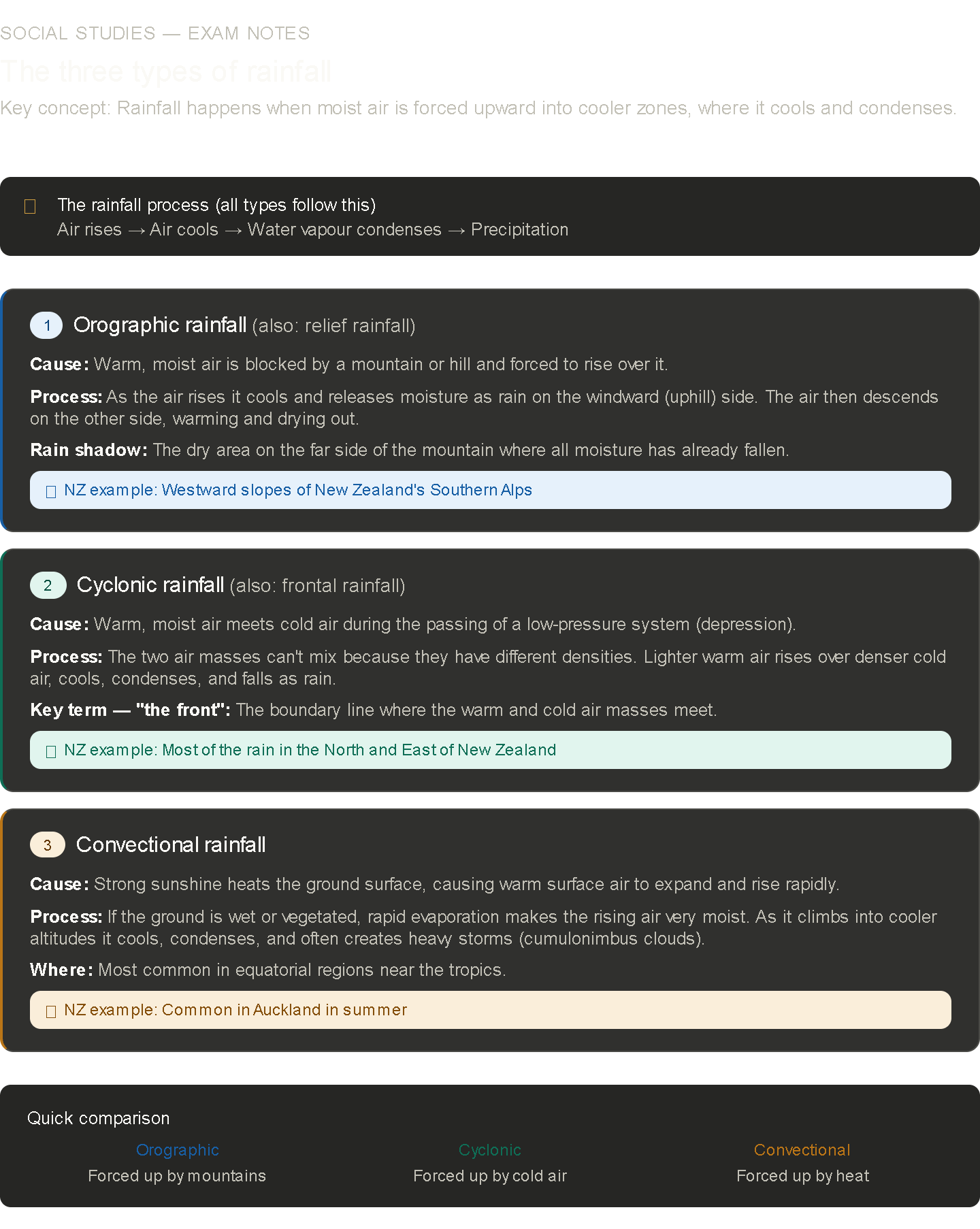
Types of Rainfall
Climate controls
`
What is Climate?
Climate: the weather conditions prevailing in an area in general or over a long period.
What factors influence climate? Controls on Climate.
Latitude
Generally, the closer to the equator a place is located, the warmer the temperature is, while the further away from the equator, the colder the temperature is likely to be. This is because the sun's rays are at less of an angle to the earth and are therefore more concentrated at the equator than at the poles - hence the temperature is warmer). Temperature tends to decrease with distance from the equator - this is known as the temperature gradient.
 |
|---|
How latitude affects temperature.
Altitude.
The higher up you go the colder it gets. Typically you lose 1°C with every 100 meters that you go up in altitude. This is because there is less atmosphere to retain the sun's heat (think of it as a duvet, the thicker it is the warmer it is).

How altitude impacts temperature.
Relief.
Relief features, such as mountains, can influence climate - in particular rainfall. High relief, such as mountains, may produce orographic rainfall. In New Zealand, Westland receives over 3 000 mm of rainfall a year, while Central Otago (in the rain-shadow of the Southern Alps) receives only 600 mm per year.
Relief can also cause wind funnelling, e.g. winds in the gap or opening between mountains in a mountain chain. This occurs in the Cook Strait area, and explains why Wellington is considered by some people to be a very windy place.
Size of landform and proximity to Oceans.
Air temperatures are warmer in summer and colder in winter over the continents than they are over the oceans at the same latitude. This is because landmasses heat and cool more rapidly than bodies of water do. Bodies of water thus tend to moderate the air temperatures over nearby land areas, warming them in winter and cooling them in summer. So for example, most of NZ is close to the ocean. This keeps the climate relatively mild. In summer, sea breezes coming off the ocean, cool the temperature down. In Winter, the ocean is warmer so breezes coming off the ocean tend to warm up the atmosphere. The ocean currents then moderate the climate.
The interiors of large landmasses such as Eurasia (Europe and Asia) are affected least by the oceans and so have greater annual temperature ranges than do coastal areas and the interiors of small landmasses. So in large land masses, there are far greater extremes of climate. Those areas away from the sea are unable to be cooled down in summer by the ocean breezes or warmed up in winter. These inland places then have extremes of climate. This is referred to as a continental climate.
Despite London and Moscow are on similar lines of latitude, London experiences much milder winters and cooler summers than Moscow as it is located closer to the sea.
Sea Temperatures and Currents.
The surface ocean currents have a strong effect on Earth's climate. Areas near the equator receive more direct solar radiation than areas near the poles. However, these areas do not constantly get warmer and warmer, because the ocean currents and winds transport the heat from the lower latitudes near the equator to higher latitudes near the poles.
There are warm and cold currents that circulate our planet and depending on which one is present on the coast this will impact temperature.
Cold Currents = Dry conditions with cool breezes
Warm Currents = Wet conditions with warm breezes
Warm ocean currents warm the air above it, which warms the coast. Cold ocean currents cool the air above it, which cools the coast. This helps keep the coast at a consistent temperature.

Wind and pressure systems.
The world is divided by a series of different pressure belts (either high pressure or low pressure).
At the equator, the air pressure is low as it is so hot. As you would expect, temperatures at the equator are highest. Warm air rises containing evaporated moisture so the air cools, condenses and forms clouds.
Heavy equatorial rainfall occurs (like in the rainforest!)
Polar Regions have high pressure. In between these are the subtropical high-pressure air masses (to the north of New Zealand) and the sub-polar low masses (to the south of New Zeal and, 40-60ºS of the equator). In general, the direction of wind movement is from high to low pressure air masses.
Deserts
Deserts.
Deserts are areas that receive very little precipitation. People often use the adjectives “hot,” “dry,” and “empty” to describe deserts, but these words do not tell the whole story. Although some deserts are very hot, with daytime temperatures as high as 54°C (130°F), other deserts have cold winters or are cold year-round. And most deserts, far from being empty and lifeless, are home to a variety of plants, animals, and other organisms. People have adapted to life in the desert for thousands of years.
One thing all deserts have in common is that they are arid, or dry. Most experts agree that a desert is an area of land that receives no more than 25 centimetres (10 inches) of precipitation a year.
Deserts are found on every continent and cover about one-fifth of Earth’s land area. They are home to around 1 billion people—one-sixth of the Earth’s population.
Although the word “desert” may bring to mind a sea of shifting sand, dunes cover only about 10 percent of the world’s deserts. Some deserts are mountainous. Others are dry expanses of rock, sand, or salt flats.
Kinds of Deserts
The world’s deserts can be divided into five types—subtropical, coastal, rain shadow, interior, and polar. Deserts are divided into these types according to the causes of their dryness.
Subtropical Deserts
Subtropical deserts are caused by the circulation patterns of air masses. They are found along the Tropic of Cancer, between 15 and 30 degrees north of the Equator, or along the Tropic of Capricorn, between 15 and 30 degrees south of the Equator.
Hot, moist air rises into the atmosphere near the Equator. As the air rises, it cools and drops its moisture as heavy tropical rains. The resulting cooler, drier air mass moves away from the Equator. As it approaches the tropics, the air descends and warms up again. The descending air hinders the formation of clouds, so very little rain falls on the land below.
The world’s largest hot desert, the Sahara, is a subtropical desert in northern Africa. The Sahara Desert is almost the size of the entire continental United States. Other subtropical deserts include the Kalahari Desert in southern Africa and the Tanami Desert in northern Australia.
Coastal Deserts
Cold ocean currents contribute to the formation of coastal deserts. Air blowing toward shore, chilled by contact with cold water, produces a layer of fog. This heavy fog drifts onto land. Although humidity is high, the atmospheric changes that normally cause rainfall are not present. A coastal desert may be almost totally rainless, yet damp with fog.
The Atacama Desert, on the Pacific shores of Chile, is a coastal desert. Some areas of the Atacama are often covered by fog. But the region can go decades without rainfall. In fact, the Atacama Desert is the driest place on Earth. Some weather stations in the Atacama have never recorded a drop of rain.
Rain Shadow Deserts
Rain shadow deserts exist near the leeward slopes of some mountain ranges. Leeward slopes face away from prevailing winds.
When moisture-laden air hits a mountain range, it is forced to rise. The air then cools and forms clouds that drop moisture on the windward (wind-facing) slopes. When the air moves over the mountaintop and begins to descend the leeward slopes, there is little moisture left. The descending air warms up, making it difficult for clouds to form.
Death Valley, in the U.S. states of California and Nevada, is a rain shadow desert. Death Valley, the lowest and driest place in North America, is in the rain shadow of the Sierra Nevada mountains.
Interior Deserts
Interior deserts, which are found in the heart of continents, exist because no moisture-laden winds reach them. By the time air masses from coastal areas reach the interior, they have lost all their moisture. Interior deserts are sometimes called inland deserts.
The Gobi Desert, in China and Mongolia, lies hundreds of kilometers from the ocean. Winds that reach the Gobi have long since lost their moisture. The Gobi is also in the rain shadow of the Himalaya mountains to the south.
Polar Deserts
Parts of the Arctic and the Antarctic are classified as deserts. These polar deserts contain great quantities of water, but most of it is locked in glaciers and ice sheets year-round. So, despite the presence of millions of liters of water, there is actually little available for plants and animals.
The largest desert in the world is also the coldest. Almost the entire continent of Antarctica is a polar desert, experiencing little precipitation. Few organisms can withstand the freezing, dry climate of Antarctica.
Sure! Here are the answers based on general knowledge of climate controls:
1. Why is it so hot and rainy in the tropics?
The tropics receive direct, intense sunlight year-round because they sit along the equator where the sun's rays hit at a 90° angle. This concentrated solar energy heats the land and ocean, causing air to rise rapidly. As the warm, moist air rises it cools and condenses, producing heavy rainfall. The cycle of intense heating and rising air repeats constantly, making the tropics both very hot and very wet.
2. Why is it so cold in the polar regions?
The polar regions receive sunlight at a very low angle, spreading solar energy over a much larger surface area, meaning less heat per square metre reaches the ground. They also experience months of total darkness in winter with no solar energy at all. Additionally, the ice and snow covered surfaces reflect most incoming sunlight back into space (high albedo), preventing the ground from absorbing heat. All of these factors combine to keep polar regions extremely cold.
3. Why do temperate areas have more moderate temperatures?
Temperate regions sit between the tropics and the poles, so they receive a moderate amount of solar energy — more than the poles but less than the tropics. They also experience distinct seasons as Earth orbits the sun, meaning temperatures shift throughout the year rather than being extreme in either direction. Proximity to oceans also helps regulate temperatures by absorbing heat in summer and releasing it in winter, buffering against extremes.
Measuring Weather
Weather Instruments — Summary Table
Instrument | What it Measures | How it Works |
|---|---|---|
Thermometer | Air temperature | Liquid (alcohol/mercury) expands up a glass tube when heated |
Barometer | Air pressure | Shows if pressure is rising or falling |
Hygrometer | Humidity | Measures water vapour content in the air |
Rain Gauge | Precipitation/rainfall | Collects rainfall over a set time period |
Anemometer | Wind speed | Spinning cups catch wind and turn a dial |
Wind Vane | Wind direction | Arrow points to where the wind is coming from |
Key Facts to Remember
Thermometer — measures in °C. Liquid expands = temperature rises.
Barometer — rising = sunny & dry (H) / falling = stormy & wet (L)
Hygrometer — measures humidity as a percentage (%)
Rain Gauge — measures how much rain has fallen in millimetres (mm)
Anemometer — spinning cups measure wind speed
Wind Vane — shows the direction the wind is coming from