Space physics
4.8.1 Solar system; stability of orbital motions; satellites (physics only)
4.8.1.1 Our solar system
Content | Key opportunities for skills development |
|---|---|
Within our solar system there is one star, the Sun, plus the eight planets and the dwarf planets that orbit around the Sun. Natural satellites, the moons that orbit planets, are also part of the solar system. Our solar system is a small part of the Milky Way galaxy. The Sun was formed from a cloud of dust and gas (nebula) pulled together by gravitational attraction. Students should be able to explain:
|
|
4.8.1.2 The life cycle of a star
Content | Key opportunities for skills development |
|---|---|
A star goes through a life cycle. The life cycle is determined by the size of the star. Students should be able to describe the life cycle of a star:
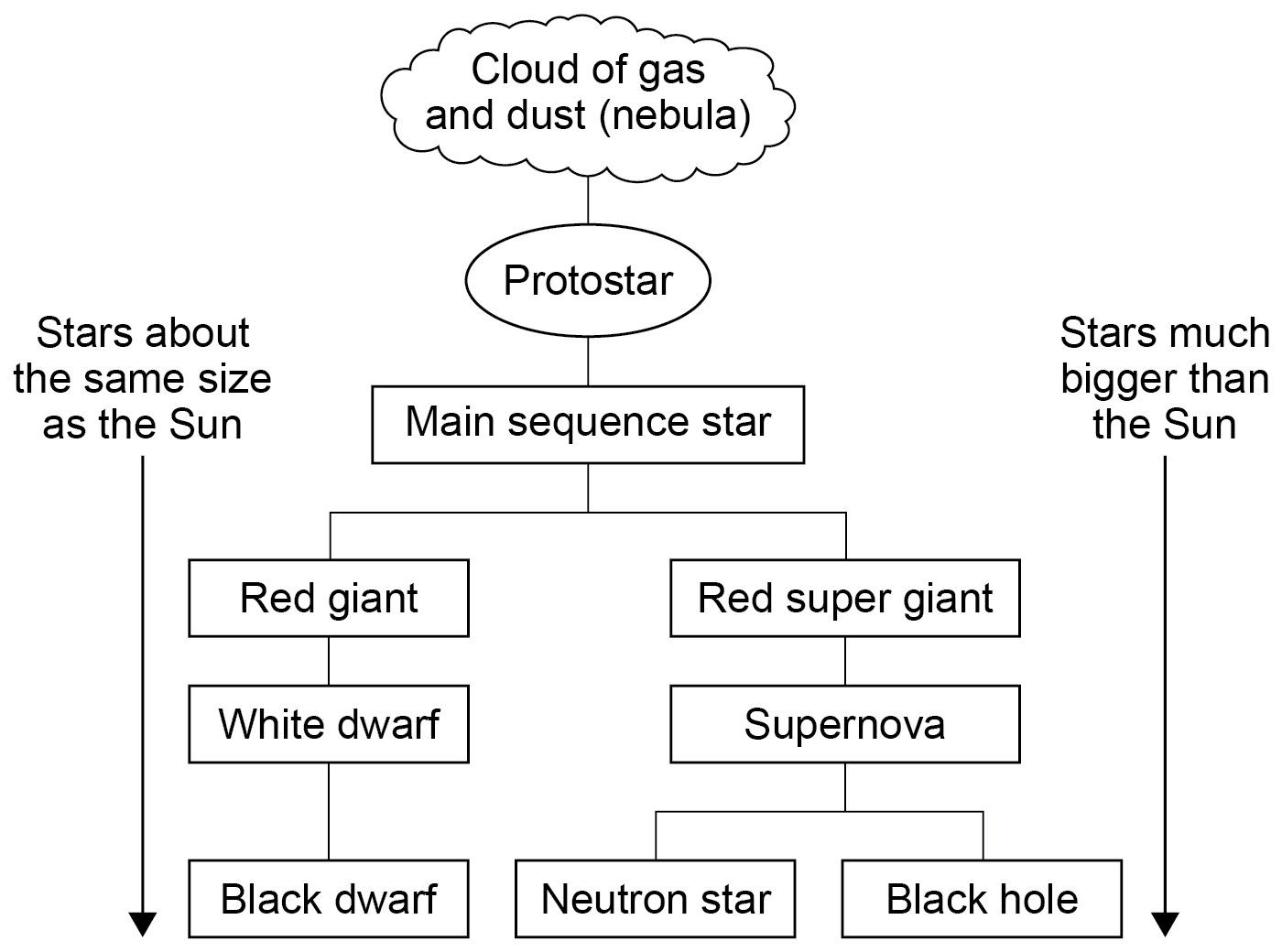 Fusion processes in stars produce all of the naturally occurring elements. Elements heavier than iron are produced in a supernova. The explosion of a massive star (supernova) distributes the elements throughout the universe. Students should be able to explain how fusion processes lead to the formation of new elements. |
|
4.8.1.3 Orbital motion, natural and artificial satellites
Content | Key opportunities for skills development |
|---|---|
Gravity provides the force that allows planets and satellites (both natural and artificial) to maintain their circular orbits. Students should be able to describe the similarities and distinctions between the planets, their moons, and artificial satellites. (HT only) Students should be able to explain qualitatively how:
|
|
4.8.2 Red-shift (physics only)
Content | Key opportunities for skills development |
|---|---|
There is an observed increase in the wavelength of light from most distant galaxies. The further away the galaxies, the faster they are moving and the bigger the observed increase in wavelength. This effect is called red-shift. The observed red-shift provides evidence that space itself (the universe) is expanding and supports the Big Bang theory. |
|
The Big Bang theory suggests that the universe began from a very small region that was extremely hot and dense. Since 1998 onwards, observations of supernovae suggest that distant galaxies are receding ever faster. Students should be able to explain:
| WS 1.2 |
| WS 1.1, 1. 3 |