Current electricity
Current
Electrical current is a flow of charge, it flows from positive to negative.
Electrons flow from negative to positive.
The longer side of the battery symbol is positive.
Q=I*t
Q= Charge [C] coulombs
I= Current [A] amps
t= time [s]
Current in series is the same everywhere.
Current in parallel splits and recombines at junctions (not necessarily equally).
Potential Difference — Voltage
Voltage is the amount of energy per Coulombs (energy each unit of charge has).
E=V*Q
E= Energy [J] joules
V= Voltage [V] volts
Q= Charge [C] coulombs
Voltage splits across all components in series.
Voltage is the same across all branches in parallel.
Resistance
How difficult is it for current to flow.
Good conductors have very little resistance.
Ohms law:
V=R*I
V= Voltage [V] volts
R= Resistance[Ω] ohms
I= Current [A] amps
Everything follows Ohms law.
But when a component “obeys the Ohm’s law” resistance is constant.
Light bulb
When the current increases the temperature increases.
As the temperature increases the particles in the filament gain KE and vibrate more.
This makes it hard for current to flow, so resistance increases
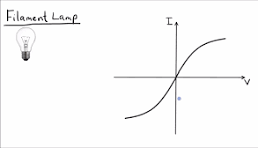
For a filament lamp, we also draw the negative (current flows the other way)
But a light bulb is not affects by current direction, so it looks the same, just with negative values
Light bulb does not obey the Ohm’s law
LDR — Light dependent resistor
As light intensity increases, resistance decreases
Thermistor
As the temperature increases, resistance decreases (opposite to light bulbs/wires)
Diode
Only allows current to flow in one direction
Protects microchips from current in the wrong direction
Wires
As the length increases, the resistance increases. It is linear