Exam Study Guide
Overview:
25 MCQ
3-7 questions per chapter
1 Table + 1 Figure
3+ Questions from Quizzes
Spatial arrangement patterns:
• Random, if the position of each individual is independent of the others
• Clumped, if the quality of the habitat is patchy or the organisms are social
•Uniform, negative interactions occur among individuals, spacing them out evenly
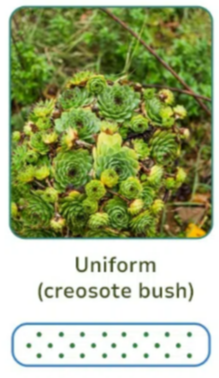
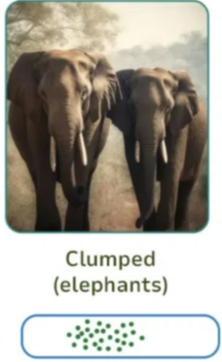
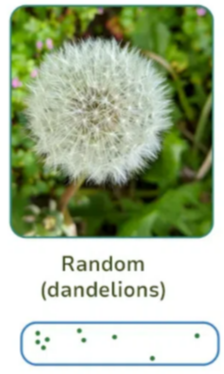
Altruism
• Altruism—behavior that has a fitness cost to the individual exhibiting it and a fitness benefit to the recipient
This is Paradoxical; alleles that make an individual more likely to be altruistic should be selected against
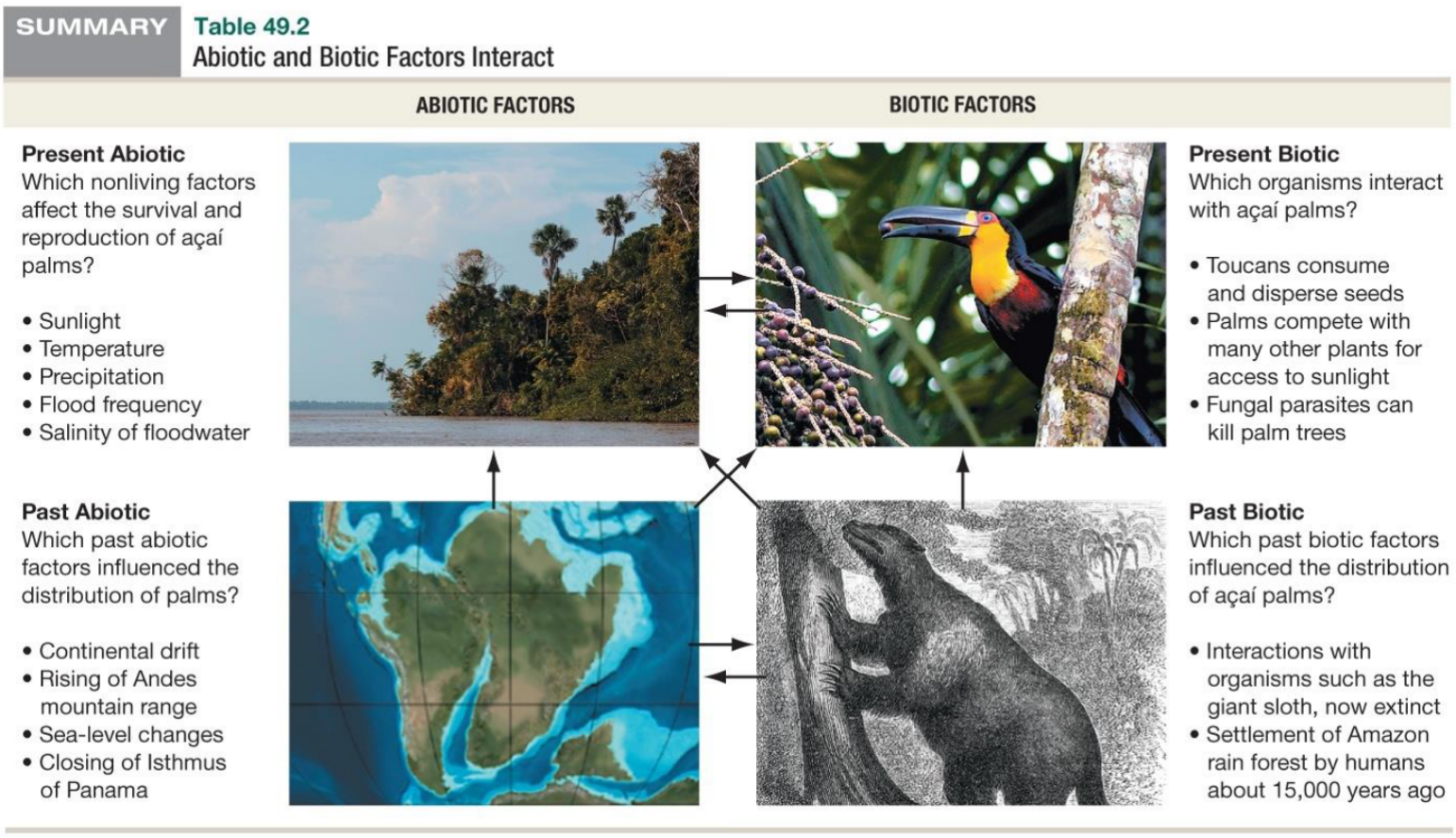
Biotic vs Abiotic Factors
• Abiotic: all the non-living elements that set the scene and influence the actions of the players (the living organisms)
Sunlight
Temperature
Water
Soil
Air
Rocks and Minerals
• Biotic: the living organisms that interact with each other and their abiotic environment
Producers
Consumers
Decomposers
Behaviors
Instinct: Genetically programmed behavior occurs from day one
Example: A newborn baby knows how to suckle for nourishment. A spider knows how to spin a web.
Fixed Action Pattern: A stimulus produces a series of actions that occur until completion( behavior will complete and action will not stop until behavior is complete.)
Example: A greylag goose will instinctively retrieve an egg that has rolled out of its nest. Even if you remove the egg mid-retrieval, the goose will continue the motions of rolling the (nonexistent) egg back to the nest.
Imprinting: imprinting is any kind of phase-sensitive learning that is rapid and apparently independent of the consequences of behavior
Example: Ducklings following the first moving object they see after hatching, typically their mother.
Associative Learning: style of learning that happens when two unrelated elements become connected in our brains through a process known as conditioning.
Example: Classical conditioning (Pavlov's dogs learning to associate a bell with food) and operant conditioning (learning through rewards and punishments).
Trial & Error Learning:fundamental method of problem-solving characterized by repeated, varied attempts which are continued until success
Example: A cat learning to navigate a maze to find food.
Habituation: Learning to ignore a stimuli that would produce a behavioral response
Example: Living near a train track and eventually not noticing the sound of the trains passing by. Or the boy who cried wolf story how they ignored him after so many cries of wolf.
Observational Learning: Watching another organism and mimicking their behavior
Example: A young chimpanzee learning to use tools by observing its elders.
Insight: Problem-solving with tools
Example: A crow using a stick to retrieve food from a deep crevice.
Biomes
• Plant communities
• Determined by abiotic conditions (weather and climate)
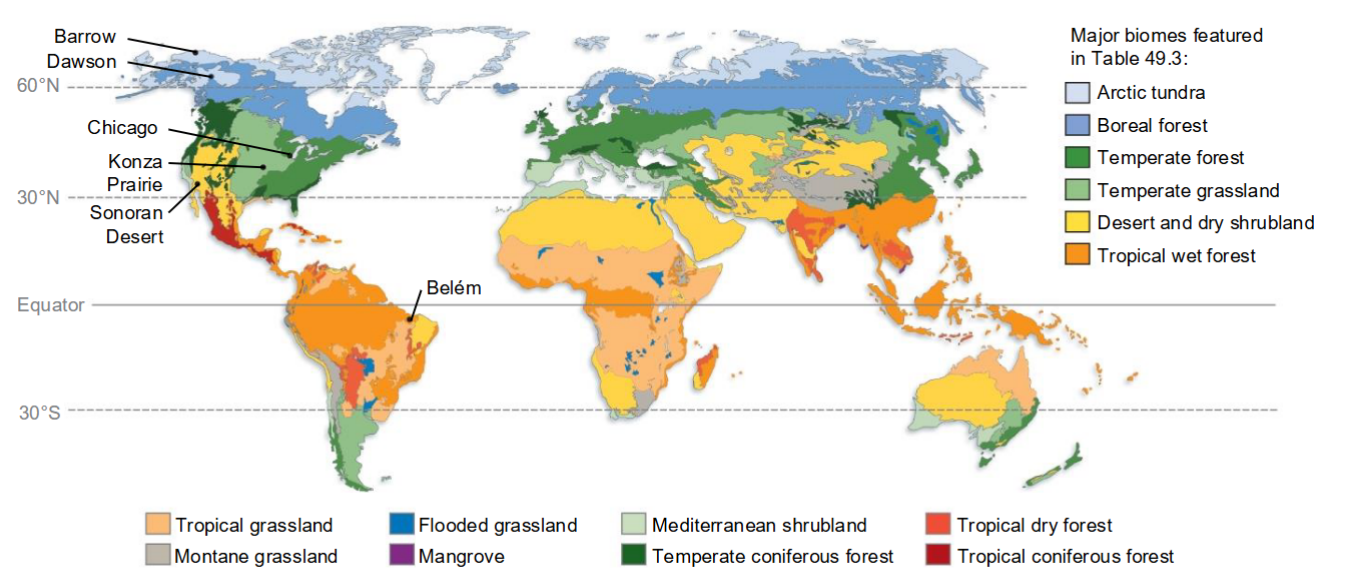
Terrestrial Biomes
Tundra: Treeless plains with permafrost; high latitudes and altitudes; cold, dry, windy.
Taiga (Boreal Forest): Coniferous forests; northern hemisphere; cold winters, short summers, moderate precipitation.
Temperate Deciduous Forest: Deciduous trees (lose leaves seasonally); mid-latitudes; warm summers, cool winters, moderate precipitation.
Temperate Grassland: Grasses dominate; mid-latitudes; hot summers, cold winters, less rainfall than forests.
Tropical Rainforest: Dense, diverse forests; near the equator; hot and humid year-round, high rainfall.
Desert: Sparse vegetation; around 30° N/S latitude; extremely dry, hot days, cold nights.
Savanna: Grasses with scattered trees; tropical regions; warm year-round, wet and dry seasons.
Aquatic Biomes
Freshwater:
Lakes and Ponds: Standing bodies of freshwater; variable sizes and depths; temperatures vary with depth and season.
Rivers and Streams: Flowing freshwater; variable sizes and speeds; temperatures vary with location and source.
Wetlands: Water-saturated soil; swamps, marshes, bogs; high biodiversity; important for water filtration.
Marine:
Oceans: Vast saltwater bodies; cover most of Earth; temperatures and salinity vary with depth and location.
Coral Reefs: Shallow, warm waters; high biodiversity; built by coral polyps; sensitive to temperature changes.
Estuaries: Where rivers meet oceans; brackish water (mix of fresh and salt); important nurseries for many species.
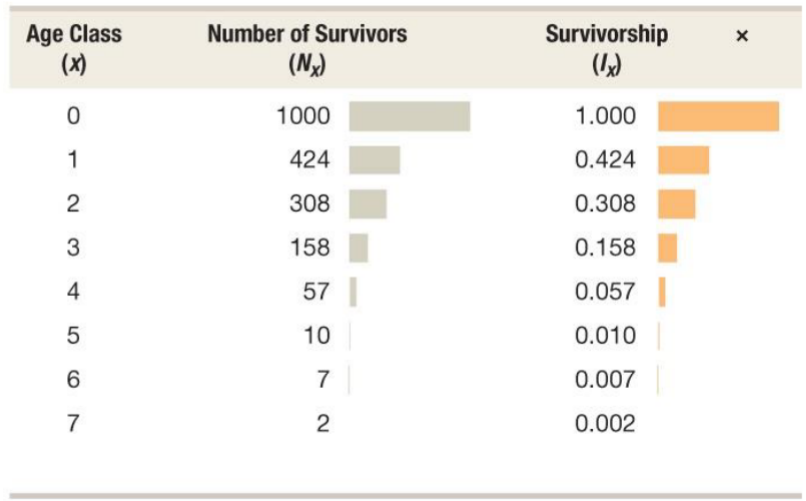
Life Table
• A life table summarizes the probability that an individual will survive and reproduce in any given time interval over the course of its lifetime
• Two approaches
Track particular individual over their entire lifetime for short-lived species
Take “snap-shot” of age structure of population at one particular time for long-lived species
Fecundity (high|low) - Pros vs Cons
• Fecundity refers to the reproductive potential of an organism; how easily and how often it can produce offspring.
• Age-specific fecundity is the average number of female offspring produced by females in each age class
• High Fecundity: Many insects, fish, and plants produce large numbers of offspring with little parental care.
Pros:
Increased chance of offspring survival
Rapid population growth
Greater genetic diversity
Cons:
Lower parental investment
Higher competition
Greater risk of overpopulation
• Low Fecundity: Mammals, especially large ones like elephants and whales, typically have few offspring but invest heavily in their care.
Pros:
Higher parental investment
Reduced competition
More stable populations
Cons:
Increased risk of extinction
Slower population growth
Lower genetic diversity
Navigation
• Piloting: is the ability to navigate using familiar landmarks. Animals create a mental map of their surroundings and use visual cues
Ex: Many birds, especially those that migrate short distances, use piloting. Squirrels also use piloting to locate buried food
• Compass orientation: moving in a specific direction, often using a "biological compass" to maintain a consistent bearing. Animals can use the sun, stars, or Earth's magnetic field for orientation.
Ex: Insects, Birds migrating long distances often use compass orientation, especially when flying over featureless landscapes like oceans. Monarch butterflies use a sun compass to navigate during their long migrations.
• True navigation: the ability to determine one's current location and navigate to a specific destination, even if the route is unfamiliar.
Ex: Sea turtles use true navigation to return to the same beach where they were born to lay their eggs. Homing pigeons
Predatory Defence
• Cryptic Coloration: This is camouflage that helps an animal blend seamlessly with its surroundings. It can involve matching the colors, patterns, and even textures of the environment.
• Mimicry: One animal evolves to resemble another species(this other species is usually known to be dangerous in some way ex: poisonous).
• Escape Behavior: This involves rapid movements or agile maneuvers to evade a predator.
• Toxins: Producing or accumulating poisonous substances that deter predators. These toxins can be injected, sprayed, or released upon contact.
• Schooling: Large groups of fish or other animals swimming together. This can confuse predators, making it difficult to target a single individual, and it also increases the chances of detecting a predator.
• Armor: Hard, protective coverings that make it difficult for predators to injure the animal.
Evolutionary arms race
(ongoing struggle between interacting species, where each evolves adaptations and counter-adaptations in response to the other. It's like a constant back-and-forth, with neither side gaining a permanent advantage.)
Prey: Driven by the very real need to not be eaten, they evolve a wide array of defenses to avoid becoming prey (camouflage, speed, toxins, etc.).
Predators/Omnivores: Driven by the equally strong need to eat, they evolve strategies to overcome those defenses (better eyesight, speed, resistance to toxins, etc.).
• Red queen hypothesis-This means that even though both predator and prey are evolving, they often remain in a relative stalemate. As prey evolve better defenses, predators must evolve better offenses just to keep up. Neither side necessarily "wins" in the long run.
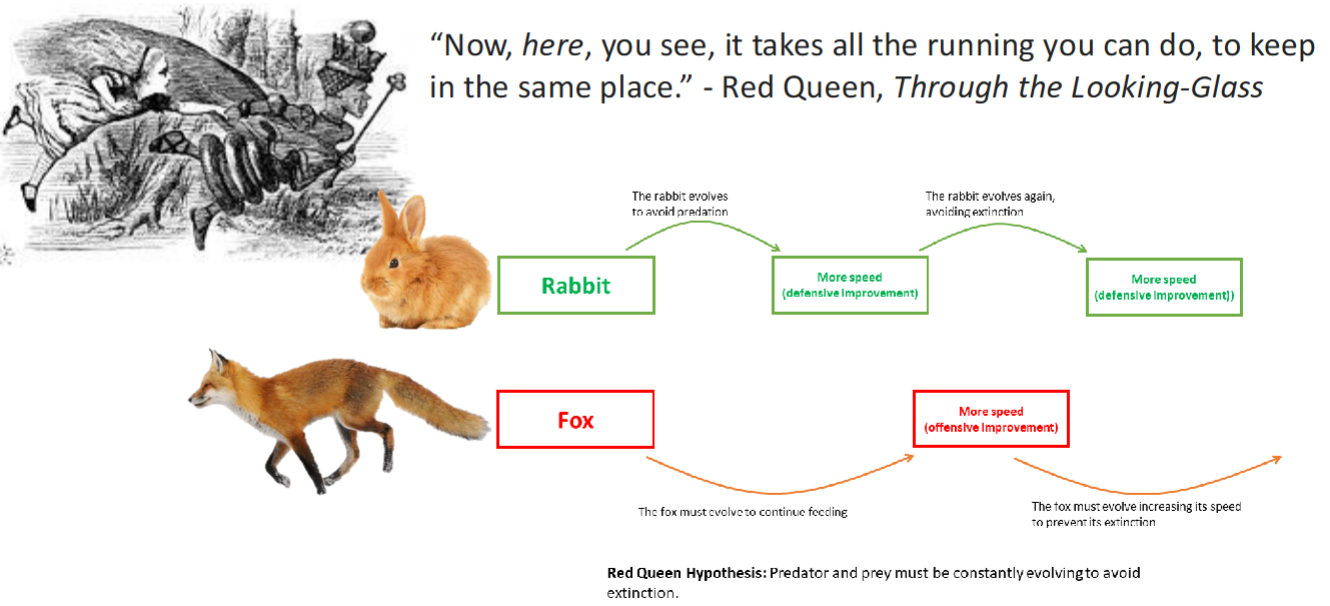
Figure:
Hadley Cells (Global air circulation patterns affect rainfall)
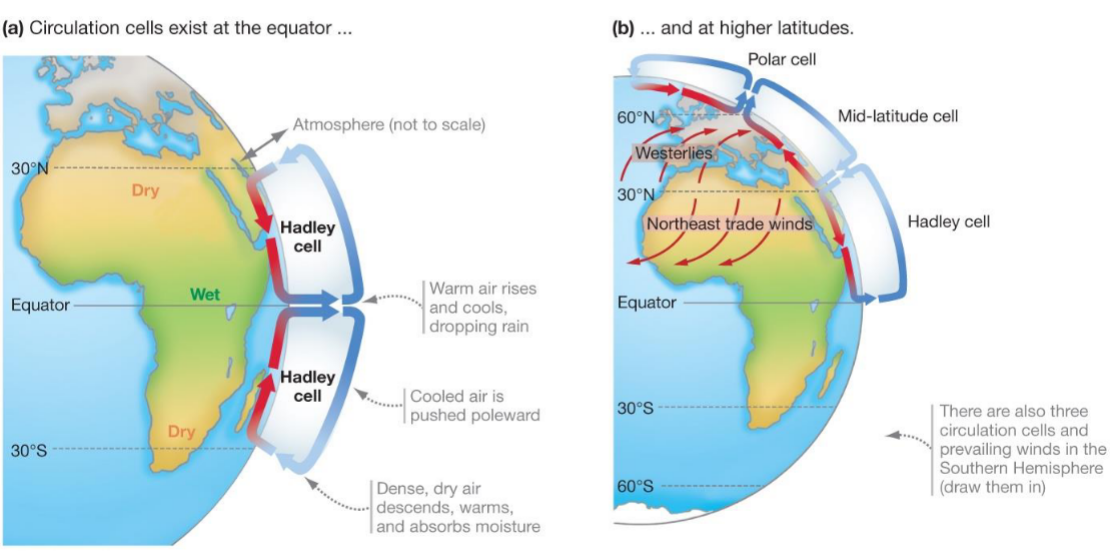
Table:
Types of interactions - summary
Types of Interaction Fitness Effects Short-Term Impact: Distribution & Abundance Long-Term Impact: Coevolution |
Commensalism +/0 Population size and range of commensal may depend on population size and distribution of host. Strong selection on commensal to increase fitness benefits in relationship; no selection on host |
Competition -/- Reduces population size of both species; if competition is asymmetric, the weaker competitor may become locally extinct, or it may retreat to a part of its niche that does not overlap with the stronger competitor. Niche differentiation via selection to reduce competition |
Consumption herbivory predation parasitism +/- Impact on prey population depends on predator density, prey density, and effectiveness of defenses. Strong selection on prey for effective defense; strong selection on consumer for traits that overcome defenses; coevolutionary arms races result |
Mutualism +/+ Population size and range of each species depend on those of the other species. Strong selection on both species to maximize fitness benefits and minimize fitness costs of relationship |