AMST Lecture 2
“Decolonization is not a metaphor” - Tuck and Young(2012)
“Settle colonialism and the elimination of Native” - Patrick Wolfe(2006)
Pages 6-8 Settler Colonialism
1) Destroys to replace
2) Structure not an event
3) There is both internal and external colonial aspects
Introduction: “This Land” + Chapter 1: “Follow the Corn”
“Writing US history from an Indigenous peoples’ perspective requires rethinking the consensual national narrative.”
The problem for Dunbar-Ortiz, is not missing facts. It it the framework that makes conquest seem natural, inevitable, or peripheral. US history makes Indigenous people seem like they are just side characters.
“Nation, race, and class converged in land.”
In indigenous perspective “land is not property, land is your relative”
Land: Territory cultivated, governed, defended and made meaningful by the indigenous
Property: Colonialism transforms land in “real estate”
Power: Who controls land and determines authority
“Land is life—or, at least, land is necessary for life.”
Manifest Destiny
Colonist believe they have the right to conquer
Where all this is talking about
Lecture 3
Origin stories are political
Puritan covenant
A sacred entitlement narrative: settlers imagine a divine mandate to take land
Terra Nulius=Land of no one
Columbus myth
The nation is symbolically tied to “discovery”, even though Columbus never reached the territory claimed by the US
Doctrine of Discovery
European claims of “discovery” became a legal-theological structure for subordinating indigenous land rights
The problem with “balanced” history
“In striving for ‘balance,’ however, historians spouted platitudes.”
Cultural conflict can flatten unequal relations of conquest into symmetrical misunderstanding
Language such as “encounter” and “dialogue” can obscure dispossession and organized violence.
• For Dunbar-Ortiz, historiographical neutrality becomes a problem when it refuses to name colonial structures.
Why multicultaralism is no decolonization
“The fundamental unresolved issues of Indigenous lands, treaties, and sovereignty could
not but scuttle the premises of multiculturalism.”
Multicultural inclusion
Adds indigenous “contributions” to a national story whose basic structure remains intacts
Colonial relation
Indigenous nations are territorially and treaty-based peoples, not simple another racial/ethnic minority
Decolonial stakes
Land, treaty obligations, jurisdiction, restitution, and soveriegnty challenge the nation’s possessive foundations
Words to know
Sovereignty means having the power to control your own land and make your own rules without outside interference.
Settler sovereignty -
Indigenous sovereignty -
Settler colonialism - inherently genocidal
“The objective of US colonialist authorities was to terminate their existence as
peoples—not as random individuals.”
Genocide targets entire groups, destroying their land, culture, political systems, and future. It includes actions like forced removal, child transfer, land seizure, and assimilation, which are interconnected aspects of this destruction.
Violence is institutional, not accidental
“Settler colonialism, as an institution or system, requires violence or the threat of
violence to attain its goals.”
People do not simply surrender land, resources, children, and futures.
Expansion therefore depends on coercive institutions and organized force.
Framing violence as equal conflict between cultures can blur asymmetry between colonizing and colonized powers
Genocide as an analytic tool
Five acts named in the convention
• Killing members of the group
• Causing serious bodily or mental harm
• Inflicting destructive conditions of life
• Preventing births
• Forcibly transferring children
Dunbar-Ortiz’s application
She uses the convention’s categories as historical tools for interpreting U.S.–Indigenous relations: massacres, removals, military occupation, boarding schools, and other policies are read as connected practices rather than isolated episodes.
Erasure after conquest: “firsting and lasting”
“Anishinaabe (Ojibwe) historian Jean O’Brien names this practice of writing Indians out of
existence ‘firsting and lasting.’”
“First” settlers
Local histories narrate Euro-American founders as if places had no prior peoples or political histories
“Last” Indians
Stories of the “last” person or tribe imagine Indigenous disappearance as completed and irreversible
Effect
Erasure converts ongoing Indigenous presence into a vanished past, helping normalize settler possession
Reservations: reversing the story of possession
“Rhetoric changed so that reservations were said to have been ‘given’ or ‘created’
for Indians.”
Earlier treaty logic: an Indigenous nation reserved a reduced portion of a much larger land base.
• Later settler narrative: the U.S. government benevolently “gave” public land to Indigenous peoples.
• The rhetorical reversal hides prior Indigenous ownership and recasts dispossession as generosity
Chapter 1: “Follow the Corn”
“America is ancient, not a ‘new world.’”
Chapter 1 reconstructs the precolonial Americas as old, populous, agricultural, urban, interconnected, politically organized, and These are to own their own culture, and that's how they will be white people under black skin or brown skin. That's the point of assimilation, and Rosa and Dunbar, these things, are on the same level. When we say assimilation, assimilation is also genocide because assimilation means cultural genocide. Genocide does not mean only killing people physically. You can kill an entire culture by establishing what is good. That is a bigger concept of murder and genocide rather than just killing one person or maybe a number of people. Violence is institutional, not accidental. Please remember this point. This is kind of summarizing the whole article. This is institutional, not accidental. As I have said in the past, colonialism as an institution or system requires violence or the threat of violence to achieve its goals. This is one of my recent projects right now. What I am trying to say in my research is that violence is a tool to shape someone's identity these days. Someone can be an actor of violence, and someone can be a sufferer of violence executed against them: your identity, my identity, somebody else's identity, whatever. I am trying to say these days, in the 21st century, all over the world, our religion or culture is not shaped by violence. Our language is not shaped by violence. Either you do violence or you are a sufferer of violence, and violence is that identity which is created through violence. I own a pawn shop. I have an assistant who is maybe 12 years old, and I can slap that poor girl or boy anytime I want. That's how I do violence against him, but some goons came up who are called goons. They came to my shop, broke my jaw, beat me, took my things, and then they fled. What they have done is they have acted with violence against me, but I was the one actually doing violence against them. You see, my identity here is shifted. I was doing violence, and I can also get violence from others. The identity that we have in society is very fluid. Finally, what we do, what we behave, and the way we behave with others, violence is one of the four constituents of our identity. That's my research. When we do settler colonialism, people do not simply surrender land, resources, children, or futures. Expansion therefore depends on coercive institutions and organized force. Framing violence as equal conflict between cultures was necessary to frame violence as equal conflict. You understand what I'm trying to say? You need organized force to execute all this because people are not going to just give their children up. People are not going to just surrender land. The way the Indigenous history we see written in the white people's history books is not telling us the whole truth. That has been organized by the Integral 10, and that's why their number is so low right now. Now, here, five very important acts have been mentioned by local Dunbar Ortiz. Genocide: What are the main aspects of it?
Gaining members of the group
Causing serious bodily or mental harm
Inflicting destructive conditions of life
Preventing births
Possibly transferring children
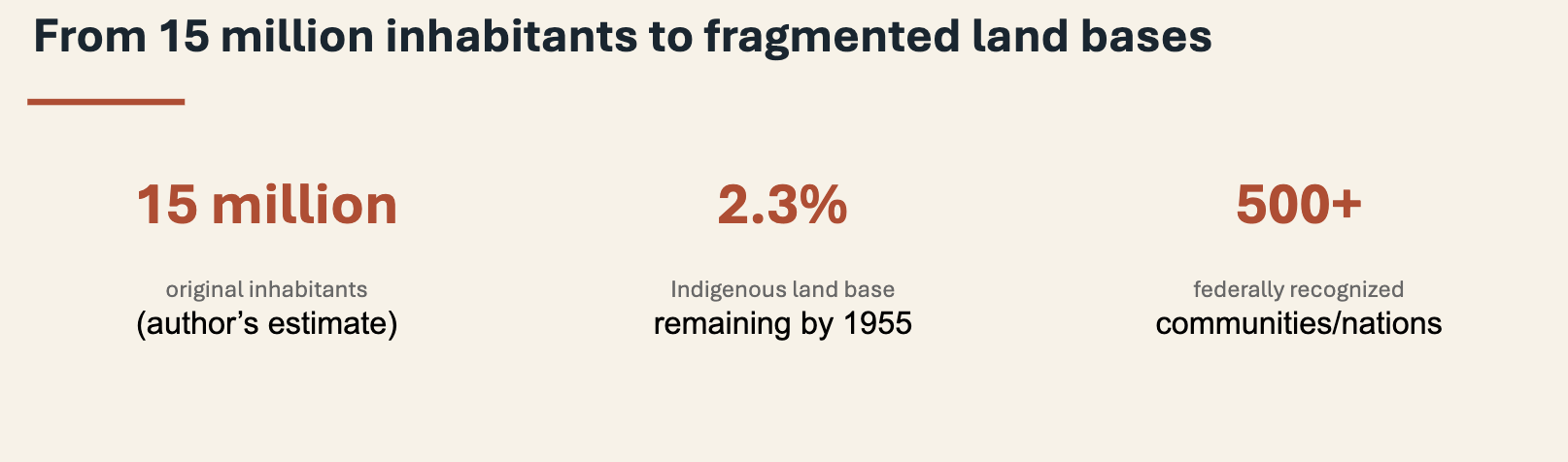
Now, think of all this and think of any Indigenous nation's history. Is there anything that did not happen to Indigenous nations? By definition, genocide is this: now, with the Indigenous nations, all of those things happened. Not just one thing happened and the other thing happened later. All those things happened simultaneously, right? Ortiz uses the convention categories as historical tools for interpreting U.S.-Indigenous relations. Massacres, removals, military occupation, boarding schools, and other policies are read as connected practices rather than isolated episodes. These are not isolated episodes. These have been very much practically taught and executed to benefit one particular race, which is the white race, and demonstrations they have to go, right? Settler colonialism is inherently genocidal. Remember this point: inherently genocidal. When you define settler colonialism, if you forget whatever I have said so far, that's okay. Just remember this point: settler colonialism is inherently genocidal because the idea itself is that I will go there, I will destroy to replace. How can I destroy without doing genocide? The very concept is genocidal, and Ranmar Ortiz showed us that picture very clearly: erasure after conquest. First thing and the last thing. Anishinaabe historian Gen O'Brien changed this practice of writing in the South of existence: first thing and last thing. Okay, anybody has any idea regarding first thing and last thing? Yeah, in the historic context that you were talking about, it's true that the first building moved by a white society, while everything that you heard about the last, the last of Indigenous society was on the area of land. When you establish that last, that means they're gone. They do not exist anymore. That ulterior motive, the discussion point, is that they are gone. The way European history is written tries to tell us that before Columbus there was no history here. Before the arrival of colonial people, there was no history. Yes, with the settlers coming to this land, history starts. That's my dear experience here. What is lasting? Tourists of the lands go around to the person or try imagining his/her disappearance as complicated and irreversible. Their existence is gone, and they go away, and that's one thing. At the same time, you can't reverse that history, that being Indian settlers. I'm someone who is living in a normal area, being an ally in that particular setting. What we want to do is challenge that first thing and last thing. In history, the way it has been shaped, we also challenge that concept, which is saying, if you are a settler, by establishing oral history in the uniform, by establishing the stories of Indigenous translations and by reclaiming those stories and by many other things such as language intervention programs, bit by bit, that irreversible concept is being challenged. Now you might say, are they strong enough against that very powerful colonial regime? That's where many people get frustrated. One of my very favorite professors, Gawri Salaam Ananthas, I highly recommend. As an Indian professor, I learned from her a lot. In one of her classes, she said, "For how many years has colonization been in power?" We roughly say 550. She said, "If you talk about decolonization, don't you think it will take the same amount of time or more?" Decolonization is not something that can rapidly happen. That can happen overnight, and the next day you see a brighter future. The idea of a brighter future is an idea. We all have to work for it, and finally, maybe we are not going to benefit, but someday we might hope that one generation could benefit. It will take time because it is strong. What is the effect of it? Irradiation, on birth, going into a vanishing present, into a vanished past, vanishing Indians. That is another concept: vanishing Indians. What I would take out of this text when we read as students: remember some key words. You don't have to remember everything that is in there. That is written by Ortiz. You have to remember certain key words and work on it. I said I want a personalized voice when you write your discussion post. Even if you do not write the whole summary of the text, that's okay, but tell me how it affects you or if it does affect you at all. If you can pick some of the vocabularies and say how Dunbar Ortiz portrayed that and how we should react to it, that should be enough. Eurasia converts ongoing Indigenous presence into a vanished past, helping to normalize settler possession. That's what it is: reservations reversing the story. What's the time? What's the time? How are we in that time? Rhetoric change: reservations were said to have been given or created for Indians. See, this is funny: you are giving Indigenous people their land. I mean, a reservation is not their land because that's after full migration. A piece of land is given to them, a place to live which is devoid of all kinds of benefits, but that's not the point. This rhetoric has been shifted in history. We are the benevolent, right, in our own regime, to have that kindness and to give some pieces of land to Indians, so that they can live. We created reservations for Indians, and that's, again, another irony. You have claimed this land as yours, and then you are giving me my land, and you are giving me that particular land which I did not want because that was not where I lived my entire life. You forcefully migrated me somewhere, and then you are saying, "Okay, I'm kind enough to give you something." Earlier, treaty logic: an Indigenous nation reserved a reduced portion of a much larger land base. Later, the central narrative is shifted this way: the U.S. government very willingly gave public land to Indigenous peoples. The rhetorical reversal hides prior Indigenous ownership, and we cast this as generosity. What's the result of it? Creation of reservations. The author's estimate is that original inhabitants were about 15 million. Indigenous land bases remain, by 1955, at 2.3%, then federally recognized communities and nations by women's class. Now, here, when we are learning these numbers, numbers here are not merely demographic. Do you think they are just demographic numbers? No! They show the material relationship between territorial loss, legal fragmentation, and the endurance of Indigenous communities. Any thought on this? Anyone? Anyone have anything to say? How is this? How this is like the endurance of indigenous communities, like material relationship between territorial loss and legal fragmentation and the endurance of indigenous communities, how is that? Okay, let me clarify just one very simple thing, so you, because of that territorial loss, legally what happens is that you are supposed to live in one part of the land, but many indigenous nations have come out of that land to get better life. And that's how we get the concept of urban Indians. And the government is trying to say oh we get them their land but still we let them come to our life, live with us like normal human beings. We have a very good identity, but in that way what's happening is that or what happened is that the people who moved out of their reservation they got more isolated from not only that land but also that culture but also that language and that's why the modern generation of Indians mostly do not speak their language and that something happened. Bit by bit meticulously because the government wanted this to happen. Okay? Yeah? Also part of the legal fragmentation part may these tribal lands also know very fragmented or checkerboarded in their ethical design to make living in them sort of kneeling possibly very difficult? Yeah. It is designed that way so that the next generation comes out of that land becomes assimilated with the white power and white culture and forget their own. Right? Okay. So now oh I guess finished introduction on chapter one from here. Okay. Follow the corn. Now this concept is very important. America is ancient not a new world. Dunbar-Ortiz is trying to say that pre-colonial America's has old populist agricultural urban interconnected politically organized and environmentally managed. The argument directly contest the settler premise that colonists entered empty or underused land. It is very important. All of the corn this particular name is given because Dunbar-Ortiz showed us the pre-colonial America was not something which was told, or they did not have any communications. Dunbar-Ortiz showed us that there was a very huge threat system and there were farmers and some indigenous nations were cultivators. They were already doing well and this land was not underused land. This was not empty land. This was already a very fertile and of course many indigenous nations were very rich. Think about the Navajos, Navajos were rich. They were the best weavers, they were the best farmers in this part of the world but the settler premise was that okay we went there, it's a barren empty land claimed by no one so we use that so when Jan Baroti says America is ancient, the author is contesting the idea of discovery, the idea of new world. There is no new world, there is nothing discovered. Something that is conquered for sure but nothing discovered. Okay!environmentally managed. The argument directly contests the settler premise
that colonists entered empty or underused land.
Lecture 3
Choose one quotation and answer all four questions.
• “Nation, race, and class converged in land.” (p. 1)
• “America is ancient, not a ‘new world.’” (p. 15)
• “The system of decision making was based on consensus, not majority rule.” (p. 25)
• “North America in 1492 was not a virgin wilderness but a network of Indigenous nations.” (p. 30)
1) What assumption is being challenged? 2) What evidence supports the claim? 3) What key term needs
definition? 4) How does the passage change the conventional U.S. historical narrative?