Lecture: SLE123 – Physics for the Life Sciences, Lecture 5 (Motion – Part 2).
Seminar this week reviews last week’s material (distance, displacement, speed, velocity, acceleration). • Bring a calculator and any questions.
Experimental-demonstration assessment: • Group formation opens tomorrow 04:00; close Thursday 31st, 20:00. • Join via Tools → Groups (1 – 200). Groups of ≤4. • Read the posted instructions & rubric, start brainstorming immediately.
Seminar slide decks are uploaded at the end of each week.
Review of Motion Concepts
Speed (scalar): magnitude only.
Velocity (vector): magnitude and direction. v=ΔtΔx,Δx=x<em>f−x</em>i
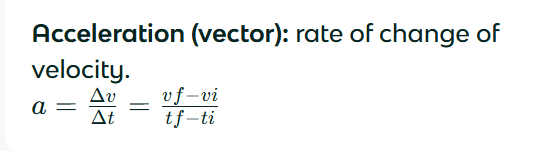
Acceleration (vector):
SI units: velocity ms−1, acceleration ms−2.
Kinematic Equations (Uniform Acceleration, 1-D)
v<em>f=v</em>i+at ( no Δx )
Δx=2v<em>f+v</em>it (mean-speed theorem, no a)
Δx=v<em>it+21at2 (no v</em>f)
v<em>f2=v</em>i2+2aΔx (no t)
Missing-variable trick:
If a problem lacks time ⇒ use (4).
If it lacks displacement ⇒ use (1).
If it lacks acceleration ⇒ use (2).
If it lacks final velocity ⇒ use (3).
Conventions & scope for this unit:
Acceleration is constant and motion is straight-line.
Horizontal: use x; vertical (free-fall, next lecture): swap x→y and a→g=9.8ms−2 (downward).
Problem-Solving Strategy
Sketch / axis diagram of the motion.
List knowns & unknowns (identify variables, note units & sign).
Choose the kinematic equation containing the unknown but not containing any additional unknowns.
Convert to SI units before substituting (e.g. kmh−1→ms−1, minutes → seconds).
Solve algebraically, keep full calculator precision until the final step, then round.
State answer with units & direction (or “magnitude only” if specified).
Key words:
“from rest” ⇒ vi=0.
“comes to rest” ⇒ vf=0.
“free-fall” ⇒ a=g (downwards ⇒ negative in up-positive axes).
Significant Figures & Algebra Tips
Retain all digits internally; round the displayed answer.
Square-rooting a negative indicates a sign or algebra error.
Dozens of older notations (u,v,s) exist; symbols do not change the physics, but course uses v<em>i,v</em>f,a,t,Δx.
Example Problems Walk-Through
(Equations chosen via the missing-variable rule; answers rounded appropriately.)
1 Airplane Take-Off Roll
Given: vi=0, a=3.2ms−2, t=32.8s. Use (3): Δx=0⋅t+21at2=21(3.2)(32.8)2=1.72×10³m.
2 Race Car
(a) Acceleration from 18.5 to 46.1ms−1 in 2.47s. • (1): a=2.4746.1−18.5=11.2ms−2. (b) Distance covered in that interval. • (4): Δx=2×11.246.12−18.52=79.8m.