8. Semantics
Many people have fals sense od how languages are related to reality and each other
Reality:
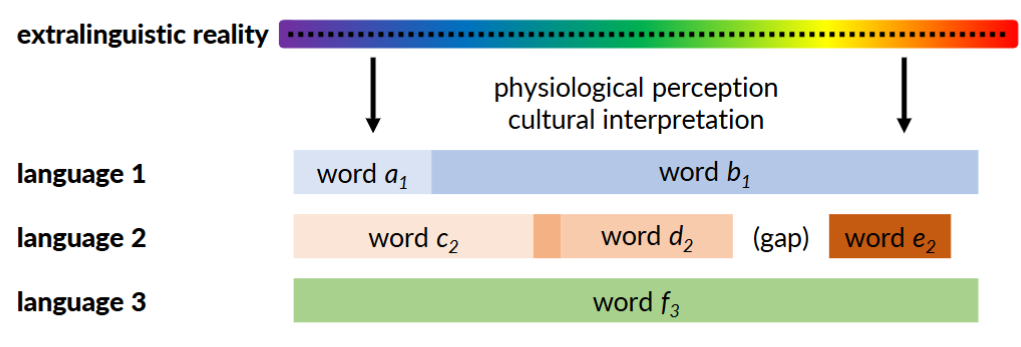
e.g. eat = essen/fressen
→ way human culture classifies phenomena of world into types is arbitrary
Traditional classification (Aristotelian)
categories defined by checklist of properties shared by all members
only two options: in or out
all members of category equally good examples
Prototype theory (Eleanor Rosch)
categories based on overall similariry with central prototypical member
include good examples and less good peripheral members
fuzzy boundaries
More complex semantic structures:
Cognitive linguistics
words not stored separately but organised in coherent structures of world knowledge
Frame: pattern/situation with functional slots (e.g. birthday party: cake, balloons, sweets, gifts, …)
Script: sequence of events (e.g. dining out: reserve table, go there, enter, greet, …)
Meanings of meaning
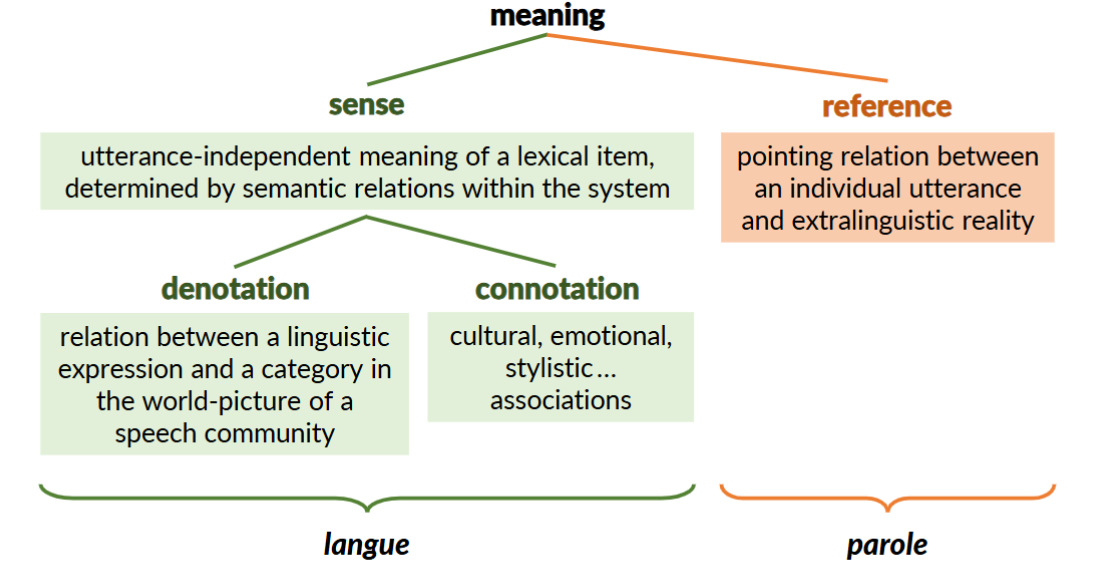
The meanings of a word
Polysemy: multiple meanings of a word (e.g. star) ←—→ homonymy (coincidental), polysemous words historically related
Polysemy often based on cognitive patterns
Metaphor based on similarity
Conceptual metaphor maps entire domain onto another e.g. knowledge is light
Metonymy based on contiguity e.g. co-occurence in reality
Syntagmatic semantics
Collocation: statistically significant co-occurence of words e.g. sour milk, to go crazy
Selection restrictions
Paradigmatic semantics
synonymy: (near-) sameness of meaning e.g. mist, fog
antonymy: oppositeness of meaning
small/large → gradable antonymy (opposite ends of scale)
alive/dead → complementary antonymy (if one true, other must be false no inbetween)
teacher/pupil → converse antonymy (if one exists other must also exist)
to open/to shut → directional antonymy (opposite directions)
Hyponymy: class inclusion e.g. duckbilled platypus - mammal - animal
Semantic change
Important types:
generalisation: unkembed “not combed” → unkempt “untidy”
specialisation: steorfan “die” → starve
metonymy: saelig “blissful” → pious → innocent → pitiable → weak → ignorant → silly “Ignorant”
metaphor: weorpan “throw” → warp “twist”
Reasons:
change in extralinguistic reality or world-view
language contact
folk etymology
human creativity, desire for expressiveness
taboo, euphemism