Barbiturates
Barbiturates Overview
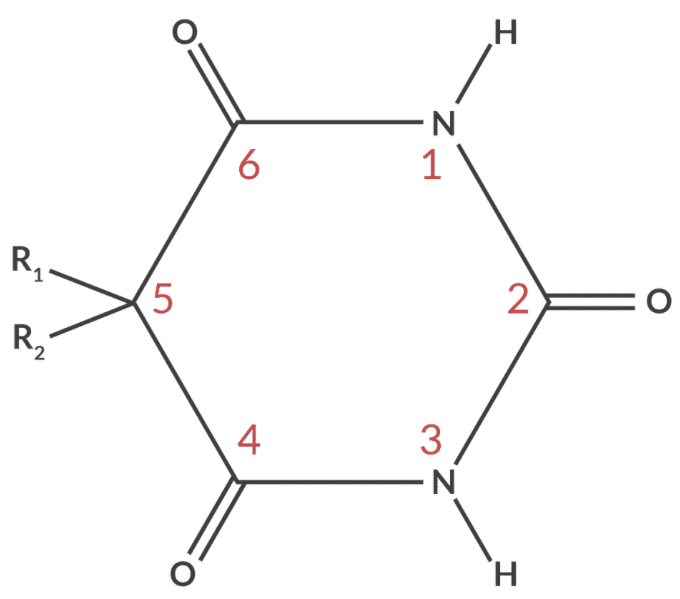
Definition: Barbiturates are a class of drugs derived from barbituric acid.
Mechanism of Action:
Barbiturates are GABA A agonists that function as hypnotics by increasing chloride channel opening.
They depress the reticular activating system in the brainstem, resulting in controlled consciousness.
Types and Variants of Barbiturates
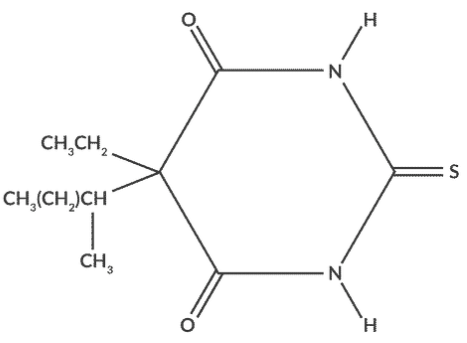
Thiobarbiturates:
Characterized by a sulfur atom in the second position of the molecule.
This configuration increases the lipid solubility and potency of the drug.
Examples: Thiopental and Thiamylal
Oxybarbiturates:
Contain oxygen in the second position.
Examples include methohexital and pentobarbital.
Adding a methyl group to nitrogen decreases the seizure threshold, thereby increasing potency.
Example is Methohexital:
Decreases seizure threshold, making it useful for electroconvulsive therapy (ECT).
Dosage: 1 to 1.5 mg/kg.
Phenobarbital:
Possesses a phenol group that introduces a carbon at the fifth position.
This modification enhances anticonvulsant effects.
Formulation & Administration
Barbiturate Solutions:
Generally, barbiturates are water-soluble with an alkaline pH of 9.
Solutions may precipitate when mixed with acidic solutions.
Administration Routes:
Venous Administration:
No venous irritation or pain occurs during administration.
Arterial Administration:
Intense vasoconstriction and crystal formation may lead to tissue necrosis which is detrimental.
Treatment for Complications
For complications arising from arterial administration:
Phentolamine and Phenoxybenzamine:
These medications induce vasodilation.
Stellate Ganglion and Brachial Plexus Block:
These procedures can cause sympathoectomy which assists in combating adverse effects.
Metabolism and Clearance
Barbiturates are cleared primarily by the liver and show redistribution upon awakening.
Repeated Dosing Effects:
Repeated doses can lead to tissue accumulation, resulting in prolonged wake-up time and hangover effects.
Key Facts About Thiopental
Chemical Name:
5-ethyl-5-(1-methylbutyl)-2-thiobarbituric acid.
Dosage:
Adults: 2.5 to 5 mg/kg.
Children: 5 to 6 mg/kg.
Onset of Action:
Rapid onset, typically 30 to 60 seconds.
Duration of Action:
Lasts approximately 5 to 10 minutes.
Active Metabolite:
At high doses, thiopental is metabolized to pentobarbital.
Effects of Barbiturates on Body Systems
Cardiovascular Effects:
Hypotension results due to venodilation and decreased preload.
Secondary myocardial depression is noted.
Thiopental may cause non-immunogenic histamine release, leading to transient hypertension and bronchoconstriction—exercise caution in asthmatic patients.
Baroreceptor reflexes remain intact, aiding in maintenance of cardiac output.
Respiratory Effects:
Barbiturates induce respiratory depression characterized by a right shift in the CO2 dissociation curve.
Central Nervous System (CNS) Effects:
Cerebral Metabolic Oxygen Requirement decreases, leading to lowered cerebral blood flow and intracranial pressure (ICP).
Barbiturates can treat intracranial Hypertension.
EEG activity diminishes, potentially leading to burst suppression or isoelectric EEG patterns.
Analgesic Effects:
Barbiturates do not exhibit analgesic properties; low doses may even increase pain perception.
Neuroprotective during focal ischemia (e.g., carotid endarterectomy) but not effective for global ischemia (e.g., cardiac arrest).
Complications Associated with Barbiturates
Acute Intermittent Porphyria:
Inducible condition associated with a defect in heme synthesis, leading to accumulation of heme precursors.
Pathway: Succinyl CoA + Glycine leads to ALA synthase producing heme precursors.
Condition exacerbated by increased activity of ALA synthase due to emotional distress, prolonged fasting (NPO status), and induction by CYP450.
Drugs to Avoid:
To prevent acute forms, avoid:
Barbiturates
Etomidate
Ketorolac
Amiodarone
Certain calcium channel blockers
Birth control pills
Lidocaine (controversial)
Anesthetic Management in Acute Intermittent Porphyria
Management Strategies:
Administer fluids and glucose to decrease ALA synthase levels.
Heme Arginate: Administers to suppress ALA synthesis.
Ensure the patient remains normothermic to prevent hypothermia.
Conclusion
Barbiturates are multifaceted agents with critical implications across various physiological systems, and their use demands an understanding of potential complications and management strategies.