Bus and ring network topologies
Bus network
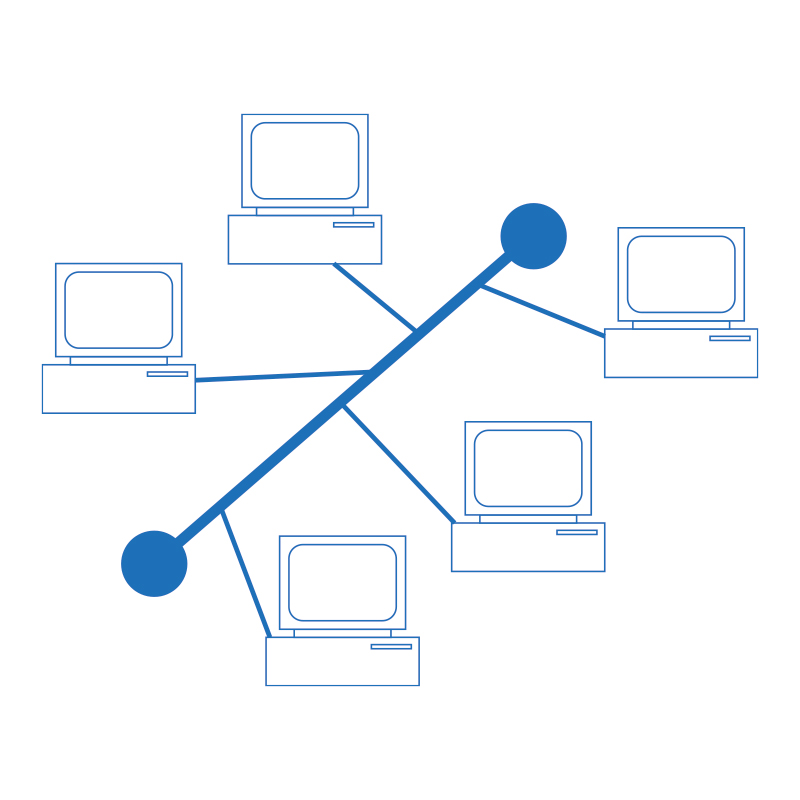
The computer systems, also known as the nodes of the network, are all connected to a single cable on which data can be sent, called the bus. A bus network has terminators [A terminator is a device that is connected to the end of a network cable to absorb signals. It also prevents the signals being reflected and causing interference.] on each end, which are needed to ensure the network functions correctly.
The bus carries data packets [A data packet is a unit of data that travels over a given network path / cable. Each packet contains information about where it came from, where it is to be sent and how to reassemble the data packets to form the original data.] along the cable. As the packets arrive at each computer system, it authenticates the destination address contained in the packet to see if it matches its own address. If the address doesn't match, the computer system ignores the packet. If the address of the computer system matches the address contained in the packet, it processes the data.
Advantages
It is easy to implement and add more computer systems to the network.
Quick to set up – well-suited for temporary networks.
Cost-effective – less cabling.
Disadvantages
It is difficult to troubleshoot the bus.
Limited cable length and limited number of stations – performance reduces as additional computers are added.
If there is a problem with the main cable or connection, the entire network goes down.
Low security – all computers on the bus can see all data transmissions.
Proper termination is required.
Data collisions [A network collision occurs when two or more computer systems (nodes) attempt to send data over a network at the same time. The collision will stop the data being transmitted and can be resolved by re-transmitting the data after a random period of time.] are more likely, which causes the network to slow down. A collision is when two computers try to send a data packet at the same time. This causes the data packets to collide and become corrupted.
Ring network
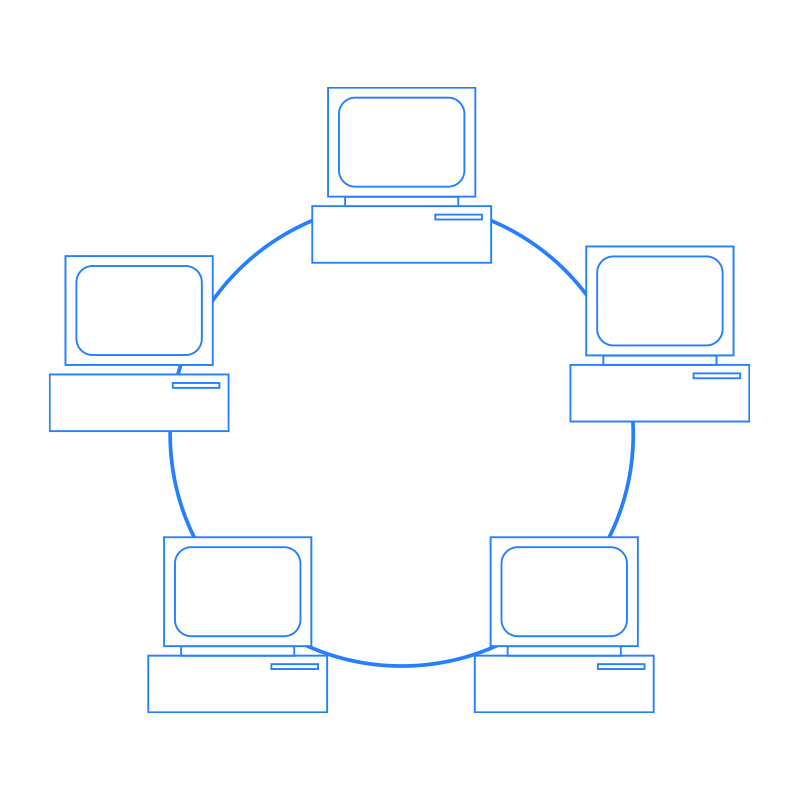
In a ring network, computer systems are connected in a ring or a loop. Data packets are sent around the ring, being passed from one computer system to the next until they arrive at their destination.
Advantages
Data is quickly transferred without a bottleneck – consistent data transfer speeds.
The transmission of data is relatively simple as data packets travel in one direction only.
Adding additional nodes has little impact on bandwidth.
It prevents network collisions.
Disadvantages
If any of the computer systems fail, the ring is broken, and data cannot be transmitted efficiently.
If there is a problem with the main cable or connection, the entire network goes down.
It is difficult to troubleshoot the ring.
Because all nodes are wired together, to add a another you must temporarily shut down the network.