Osmoreg and Excretion
FOR REVISON = green table + more detail for last session and half of this session summary (maybe watch Panopto to add more detail
Freshwater Invertebrates
Osmoregulatory Mechanisms
Unlike marine invertebrates, freshwater invertebrates are osmoregulatory = body fluids are typically hypertonic (higher concentration of ions) compared to their surroundings.
They have the ability to regulate both extracellular (excretory systems) and intracellular fluids.
These invertebrates often rely on their excretory systems to maintain extracellular fluid balances, producing highly dilute urine to cope with their freshwater environments.
Hyper-Hypoosmotic Invertebrates
Unique Adaptations
Certain invertebrates exhibit unique osmoregulatory strategies, classified as hyper-hypoosmotic regulators.
Palaemonetes (salt marsh shrimp) is hyperosmotic in freshwater but hypoosmotic in seawater.
Conversely, Artemia (brine shrimp) regulates as hypoosmotic in seawater and can withstand salinities three times greater than seawater.
These organisms must actively take in water and expel excess salts through specialized glands, which operate via active transport.
Invertebrate Osmoregulatory Challenges
Overview of Conditions
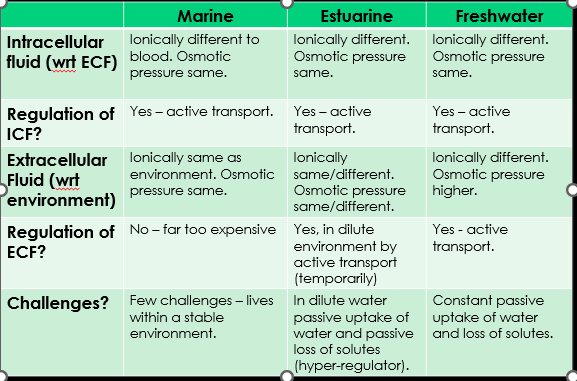
Overall, these creatures face varying difficulties based on their environments, with osmotic pressure influencing survival strategies.
Terrestrial Invertebrates
Water Conservation Strategies
Terrestrial invertebrates evolve mechanisms to conserve water:
Develop impermeable integuments, such as the waxy epicuticle found in insects.
Occupy moist habitats (hydrophiles) and obtain water via fluid feeding or by absorbing from their environment, as seen in spiders and mites.
They can also derive water from the metabolic breakdown of nutrients:
C6H12O6 + 6O2 => 6CO2 + 6H2O
Osmoregulatory Organs in Invertebrates
Overview of Organ Types
Four primary types of osmoregulatory organs in invertebrates include:
Contractile vacuoles (found in protozoans and sponges)
Nephridial glands (associated with platyhelminths)
Antennal or green glands (pertaining to crustaceans)
Malpighian tubules (common in insects)
Contractile Vacuoles
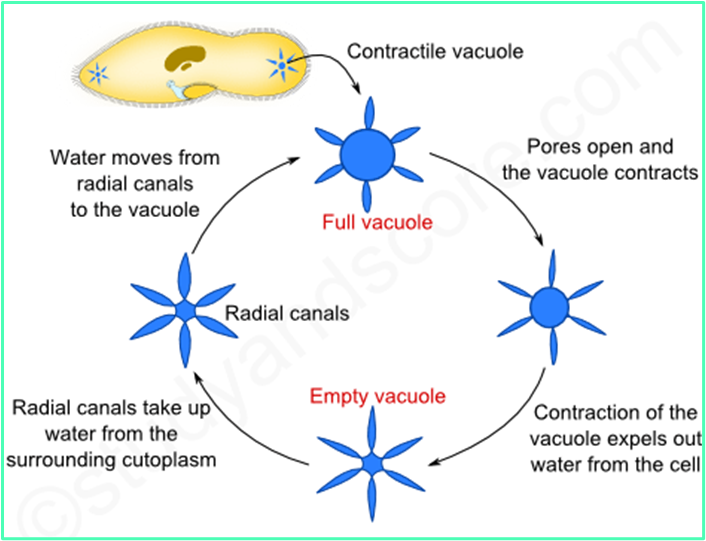
Function: Found in protozoans and sponges (very small single cell protist) with a cytoplasm that is hyperosmotic relative to their environment.
Mechanism: These vacuoles create a pressure differential and utilize mitochondria to maintain osmotic balance.
Nephridia: Protonephridia
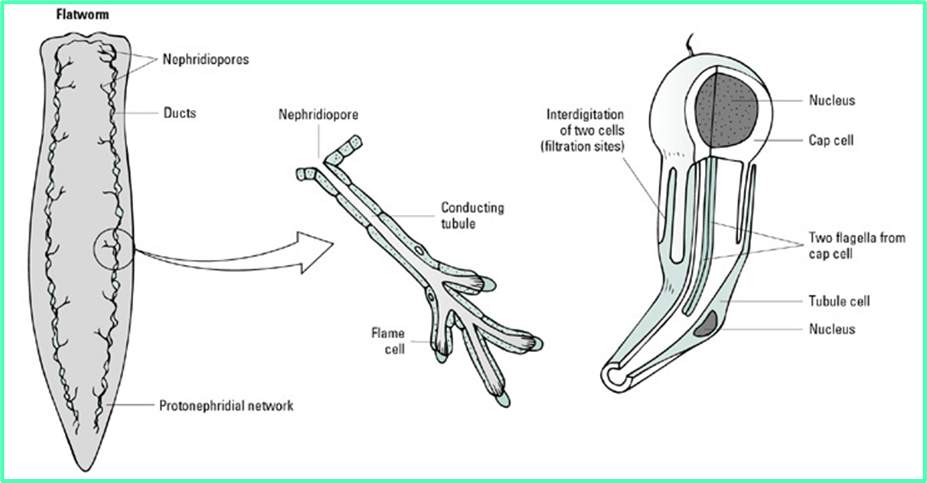
Basics: Considered one of the earliest forms of excretory systems, functioning in flatworms and rotifers.
Structure: A network of internal blind tubes that connect to the exterior via nephridophores.
Ends are capped by specialized cells, facilitating fluid movement through tubules
Types: Consist of flame cells with multiple flagella, drawing extracellular fluid through their structure, and solenocytes with a single flagellum, both functioning in liquid regulation.
Nephridia: Metanephridia
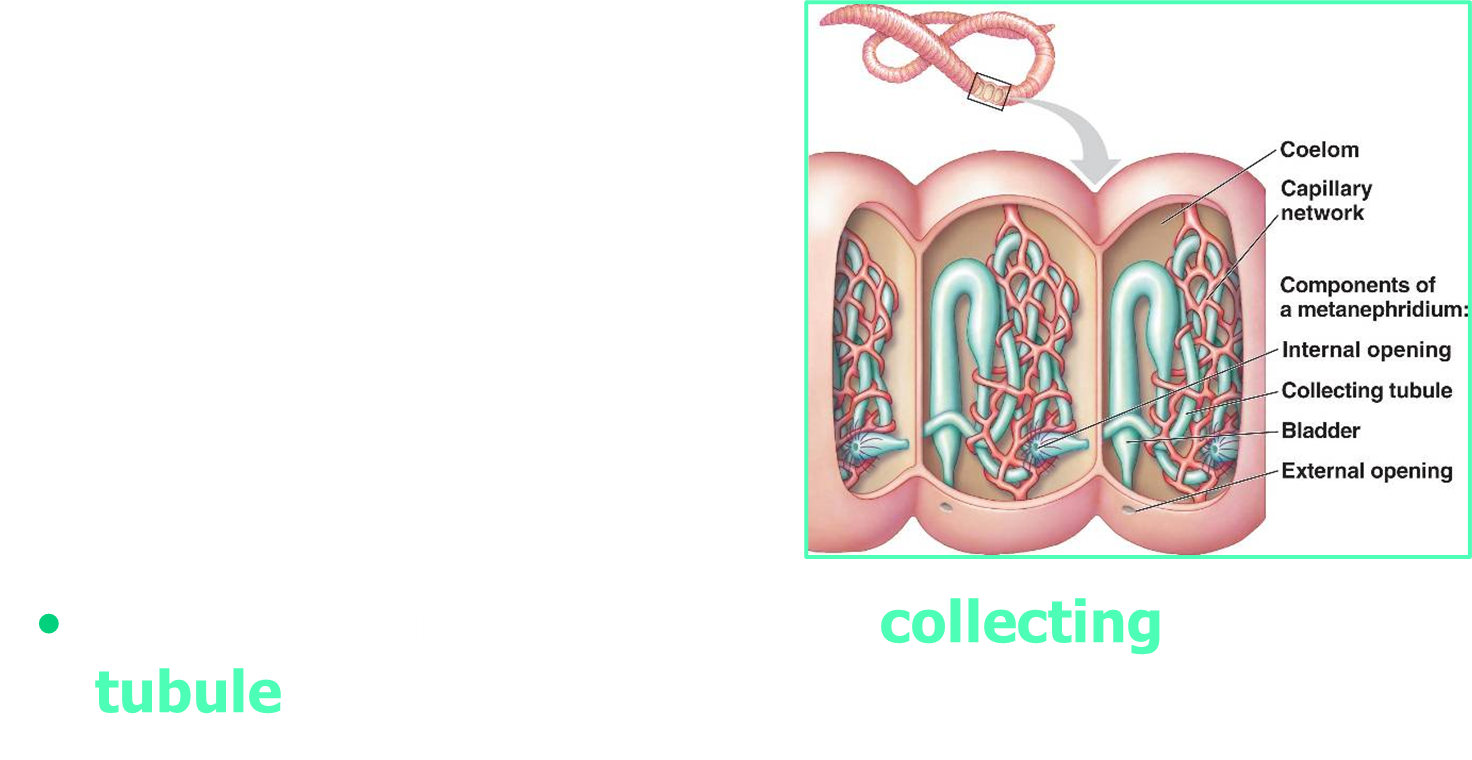
Structure: More complex systems found in annelids and mollusks
Involving internal tubules that open to the exterior known as nephridiopore and employ ciliated funnels known as nephrostomes for fluid absorption.
•Coelomic fluid passes into the collecting tubule.
Arthropod Excretion Adaptations
Exhibiting diverse osmoregulatory features due to their open circulatory system, these include:
Aquatic crustaceans excreting NH4+ through their gills with specialized antennal glands.
Terrestrial arthropods predominantly excreting uric acid and urea.
Antennal Glands in Arthropods
Structure: Comprised of a closed-end sac leading to a labyrinth; involve a nephridial canal directing urine out of the organism.
Function: Facilitate ultrafiltration of haemolymph, with urine modification occurring in the labyrinth and nephridial canal.
Insects: Malpighian Tubules
Mechanism: K+ is actively secreted into the tubes influencing water movement, with primary urine being processed in the hindgut for effective water reabsorption leading to uric acid precipitation.
Summary of Invertebrate Osmoregulatory Organs
Organs | Excretory Products | Primary Function | Mechanism | Environment |
|---|---|---|---|---|
Contractile Vacuoles | Waste from catabolism | Volume regulation – eliminate water | Active transport of ions | Aquatic |
Proto- & Metanephridia | Ammonia (NH4+) | Eliminate ions and nitrogenous wastes | Ultrafiltration, reabsorption | Aquatic/Moist |
Antennal Glands | Mg2+, SO42- | Eliminate divalent ions | Ultrafiltration, reabsorption | Aquatic |
Malpighian Tubules | Uric acid (solid) | Eliminate nitrogenous waste, conserve water | Active secretion, reabsorption | Terrestrial – dry |
Osmoregulation in Vertebrates
Variability in Integument Permeability
The permeability of the integument in vertebrates varies significantly:
Amphibians: generally permeable.
Fishes: impermeable skin with highly permeable gills.
Reptiles, birds, and mammals: largely impermeable.
Secondary aquatic mammals: retain impermeable features adapting them to aquatic environments.