Machine Checkout Guidelines
Importance of Equipment Check:
Failure to check anesthesia machine can lead to critical incidents.
Providers may be held liable for incidents resulting from not checking the anesthesia machine.
Each machine should be checked according to the specifications provided by the manufacturer.
Most recent update:
2008 ASA Checkout: Acknowledges that modern machines have automated checkout features, which includes performing breathing system and ventilator function tests. It requires the provider to then check various areas but does not indicate how the check is to be performed. It was created as the 2008 task force recognized that there is growing complexity of machine mechanics and variability in machines from different manufacturers.
BEFORE 2008 (from original 1993 update):
FDA Manufacturer-Specific Checkout: Provides a detailed checklist useful for identifying problems manually. It was previously the gold standard for many years, as it is very detailed and will find almost any problem fix. It was based on how older machines were driven primarily by pneumatics. However, this is now an outdated protocol as modernized machines are computer/electronic driven and have taken over the market.
2008 Machine Check Recommendations (ASA)
DAILY (once/day) pre-anesthesia checkout (includes those to be done before each patient):
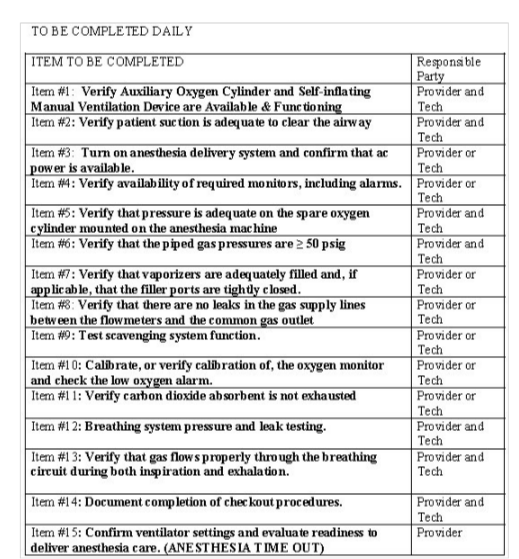
Before EACH patient check:
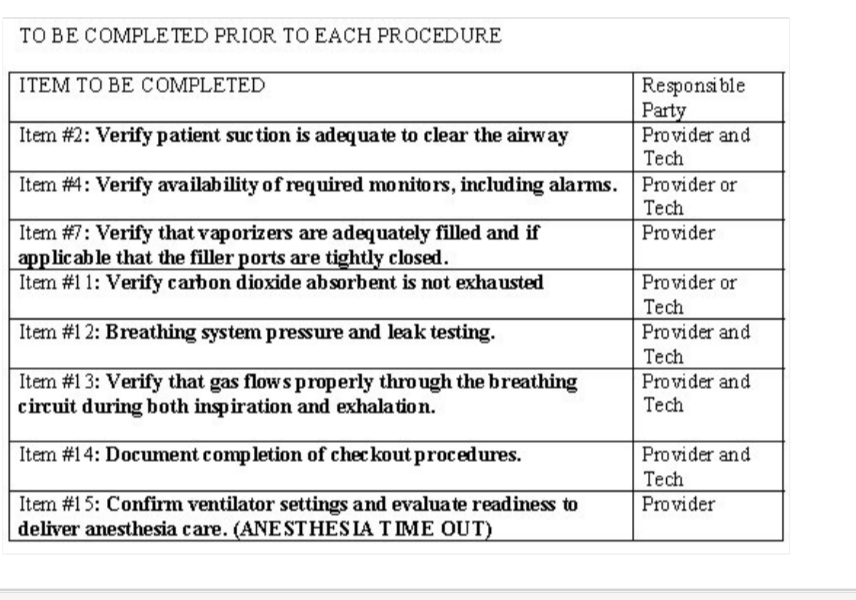
ITEM #1
Verify Auxiliary Oxygen Cylinder and Self-inflating Manual Ventilation Device (AMBU BAG) are Available & Functioning
Frequency: Daily.
Responsible Parties: Provider and technician.
Rationale: Failure to be able to ventilate is a major cause of morbidity and mortality related to anesthesia care. Because equipment failure with resulting inability to ventilate the patient can occur at any time, a self-inflating manual ventilation device (eg. AMBU bag) should be present at every anesthetizing location for every case and should be checked for proper function. In addition, a source of oxygen separate from the anesthesia machine and pipeline supply, specifically an oxygen cylinder with regulator and a means to open the cylinder valve, should be immediately available and checked. After checking the cylinder pressure, it is recommended that the main cylinder valve be closed to avoid inadvertent emptying of the cylinder through a leaky or open regulator.
ITEM #2
Verify patient suction is adequate to clear the airway
Frequency: Prior to each use.
Responsible Parties: Provider and technician.
Rationale: Safe anesthetic care requires the immediate availability of suction to clear the airway if needed
ITEM #3
Turn on anesthesia delivery system and confirm that AC power is available.
Frequency: Daily
Responsible Parties: Provider or Technician
Rationale: Anesthesia delivery systems typically function with backup battery power if AC power fails. Unless the presence of AC power is confirmed, the first obvious sign of power failure can be a complete system shutdown when the batteries can no longer power the system. Many anesthesia delivery systems have visual indicators of the power source showing the presence of both AC and battery power. These indicators should be checked and connection of the power cord to a functional AC power source should be confirmed.
Desflurane vaporizers require electrical power and recommendations for checking power to these vaporizers should also be followed
ITEM #4
Verify availability of required monitors and check alarms.
Frequency: Prior to each use.
Responsible Parties: Provider or technician.
Rationale: Standards for patient monitoring during anesthesia are clearly defined. The ability to conform to these standards should be confirmed for every anesthetic. The first step is to visually verify that the appropriate monitoring supplies (BP cuffs, oximetry probes, etc.) are available. All monitors should be turned on and proper completion of power-up self tests confirmed. Given the importance of pulse oximetry and capnography to patient safety, verifying proper function of these devices before anesthetizing the patient is essential. Capnometer function can be verified by exhaling through the breathing circuit or gas sensor to generate a capnogram, or verifying that the patient’s breathing efforts generate a capnogram before the patient is anesthetized. Visual and audible alarm signals should be generated when this is discontinued. Pulse oximeter function, including an audible alarm, can be verified by placing the sensor on a finger and observing for a proper recording. The pulse oximeter alarm can be tested by introducing motion artifact or removing the sensor.
Audible alarms have also been reconfirmed as essential to patient safety by ASA, AANA, APSF and JCAHO. Proper monitor functioning includes visual and audible alarm signals that function as designed.
ITEM #5
Verify that pressure is adequate on the spare oxygen cylinder mounted on the anesthesia machine.
Frequency: Daily
Responsible Parties: Provider and technician
Rationale: Anesthesia delivery systems rely on a supply of oxygen for various machine functions. At a minimum, the oxygen supply is used to provide oxygen to the patient. Pneumatically-powered ventilators also rely on a gas supply. Oxygen cylinder(s) should be mounted on the anesthesia delivery system and determined to have an acceptable minimum pressure (1000 PSI).
The acceptable pressure depends on the intended use, the design of the anesthesia delivery system and the availability of piped oxygen (aka, know how much O2 you are expecting to use for your patient’s case)
ITEM #6
Verify that piped gas pressures are ≥ 50 psig.
Frequency: Daily
Responsible Parties: Provider and technician
Rationale: A minimum gas supply pressure is required for proper function of the anesthesia delivery system. Gas supplied from a central source can fail for a variety of reasons. Therefore the pressure in the piped gas supply should be checked at least once daily
You may need to use the cylinder or even cancel a case depending on how long the procedure is planned to be
ITEM #7
Verify that vaporizers are adequately filled and, if applicable, that the filler ports are tightly closed.
Frequency: Prior to each use.
Responsible Parties: Provider. Technician if redundancy desired.
Rationale: If anesthetic vapor delivery is planned, an adequate supply is essential to reduce the risk of light anesthesia or recall. This is especially true if an anesthetic agent monitor with a low agent alarm is not being used. Partially opened filler ports are a common cause of leaks that may not be detected if the vaporizer control dial is not open when a leak test is performed. This leak source can be minimized by tightly closing filler ports. Newer vaporizer designs have filling systems that automatically close the filler port when filling is completed.
High and low anesthetic agent alarms are useful to help prevent over- or under-dosage of anesthetic vapor. Use of these alarms is encouraged and they should be set to the appropriate limits and enabled
ITEM #8
Verify that there are no leaks in the gas supply lines between the flowmeters and the common gas outlet. AKA, negative pressure leak test.
Frequency: Daily and whenever a vaporizer is changed.
Responsible Parties: Provider or technician.
Rationale: The gas supply in this part of the anesthesia delivery system passes through the anesthetic vaporizer(s) on most anesthesia delivery systems. In order to perform a thorough leak test, each vaporizer must be turned on individually to check for leaks at the vaporizer mount(s) or inside the vaporizer. Furthermore, some machines have a check valve between the flowmeters and the common gas outlet, requiring a negative pressure test to adequately check for leaks. Automated checkout procedures typically include a leak test but may not evaluate leaks at the vaporizer especially if the vaporizer is not turned on during the leak test. When relying upon automated testing to evaluate the system for leaks, the automated leak test would need to be repeated for each vaporizer in place. This test should also be completed whenever a vaporizer is changed. The risk of a leak at the vaporizer depends upon the vaporizer design. Vaporizer designs where the filler port closes automatically after filling can reduce the risk of leaks.
Most common leak is INSIDE the vaporizer
ITEM #9
Test scavenging system function.
Frequency: Daily
Responsible Parties: Provider or Technician
Rationale: A properly functioning scavenging system prevents room contamination by anesthetic gases. Proper function depends upon correct connections between the scavenging system and the anesthesia delivery system. Depending upon the scavenging system design, proper function may also require that the vacuum level is adequate which should also be confirmed daily. Some scavenging systems have mechanical positive and negative pressure relief valves. Positive and negative pressure relief is important to protect the patient circuit from pressure fluctuations related to the scavenging system. Proper checkout of the scavenging system should ensure that positive and negative pressure relief is functioning properly. Due to the complexity of checking for effective positive and negative pressure relief, and the variations in scavenging system design, a properly trained technician can facilitate this aspect of the checkout process.
ITEM #10
Calibrate, or verify calibration of, the oxygen monitor and check the low oxygen alarm.
Frequency: Daily
Responsible Parties: Provider or Technician.
Rationale: Continuous monitoring of the inspired oxygen concentration is the last line of defense against delivering hypoxic gas concentrations to the patient. The oxygen monitor is essential for detecting adulteration of the oxygen supply. Most oxygen monitors require calibration once daily, although some are self-calibrating. For self-calibrating oxygen monitors, they should be verified to read 21% when sampling room air. When more than one oxygen monitor is present, the primary sensor which will be relied upon for oxygen monitoring should be checked.
The low oxygen concentration alarm should also be checked at this time by setting the alarm above the measured oxygen concentration and confirming that an audible alarm signal is generated
ITEM #11
Verify carbon dioxide absorbent is not exhausted.
Frequency: Prior to each use
Responsible Parties: Provider or technician
Rationale: Proper function of a circle anesthesia system relies on the absorbent to remove carbon dioxide from rebreathed gas. Exhausted absorbent as indicated by the characteristic color change should be replaced. It is possible for absorbent material to lose the ability to absorb CO2 yet the characteristic color change may be absent or difficult to see. Some newer absorbents do not change color when desiccated. Capnography should be utilized for every anesthetic and, when using a circle anesthesia system, rebreathing carbon dioxide as indicated by an inspired CO2 concentration > 0 (so normal inspired CO2 is 0, if it does not return to 0 on the line, this indicates exhausted scrubber) can also indicate exhausted absorbent (especially important with longer procedures).
ITEM #12
Breathing system pressure and leak testing. AKA, positive pressure leak test.
Frequency: Prior to each use.
Responsible Parties: Provider and technician.
Rationale: The breathing system pressure and leak test should be performed with the circuit configuration to be used during anesthetic delivery. If any components of the circuit are changed after this test is completed, the test should be performed again. Proper testing will demonstrate that pressure can be developed in the breathing system during both manual and mechanical ventilation and that pressure can be relieved during manual ventilation by opening the APL valve.
Automated (built-in) testing is often implemented in the newer anesthesia delivery systems to evaluate the system for leaks and also to determine the compliance of the breathing system. The compliance value determined during this testing will be used to automatically adjust the volume delivered by the ventilator to maintain a constant volume delivery to the patient. It is important that the circuit configuration that is to be used be in place during the test
ITEM #13
Verify that gas flows properly through the breathing circuit during both inspiration and exhalation.
Frequency: Prior to each use.
Responsible Parties: Provider and technician.
Rationale: Pressure and leak testing does not identify all obstructions in the breathing circuit or confirm proper function of the inspiratory and expiratory unidirectional valves. A test lung or second reservoir bag can be used to confirm that flow through the circuit is unimpeded. Complete testing includes both manual and mechanical ventilation. The presence of the unidirectional valves can be assessed visually during the PAC, but NOT normal/abnormal function of the unidirectional valves. Checkout procedures to identify valve incompetence which may not be visually obvious can be implemented but are typically too complex for daily testing. A trained technician can perform regular valve competence tests. Capnography should be used during every anesthetic and the presence of carbon dioxide in the inspired gases can help to detect an incompetent valve (aka, malfunctioning).
ITEM #14
Document completion of checkout procedures.
Frequency: Prior to each use.
Responsible Parties: Provider and technician.
Rationale: Each individual responsible for checkout procedures should document completion of these procedures. Documentation gives credit for completing the job and can be helpful if an adverse event should occur. Some automated checkout systems maintain an audit trail of completed checkout procedures that are dated and timed.
ITEM #15
Confirm ventilator settings and evaluate readiness to deliver anesthesia care (ANESTHESIA TIME OUT)
Frequency: Immediately prior to initiating the anesthetic.
Responsible Parties: Provider
Rationale: This step is intended to avoid errors due to production pressure or other sources of haste. The goal is to confirm that appropriate checks have been completed and that essential equipment is indeed available. The concept is analogous to the “time out” used to confirm patient identity and surgical site prior to incision. Improper ventilator settings can be harmful especially if a small patient is following a much larger patient or vice versa. Pressure limit settings (when available) should be used to prevent excessive volume delivery from improper ventilator settings
Includes:
Monitors functional?
Capnogram present?
Oxygen saturation by pulse oximetry measured?
Flowmeter and ventilator settings proper?
Manual/ventilator switch set to manual?
Vaporizer(s) adequately filled?
**either completed out loud OR in head
SIUE NA Machine Check Protocol
MACHINE CHECK:
Turn everything on
Anesthesia machine
Vital signs monitor
Airway gas monitor
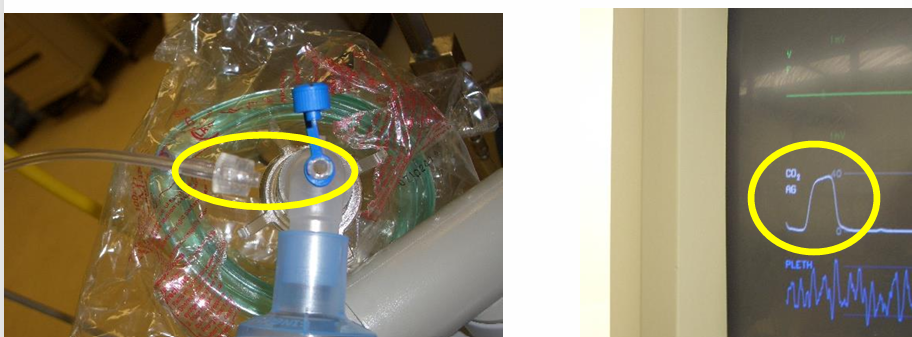
CHECK THE CO2 SENSOR:
Test the CO2 sensor
Unscrew the CO2 line from the Y-piece
Blow into the CO2 line
Look for the CO2 waveform on the monitor
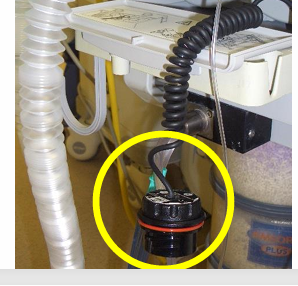
CALIBRATE THE O2 SENSOR:
Open the sensor to air
Choose calibrate to 21%
Replace sensor when complete
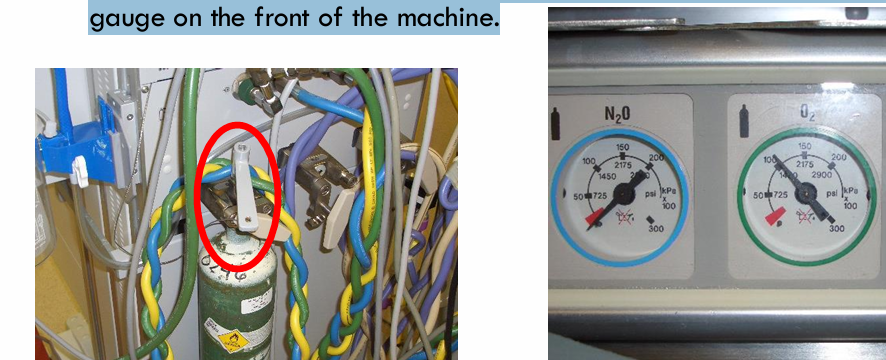
CHECK SUPPLY AND DELIVERY:
Open all cylinders by turning the cylinder key counterclockwise and then close all cylinders.
Verify no leaks at cylinder/yoke interface (turn them off and tank pressure should hold).
Reopen all cylinders.
Ensure at least 1000 psi for O2 and 750 psi for N2O available on the gauge on the front of the machine.
CHECK SUPPLY AND DELIVERY:
Disconnect all gas hoses from wall.
Open flowmeters 5L of O2 & N2O.
Close the O2 cylinder, press the O2 flush valve, and listen for the O2 failure alarm. Pressure should drop to zero.
Confirm that N2O ceases first by watching the N2O flowmeter float drop prior to the O2 flowmeter float.
Reconnect the O2 supply hose to the wall (alarm should stop).
Reconnect remaining hoses to wall.
Check pipeline pressures on the front of the machine (45-50 psi)
CHECK SUPPLY AND DELIVERY:
Test all flowmeters
Ensure that as N2O is increased, O2 also increases
Ensure that as O2 is decreased, N2O decreases
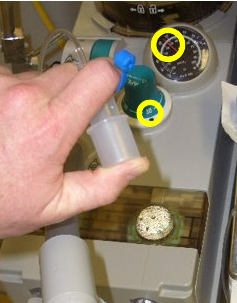
POSITIVE PRESSURE LEAK TEST:
Close the APL valve to 30
Occlude the Y-piece O2 flush valve until the pressure increases to 30 psi on the gauge
Apply pressure to bag up to 50 cm H2O
Pressure shouldn’t fall much for 10-15 seconds
Return the APL valve to open, which will empty bag into scavenger system
**This is for a MANUAL test on an older machine, most modern machines do this automatically
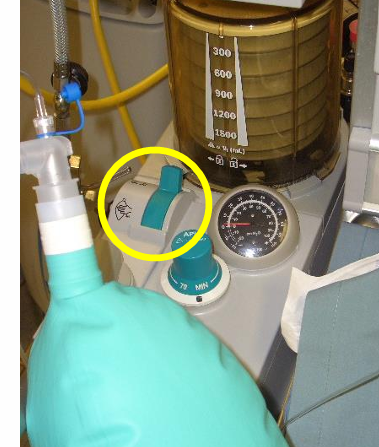
VENTILATOR AND CIRCUIT DISCONNECT CHECK:
Attach the bag to the Y-piece
Turn O2 flowmeter on 10L
Set appropriate ventilator settings
Flip the lever from bag to ventilator mode
You can fill the bellows by
Turning up the gas flows OR
Pressing the O2 flush button
Remove bag to test ventilator disconnect alarm
Turn vent and O2 flowmeter off
Replace bag back to original spot once flipped back to APL (otherwise you won’t be able to get positive pressure during your case)
For your own sanity and to stop the beeping, stop the apnea alarm after the ventilator test by ending the case
CONFIRM PROPER FUNCTION OF SCAVENGER SYSTEM:
Check general tightness of connections between the scavenging system and the anesthesia delivery system (eliminates gases from APL and ventilator relief valve)
Depending upon the scavenging system design, confirm that the vacuum level is adequate.
**loosen the top screw to see the inside valve move freely up and down and then set so it floats in middle
Some scavenging systems have mechanical positive and negative pressure relief valves.
Proper checkout of the scavenging system should ensure that positive and negative pressure relief is functioning properly.
Positive pressure relief valve is tested by closing suction valve completely and overfilling reservoir bag.
Negative pressure relief valve is tested by opening suction valve completely and allowing the bag to collapse
**Can only be tested on older machines, not newer machines. You are not expected to be able to troubleshoot this part of the machine.
SUCTION:
Suction on MAX
Canister in place with tubing connected and key turned upright
Tubing with Yankauer tip (often tucked into common gas outlet)
**most common issue is disconnection at cannister OR the little key is turned to OFF and not ON
SODA LIME:
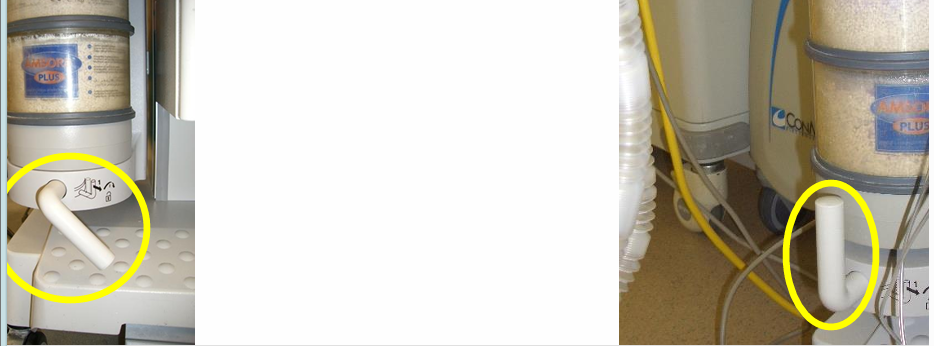
Change if discolored OR if inspired capnography is high (not returning to baseline 0)
Ensure CO2 canister holder is locked closed (if there is a leak, this is a common area to lose positive pressure and you won’t be able to effectively ventilate a patient)
VAPORIZERS:
Test vaporizers by rotating each dial counterclockwise and then closing it one at a time. You should not be able to open two vaporizers at the same time.
Check anesthetic levels in vaporizers (sight gauge)
Note that dials cannot be rotated unless vaporizer is properly seated in machine
EMERGENCY:
Verify that ambu bag is in room
Check function of ambu bag
Verify auxiliary oxygen tank is full and available
Make sure regulator is present
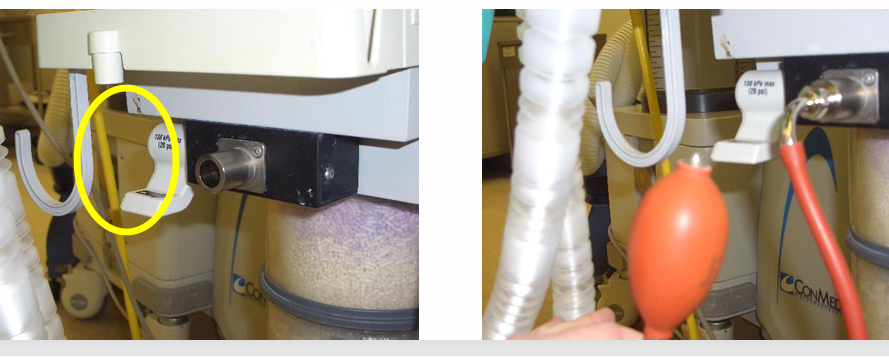
NEGATIVE PRESSURE LEAK TEST:
Open common gas outlet and close gas flows
Attach suction bulb, squeeze, and ensure bulb stays flat for 10 sec
Repeat w/ each vaporizer dial turned to open
**You most likely will not be able to manually check this anymore d/t it being an internal test within the modern anesthesia machine