CH 4 NOTES- Intro to Dev. Psych
VOCAB:
Growth charts: charts that show average values of height, weight, and other measures of growth, based on large samples of normally developing infants; the charts are used to evaluate an infant’s development
Fontanels: “soft spots,” or spaces, that separate the bones of the skull prenatally and in early infancy
Neuron: a nerve cell
Axon: the main protruding branch of a neuron; it carries messages to other cells in the form of electrical impulses
Dendrites: the protruding parts of a neuron that receive messages from the axons of other cells
Synapse: the tiny gap between the axon of one neuron and the dendrite of another
Neurotransmitter: a chemical secreted by a neuron sending a message that carries the impulse across the synaptic gap to the receiving cell
Synaptogenesis: the process of synapse formation
Myelin: an insulating material that forms a sheath around certain axons and speeds the transmission of nerve impulses from one neuron to the next
Spinal cord: the part of the central nervous system that extends from below the waist to the base of the brain
Brain stem: the base of the brain, which controls such elementary reactions as blinking and sucking, as well as such vital functions as breathing and sleeping
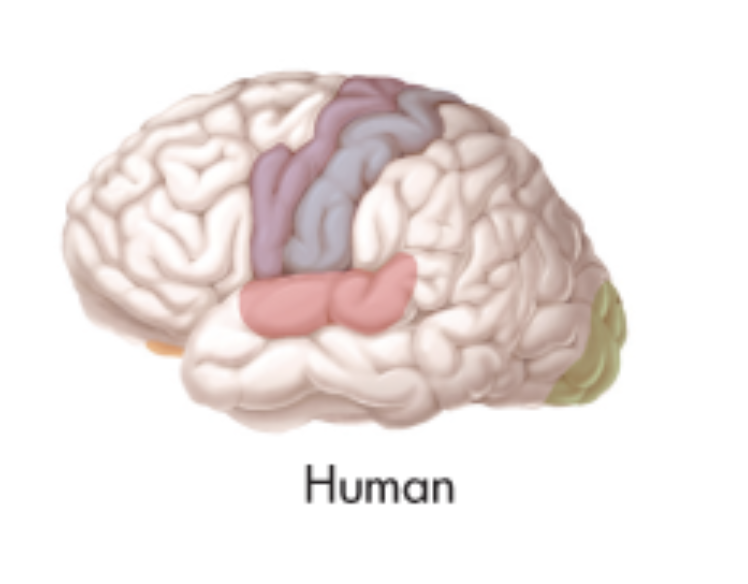
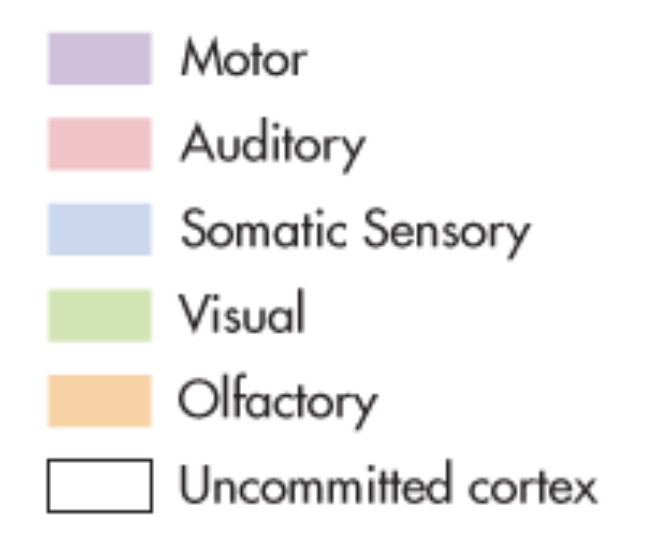
Cerebral cortex: the brain’s outermost layer. The networks of neurons in the cerebral cortex integrate information from several sensory sources with memories of past experiences, processing them in a way that results in human forms of thought and action
Experience-expectant: processes of brain development that seem to anticipate experiences that are universal in all normally developing members of our species
Experience-dependent: development of neural connections that is initiated in response to experience
Exuberant synaptogenesis: a rapid growth in synaptic density that prepares the brain for a vast range of possible experiences
Synaptic pruning: the process of selective dying-off of nonfunctional synapses
Perceptual narrowing: a process in which infants lose their apparently innate abilities to detect certain sensory features because those features do not occur very often in their environments
Electroencephalography (EEG): a common physiological method used to evaluate infant sensory capacities, which involves attaching sensors to the baby’s head and measuring changes in brain waves in response to the presentation of different stimuli
Visual preference technique: a common behavioral method used to evaluate infant sensory capacities, which involves presenting two different stimuli at once to determine if the baby displays a preference by looking at one longer than the other
Habituation: the process in which attention to novelty decreases with repeated exposure
Dishabituation: the term used to describe the process in which an infant’s interest is renewed after a change in the stimulus
Phonemes: the smallest sound categories in human speech that distinguish meanings
Visual acuity: sharpness of vision
Multimodal perception: the ability to perceive an object or event by more than one sensory system simultaneously
Reflex: a specific, well-integrated, automatic (involuntary) response to a specific type of stimulation
Babinski- when the bottom of the baby’s foot is stroked, the toes fan out and then curl
Crawling- when the baby is placed on the stomach and pressure is applied to the soles of the feet, the arms and legs move rhythmically
Eyeblink- rapid closing of eyes
Grasping- when a finger or some other object is pressed against the baby’s palm, the baby’s fingers close around it
Moro- if a baby experiences a sudden dropping sensation while being held or hears a loud noise, the baby will throw the arms outward while arching backward and then bring the arms together as if grasping something
Rooting- when touched on the cheek, the baby turns head in the direction of the touch and opens mouth
Stepping- when held upright over a flat surface, the baby makes rhythmic leg movements
Sucking- the baby sucks when something is put into his or her mouth
Piaget’s Stages of Cognitive development:
Sensorimotor- Infants’ achievements consist largely of coordinating their sensory perceptions and simple motor behaviors. As they move through the six substages of this period, infants come to recognize the existence of a world outside themselves and begin to interact with it in deliberate ways.
Preoperational- Young children can represent reality to themselves through the use of symbols, including mental images, words, and gestures. Still, children often fail to distinguish their point of view from that of others, become easily captured by surface appearances, and are often confused about causal relations.
Concrete operational- As they enter middle childhood, children become capable of mental operations, internalized actions that fit into a logical system. Operational thinking allows children to mentally combine, separate, order, and transform objects and actions. Such operations are considered concrete because they are carried out in the presence of the objects and events being thought about.
Formal operational- In adolescence, the developing person acquires the ability to think systematically about all logical relations within a problem. Adolescents display keen interest in abstract ideas and in the process of thinking itself.
Primary circular reaction: the term Piaget used to describe the infant’s tendency to repeat pleasurable bodily actions for their own sake
Learning: a relatively permanent change in behavior brought about by making associations between behavior and events in the environment
Classical conditioning: learning in which previously existing behaviors come to be elicited by new stimuli (Pavlov)
Conditional stimulus: a stimulus that elicits a behavior that is dependent on the way it is paired with the unconditioned stimulus
Unconditional stimulus: the stimulus, such as food in the mouth, that invariably causes the unconditional response
Unconditional response: the response, such as salivation, that is invariably elicited by the unconditional stimulus
Conditional response: a response to the pairing of the conditioned stimulus and the unconditioned stimulus
UCS → UCR
UCS + CS → UCR
CS → CR
Operant conditioning: learning in which changes in behavior are shaped by the consequences of that behavior, thereby giving rise to new and more complete behaviors (Skinner)
Infants States of Arousal:
Nonrapid eye movement (NREM) sleep- quiet rest; little motor activity; eyes closed and still; steadily breathing
Rapid eye movement (REM) sleep- increased motor activity; facial movements and smiles; some eye movements; irregular breathing
Periodic sleep- between REM and NREM sleep—periods of deep and steady breathing alternate with periods of more rapid and shallow breathing
Drowsiness- intermediate between NREM and REM sleep—eyes open and close, appearing glazed when open; breathing faster and more variable than in NREM sleep
Alert inactivity- some motor activity; relaxed face; eyes open and bright; steady but more rapid breathing compared to NREM sleep
Active alert- frequent disorganized motor activity; vocalizations and irregular breathing; skin flushed
Distress- vigorous disorganized motor activity; red skin; crying
Kwashiorkor: a potentially fatal form of malnutrition in which the diet is extremely low in protein
SUMMARY:
Physical Growth
As growth charts reveal, early physical growth is rapid, with the infant gaining about 6 pounds (2.7 kilograms) and growing more than 4 inches (10 centimeters) in just 12 weeks.
The growing brain pushes against the bones of the skull, expanding the infant’s head circumference.
Brain Development
At birth, the brain contains most of the cells (neurons) it will ever have, but it will become four times larger by adulthood.
Increased size results primarily from an increase in the connections among neurons and from myelination, which insulates axons and speeds the transmission of impulses.
At birth, the cerebral cortex is less mature than the brain stem, which controls reflexes such as sucking and vital functions such as breathing. Development of the cortex occurs through both experience-expectant and experience-dependent processes.
Sensing the environment
Because of immaturity of the eye’s structures, newborns are very nearsighted, but visual acuity soon improves. Newborns are able to visually scan their surroundings, they can perceive patterns and discern among forms, they show a preference for faces, and they have the ability to distinguish their mother’s face.
The organization of behavior
According to Jean Piaget, infants gain knowledge largely by coordinating sensory perceptions and simple motor responses. During the first few months, they progress through the first two of the six substages of the sensorimotor stage:
In substage 1, infants learn to control and coordinate inborn reflexes.
In substage 2, accommodation first appears, and infants prolong pleasant sensations arising from reflex actions.
According to learning theorists, learning, as evidenced by a change in behavior, occurs when the infant makes associations between his or her behavior and events in the environment. Learning may take various forms:
In classical conditioning, previously existing behaviors come to be associated with, and elicited by, new stimuli.
In operant conditioning, new behaviors may come about as a result of the reinforcement and punishment of behaviors
Becoming coordinated with the social world
Newborns sleep approximately two-thirds of the time, but their periods of sleep are relatively brief, and they may be awake at any time. They tend to adapt gradually to adults’ night/day sleep cycle, but the specifics of their sleep cycle depend in part on cultural patterns.
The maternal–infant coordination that nursing requires has a biological underpinning. However, culture influences the age at which infants breast-feed and their feeding schedules. Newborns tend to prefer a 3-hour schedule, moving to a 4-hour schedule by 2½ months and approximating an adult schedule by 7 or 8 months.
Infants’ crying is a primitive means of communication that evokes a strong emotional response in adults and alerts them that something may be wrong. Infants tend to cry less in cultures with caregiving practices such as prolonged holding and frequent feeding. Certain distinctive patterns of early cries may indicate difficulties.