The Learning Approach
AIR
associations (behaviourism)
imitation/obersavion (social learning)
reinforcement (behaviourism)
Associations
Pavlov- classical conditioning
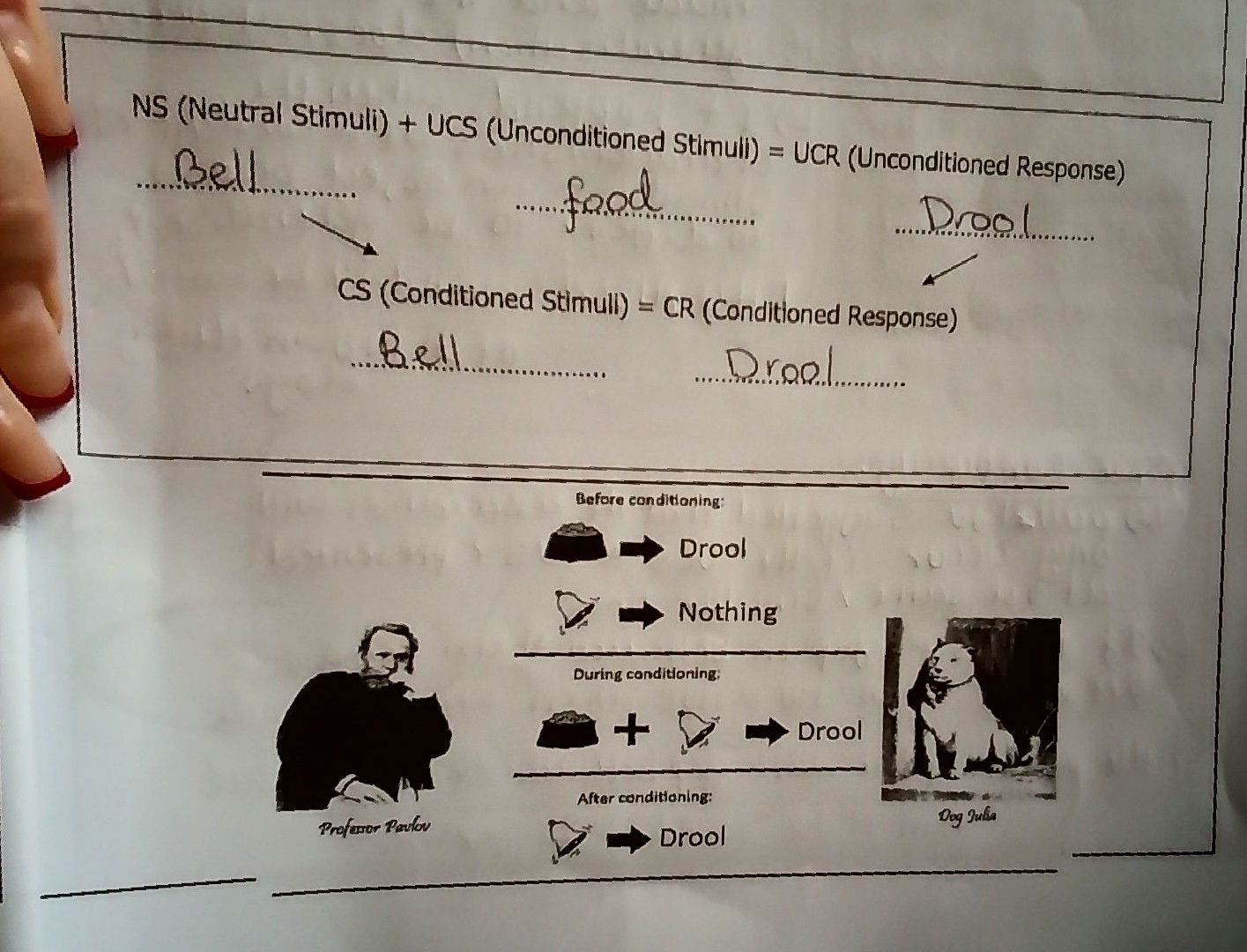
classical conditioning: learning thru association
classical conditioning was documented by Pavlov who was originaly investigatng the digestive system of dogs ( less bias)
he had a dog with a tube in it mouth and notice when the door opened and the the bell rang causing it to salivate
pavlov’s dogs made the association between the bell and arrival of food
little albert
Watson paired the white rat with a loud bang repeatedly to create an association between the two unrelated stimuli, and little Albert began fearing the white rat without the noise.
stimulus generalisation
the stimulus as characteristics close to the conditioned stimulus then this association would be generalised to the new stimulus
little albert: was scared of any white fluffy object
stimulus discrimination
at some point the association will not be made and the SG (stimulus generalisation) doesn’t occur
this happens when the characteristics of a conditioned stimulus and an objects become to different to be generalised
little albert: wouldn’t be scared of a brown fluffy dog
time continuity
pavlov suggested that the association will only occur if the UCS (unconditioned stimuli) and the NS (neutral stimuli) are presented at the same/similar time
if there is a gap in between them being presented then no association will be made
little albert: if there was a gap between the bang and the rat them he wouldn’t be scared
operant conditioning
is learning by consequence
type | deninition | example |
positive reinforcement | performing a behaviour bc ur getting a reward for it | being rewarded by ur teacher for excellent homework bc it increases the likelihood of re-occuring behaviour |
negative reinforcement | performing a behaviour to avoid being punished for it | doing homework to avoid detention (strengthened a given behaviour) |
punishment | unpleasent consequence of behaviour | being punished ( the punishment aids in deacreasing behaviours ) |
Skinner
Positive reinforcement: tested by placing a hungry rat in a Skinner box containing a lever so when the rat moved around the box it would accidentally knock the lever, which would release food (reward).
The rats quickly learned to pull the lever after a few times of being in the box.
The rats repeated this action because they were positively reinforced by the reward.
Negative reinforcement: worked by electrocuting the rat (punishment).
As the rat moved around the box, it would knock the lever and an electric current would switch on.
The rat learned to go to the lever when the light switched on to avoid electrocution.
The consequence of escaping the electrical current ensured that they would repeat the action.
analysis:
antecedents: what happens prior to the behaviour being performed ( wherther the rats pushed the lever sporadicaly/unknowingly or knew to push it
behaviours: whether they push the lever
consequence: this is what happends after the operant (result) for the rat it got a pellet of food
Immitation/observation
social learning theory
Basic assumptions
vicarious reinforcement
the observer sees the model receiving a positive or negative consequence which affects likelihood of immitation
imitation
copying behaviour
identification
copying someone u can relate to
modelling
following behaviour u think is good
Bobo doll experiment
by Bandura
aim
to investigate if social behaviours can be aquired by observation and imitation
procedure
36 male and 36 female participants aged 3-6
aggression levels tested to eliminate any extreme aggressiveness or anyone too calm
then assigned to 1 of 3 conditions
each condition has 12 females and 12 male children
Stages of the Experiment
Modeling
Condition 1: Watched female or male model be aggressive to a Bobo doll
Condition 2: Watched female or male model be nice to a Bobo doll
Control: Just watched the Bobo doll and nothing else
Aggression Arousal
All subjected to mild aggression arousal by saying how good new toys were, then saying they are not allowed to play with them
Delayed Imitation
All conditions had aggressive toys (e.g., dart gun and hammer) and non-aggressive toys (e.g., dolls and a tea set)
The children were each observed for 20 minutes through a one-way mirror in 5-second intervals
results
children who oberved the agressive modle where generally agressive to the bobo doll then the non-agressive and control conditions
boys r more likely to imitate same sex models than girls
the evidence for girls immitating same sex models r not strong
conclusion
findings support bandura’s social learning theory
evaluation
pros | cons |
|
mediational processes ARRM
Attention: for a behaviour to be imitated it has to grab attention. You have to see or hear an action to imitate it.
Retention: a memory of a behaviour must be formed for it to later be imitated e.g. thinking about it.
Reproduction: whether we are physically able to reproduce the observed behaviour to imitate it.
Motivation: the rewards and punishment will be considered before the immitation. do the benifits outweigh the costs and visa versa.