Intelligence
Intelligence: The ability to solve problems, learn from experience, and use knowledge to adapt to novel situations
General intelligence(g): Underline specific metal abilities and is therefore measured by every task on an intelligence
Testing
Achievement: Designed to asses what you already know
Aptitude: Designed to predict future performances in ability EX:ACT/SAT
Intelligence test: Wechsler’s
WAIS: Adult intelligence test
WISC: Child intelligence test
Reification: Taking a score or number and making it a part of you
Construction of Tests
Standardization: Defining meaning full scores by comparison with a performance of a pretested group
Normal curve/Bell curve:
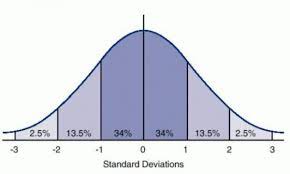
Flynn Effect: you always score better than the previous generation
Savant Syndrome: Persons with various developmental disorders, have an amazing ability and talent
Standard test
Reliability: the extent to which a test yields consistent results
test retest reliability: take test once(26)/take it again(26)-reliable, first(29)/second(14)-unreliable
Odds vs events:1-10 even(29),1-10 odd(15)-unreliable
Validity:the extent to which a test measures or predicts what its supposed to
Content validity: does test sample behavior that is of interest- is it testing you on what it’s supposed to be tested on? Ex: Parallel parking vs. Highway parking
Predictive validity: the success with which a test predicts the behavior it is designed to predict. Ex: stability vs. change
Cross-sectional study: sub groups of different ages at one time
longitudinal study: same people over a long period of time (fairly scale)= +.66
Nature vs. nurture in intelligence( Genetics vs. Genes)
Heritability: the variation between individuals attributable to genetic factors
Identical twins raised together: =+0.66
Identical twins raised apart: =+.72
Fraternal twins raised together: =+0.60
Siblings raised together: =+0.45
Adopted siblings: =+0.32
Important Contributors
Alfred Binet: Created standardized test to identify children requiring extra attention in school
Francis Galton: Psychometrics, nature vs. nurture, Believed genetics was the most important factor
Howard Gardner: Theory of multiple intelligence to expand traditional conceptions of intelligence, 8-9 different types of smart. Savant Syndrome
Daniel Goleman: Importance of emotional intelligence
Charles Spearman: Intelligence traced to a single underlying general metal ability known as g. or general intelligence. Factor Analysis
Robert Sternberg: Triarchic theory of intelligence, analytical, creative, and practical abilities come together to create intelligence.
Lewis Terman: Expanded Binet’s system to create the concept of IQ and early IQ tests, mental chronological age to calculate IQ, Stanford Binet, Eugenics
LL Thurstone: Critic of spearman who believed intelligence was made up of seven separate mental ability’s
William Stern: IQ score Mental age/Chronological age times 100
| Name | Origins of Intelligence | Name of Test | Summary of Test |
|---|---|---|---|
| Francis Galton(Cousin of Charles Darwin) | Nature—Intelligence comes from good genes. He suggested that smart families should breed and believed in eugenics | None. His attempts were crude and unscientific | He looked at successful European families in his book Hereditary Genius |
| Alfred Binet | Nurture-- Assumed low scoring kids could make gains with more remedial help and attention. | Binet’s Mental Ability Test | Tested French school children to determine their strengths and weaknesses. Provided a mental age, showing the intellectual capabilities of the student. |
| William Terman | **Nature—**Also supported eugenics; encouraged low scoring groups to become sterilized. | Stanford-Binet | Revised Binet’s Mental Ability TestFirst to adopt IQ scoreIQ= mental age/chronological age x100 (Note: this procedure is no longer used to calculate IQ)Only included verbal sections and were biased against non-English speakers.Tested immigrants (which led to quotas in immigration policy) and WWI recruits. |
| David Wechsler | **Nurture—**believed in a broad view of intelligence. “Intelligence is the aggregate or global capacity of an individual to act purposefully, to think rationally and to deal effectively with the environment.” | WAIS (for adults)WISC (for children) | Includes 11 sections, including verbal and performance subtests. Allowed non-English speakers to demonstrate their intelligence on the performance sections |
\n
Split half—Divide test into two halves and compare the results (like odd v. even)
Different tests—Take the test more than once and compare the results.
\n