Evolution
Early Earth and Evolution
four stages of the current hypothesis of life…
abiotic synthesis of small organic molecules
joining of small molecules into macromolecules
packaging of macromolecules into protocells, membrane enclosed droplets
origin of self replicating molecules
Earth is 4.6 billion years old, and life showed up about 3.8 billion years ago
Conditions of Early Earth→
atmosphere made of water vapor, nitrogen, carbon dioxide, methane, ammonia, and hydrogen sulfide
Oparin and Haldane: early atmosphere could have synthesized organic molecules using energy from lightning and UV radiation
Miller and Urey: tested the hypothesis and produced many amino acids, showed abiotic synthesis is possible
self replicating RNA was the first genetic material not DNA because it can act as an enzyme
Fossil Record→
the fossil record is the sequence in which fossils appear in the layers of sedimentary rock of Earth’s surface
incomplete, and favors organisms that existed for a while, were abundant/widespread, and had hard shells or bony exteriors
dating of fossils…
relative dating: order of rock layers to determine relative age and relation to other fossils
radiometric dating: uses the decay of radioactive isotopes to determine the age of fossils, based on half-life
Origin of Organisms→
2.7 billion years ago oxygen started to accumulate due to photosynthesis and prokaryotes evolved in an oxygen rich enviornment
2.1 billion years ago eukaryotes appeared
endosymbiotic hypothesis: mitochondria and choloroplasts were small prokaryotes that began to live within larger cells
circular DNA
enzymes and transport systems like prokaryotes
splitting process like prokaryotes
have their own ribosomes
mitochondria FIRST then chloroplast
1.2 billion years ago multicellular organisms evolved
500 million years ago plants, animals and fungi started to appear on Earth
Rise and Fall of Species→
continental drift: movement of Earth’s continents
describes disjunct geographic distribution of some species
explains why no placental mammals are indigenous to Australia
mass extinctions: the loss of a large amount of species at once from ecological changes, and can dramatically alter a complex community and give rise to new species
leads to adaptive radiation where new species are formed to fill the gaps left by the newly extinct species
Major Changes in Body Form→
evo-devo: feild of study where evolutionary and developmental biology converges and explains how slight variations can lead to major differences between species
exaptations: parts of an organism that were once used for one thing, but now are used for something else
heterochrony: evolutionary change in the rate of growth of an organisms body part
slow hind leg growth in whales = no more hind less
expedited growth of bat fingers = support for wings
homeotic genes: master regulatory genes that determine the location and organization of body parts
where wings will develop/flower petal arraignment
hox genes determine the legs of an organism, snakes don’t have any and chickens do
Darwinian Evolution
Before Darwin→
Linnaeus: created the binomial naming system and started to classify animals in to catagories based on his idea of their creation patterns
Cuvier: opposed evolution and thought events happened suddenly
Lyell: the geological processes that have occurred to shape Earth have been gradual, not catastrophes
Lamark: developed the idea of evolution based on use and disuse, and the inheritance of acquired characteristics
Wallace: same idea as Darwin, south pacific islands
Darwin→ believed that evolution occured through natural selection
individuals in a population vary in their traits
a population can produce more offspring that can survive
individuals with inherited characteristics and better suited to the enviornment and more likely to reproduce
occurs throught the unequal reproductive success of individuals which leads to adaptations
humans can modify species through artificial selection
Evidence for Evolution→
direct observations: insect populations rapidly becoming resistant to pesticides (DDT)
homology: characteristics in related species that have underlying similatiry but have different uses, anatomical signs of evolution
ex. human arm, whale flipper, bat wing
embryonic: early stages of animal development
vestigial organs: remnants of structures that served important functions in ancestors
molecular homologies: shared characteristics on the molecular level (RNA/DNA)
convergent evolution: describes why distant or unrelated organisms can ressemble each other, similar enviorment develops similar organisms
the fossil record: show the evolutionary changes over time and the origin of new species
transitional fossils support Darwin’s idea of evolution
biogeography: the geographic distribution of species
species in discrete geographic areas are usually more closely related
continental drift: explains the similarity of species on distant continents
endemic species: species found at certain geographic locations and nowhere else
Diversification and Genetic Variation
Mutations→
the only source of new genes and new alleles
point mutations: changes in a one nucleotide base in a gene (sickle cell anemia)
chromosomal mutations: can move around and delete many loci at once and are usually harmful and can become worse in later generations
most genetic variation is due to the sexual recombination of genes
crossing over in prophase 1
independent assortment in meiosis
fertilization
Hardy-Weinberg Equation→
q² + 2pq + p² = 1 AND p + q = 1
q = recessive trait
p = dominant trait
if a population is at Hardy-Weinberg equalibrium, then…
no change in allelic frequency
random mating
no natural selection
very large population size
no gene flow in or out
it’s very unlikely to be at equalibrium because populations are almost always evolving
to solve…
take the square root of the percentage of RECESSIVE alleles to find q
solve p + q = 1 for p
enter values into the second equation
Allele Frequencies→
there’s three major factors that alter allele frequency…
natural selection: alleles being passed on in different proportions than the original generation had
genetic drift: unpredictable fluctuation in allele frequencies from on generation to the next, smaller population more drift
founder: few individuals are isolated from the bigger group and form a nonrepresentitive gene pool of the original population
bottleneck: sudden change in the enviornment hugely reduces the gene pool and is not reflective of the original population
gene flow: gain or loss of alleles through the addition or subtraction of the population due to the movement of gametes or individuals
reduces the genetic differences between populations making them more similar
Natural Selection→
relative fitness: contribution of an organism to the next generation’s gene pool compared to the others contibution
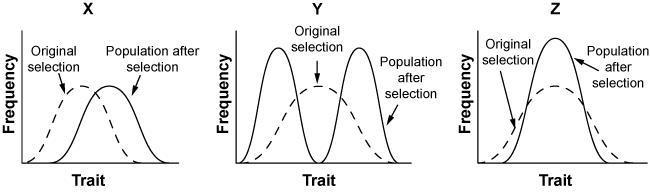
directions of selection…
directional: shift of the overall population to one side or the other
ex. black moths survived better in England so there were only black moths
disruptive: shift the population to both of the extremes
ex. birds have either large or small beaks to crack open their respective seeds
stablizing: removes the extremes from the population
ex. large and small babies rarely survive so most of them are average size
 sexual selection: individuals with certain inherited traits are more likely to be chosen to be someone’s mate can result in sexual dimorphism (difference in appearance between males and female species)
genetic variation is preserved through diploidy (have the ability to hide recessive genes because they are diploid) and heterozygous advantage (heterozygous individuals at a certain locus have advantages for survival)
Origin of Species→
speciation: the process in which new species arise
microevolution: change in the genetic makeup of a population from generation to generation, singular gene pool
macroevolution: broad pattern of evolutionary changes above the species level, appearence of feathers
biological species concept: defines species as a group of organisms that are able to produce feritle, viable offspring with each other
reproductive isolation: the existance of biological barries that prevent other species producing viable offspring together
prezygotic barriers: prevent mating, or hinder fertilization
habitat isolation: two species don’t live near each other and therefore cannot produce offspring
behavioral isolation: signals used to attract mates are specifc to a species and varies between them
temporal isolation: species breed at different times of the day
mechanical isolation: species are anatomically incompatable
gametic isolation: the gametes are unable to fuse and form a zygote
postzygotic barriers: prevent the hybrid offspring from developing into a fertile adult
reduce viability: the zygote is formed, but genetic incom[atibility causes a cease in development
reduced fertility: the hybrid is viable, but it cannot reproduce
breakdown: hybrid is viable and feritle, but when two hybrids mate their offspring are weak or sterile
allopatric speciation: a new species forms because it is geographically seperated from the parent population
due to geological events
smaller populations undergo more frequently because they’re more likely to have their gene pools significantly altered
sympatric speciation: small part of the population forms a new species without being geographically seperated
switch to new habitat, food source, or polyploidy (extra set of chromosomes)
adaptive radiation: many new species arise from a single common ancestor
Speed of Speciation→
gradualism: species gradually diverge more and more until they acquire new adaptation
punctuated equalibrium: species change at once and explaings the gaps in the fossil record