Chapter 10
Samuel Morton
Skulls racist experiment: concluded Intellect of White > Asian > Indigenous > Black based on skull size
Flawed experiment because (1) Small Sample Size, (2) Some women, who are biologically smaller, (3) “Had a feeling” one was black or white, no system to prove otherwise
Now his findings are scientifically useless, but it’s interesting to analyze the racism even in “objective” studies
Scientific Racism
Stuff did not align!
Asians were smarter than some White people, but were just seen as exceptions
Some Jews were very smart 😋
More education improved the IQ of black people even though they were supposedly completely stupid, hence NOT BIOLOGICAL DIFFERENCES
Athleticism is also not biological!
There is no gene that determines better athletic capabilities
Also impossible to track this because of distinguishing races: intermarriages [slaves and slave owners, Europeans and Indigenous rape]
TREND: Increase in intermarriages
No race is better at all sports —> Basketball is dominated by black people, but not so much sailing, bowling, etc. / Jews are good as baseball
SOCIAL CIRCUMSTANCE determines behaviour/capacities
The norm of calling black people stupid but good at sports incentivizes them to go more into sports instead of "jobs that require intellect: doctors, nurses, engineers”
Prejudice: an attitude that judges a person/their group based on their real or imagined characteristics
Discrimination: unfair treatment of people because of their group membership
Race
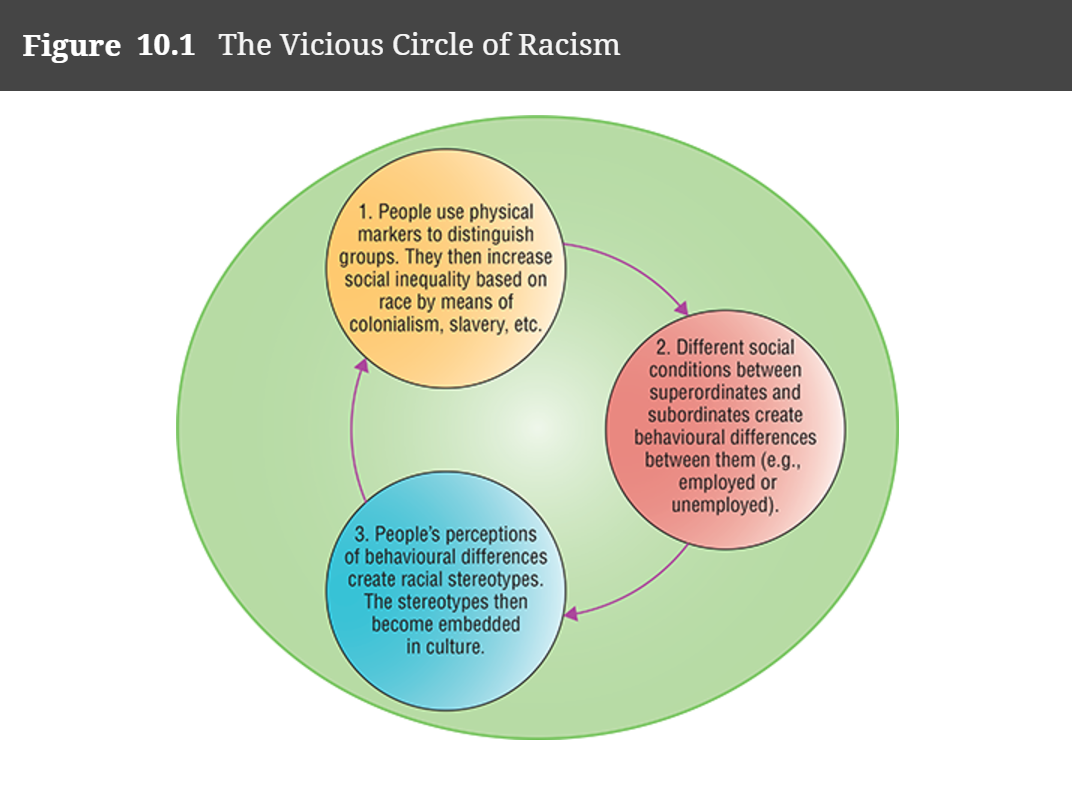
a social construct used to differentiate people in terms of one or more physical indicators
HAS LARGE EFFECTS ON PEOPLE’S LIVES
not based on biology
Why does Race Matter?
Used as scapegoats
The term perpetuates and creates social inequality
View of certain terminology can change: The term Indian was okay with Indigenous people before, but it is now scorned
Ethnic Group → people whose cultural markers are considered significant
Don’t determine differences in behaviour → rather SOCIAL STRUCTURAL DIFFERENCES differentiate different people
Ex: Black people faced discrimination; it was not their intelligence determined by their culture, but rather the structural factors revolving around their skin colour
Culture is unimportant in determining economic success
Marginalized groups have lower income, but that’s due to structural factors
Canada - Racial and Ethnic Stratification
Resources determine economic success → education, literacy, urbanity, and financial assets
British in Canada had the most power
Then immigrants
John Porter: Canada is a vertical mosaic for being racially stratified and being low-mobility for its “value system” encouraging the retention of ethnic culture
Wrong: Post WWII, More racial diversity in politics/government/professional groups
Wrong: Post WWII, more education/income for Asians, Hispanic, etc.
Their children had above-average success
Now: post 1990s, visible minorities are less successful economically than one would expect → their credentials began not being recognized by Canadian standard
Productivity loss of a billion dollars just because the foreign credentials system is poorly developed
Development of the Foreign Credentials Recognition Program
Loans from gov./non-profit orgs. to fund the additional coursework or taking of qualifying exams
Critiques of the “Ideal Immigrant”
Their worsened well-being (no family, economic stress) (new language)
International students have mental issues from the pressure of not wanting to let their parents down [to the point of suicide ;-;]
The government’s ability to provide jobs for all immigrants
less work experience and earn less due to it
Potential discrimination, as most immigrants are of minority (Asian)
How to FIX!
language and community support services
post-graduate employment services
more recognition of foreign credentials, etc.
Can’t lower tuition fee though: Universities require International fees to stay afloat
Visible Minority
Term from Canada to help lower racial discrimination in hiring
Defined: “not Aboriginal; non-Caucasian in race or non-white in colour”
Can lead to making all minority groups seem the same, people now use the term “racialized person”
Racialization
The process by which racial categories are constructed based on physical characteristics, language, culture, religion, and so on
27.3% of Canadian adults are racialized
Economically and social disadvantaged
Cannot generalize the data, different races experience different stuff [general: racialized women and men (Moreso) make less than their white counterparts]
Labels of ethnic and racial groups can change
Jew were seen as a race until post WWII, when it was seen as an ethnicity
Symbolic Interactionalism
Change in social context changes what people believe the race or ethnicity that they belong to
Ex: defining yourself as Italian Canadian because the government imposed the title onto you, so your social context of being seen as one makes you embody that race
Negotiation develops racial and ethnic labels
They are imposed, and people can accept, reject, or modify them —> leads to a new stable ethnic identity
Ex: Indians for Indigenous people → fighting against the colonial terms imposed onto them
People can also CHOOSE their ethnicity or racial identity
Ex: most Freedom of White Canadians
Black people, however, have less freedom because their identities are imposed onto them ☹
Irish Canadians eventually gained freedom of culture and away from their stereotype of being drunk, lazy, and superstitious
Herbert Gans: Symbolic Ethnicity
Defined: a nostalgic allegiance to the culture of the immigrant generation, or that of the old country; a love for and a pride in a tradition that can be felt without having it in everyday life”
Ex: Irish and only really celebrating St. Patrick’s Day
Racism
the belief that a visible characteristic of a group makes them inferior and justifies discrimination (ex: Skin Colour) (ex: Hating heterochromia is also racism)
Comes from certain groups feeling threatened
Ex: China racism for causing COVID-19, Anti-Asian hate
Micro-Aggressions
A means of measuring the extent to which a certain group is having their racial identity imposed onto them
Defined: discrimination that occurs day-to-day without people noticing that they are doing them (ex: Turning away in the elevator)
TREND: Black people treated the worst, Indigenous very close
Associated with white privilege
More seen as individuals rather than as a group
White people perpetuate this circumstance, hence perpetuating racism
Critical Race Theory
Majority group does not face prejudice from the minority group
Legal, education, health, and more discriminate against the members of the minority group
majority group justifies the social hierarchy because they are blind to institutional racism
Conflict Theory
Assimilation: the minority group becomes absorbed in the culture, beliefs, and values of the majority, becoming less distinct from them
Internal Colonialism (Conflict Theory): people from one country invading the same country and in the process changing or destroying the existing culture —> leads to developing racist beliefs, that normalize their inferiority
Indigenous
Expulsion: the forcible removal claimed by another population
Indian Act → means of “assimilating” Indigenous people to a better life and getting rid of the tribal system
Obliterated Indigenous heritage and culture; cultural genocide
Genocide: the intentional extermination of an entire race population
Seeing Indigenous people as evil/feral further normalized their inferiority
Truth and Reconciliation
TRC launched with calls of action (94 went through, only 13 passed)
The first call to action was to lower the amount of Indigenous people in the child welfare system (ready for adoption), not having gone through entirely
“The public interest is defined as the interests of a non-Indigenous public” WHICH NEEDS TO CHANGE
Fear of it becoming the Royal Commission of Aboriginal Peoples, which was ignored by the government and dissolved
Overall progress! → more stories/Ind. uni attendance/arts and culture/more movies/social movements (Idle No More)
Quebecois
Conquest: forcible capture of land and political and economic domination of its inhabitants (who are not kicked out)
The British took control of the French’s large-scale commerce (fur trade), but kept their religion and politics and agriculture relatively frenchie
Two Solitudes → French and British lived separate lives, rarely became friends, spoke different languages, and British had way more money even despite the middle-class growth
Quiet Revolution → wanting political change because the Catholic Church doing everything was NOT working; they needed government intervention politically and economically. The goals were to solve:
The demographic decline (low birth rate of Quebec women, less than 2.1)
Teaching English culture (deletion of French culture, language)
Ethnic Stratification (high-paying jobs, private management positions were more for the English-origin) (French got some good jobs though)
English use (all large and technologically advanced businesses were from the English and Americans → less upward mobility for French people)
Quebec’s extra demands
Banks be situated in Quebec and invest into the province
The state should be more an economic planar and forbid foreign ownership of cultural enterprises
Make French Education required + French-only signs in places
Quebec Today
Banned religious signs, preserving French culture
Reduced immigration levels
Out-of-province students have to pay double the tuition
THEREFORE Quebec nationalism is based less on citizenship and more on ethnicity
Black Canadians
Slavery: the ownership and control of people
Canada had the underground railway + less than USA, but still had slavery
also socially segregated and rarely highly paid
Today: no racist laws and now letting in immigrants based on their economic contribution → Black people now:
Earn more post-sec degrees
more job overqualification
Bias in court
More likely to face racism in the job market
Split Labour Market: Edna Bonacich
Low and high-wage workers compete for the same jobs, then high-wage workers hate the low-wage workers → result in racist attitude
Due to Asians getting more service sector jobs and cheap labour (the whole reason they were allowed to immigrate lmao)
Ex: Construction of the Canadian Pacific Railway 💀 but with Head Tax afterwards, deportments, and banning [Chinese] immigration
1960s: laws finally lifted against Asian discrimination
“Exclusion Leagues” formed to pressure the government in Anti-Asian riots
Canadians were jealous of Asians getting more hired [as they were willing to work for less money]
Advantages to Ethnicity → explain how some lineages >3 generations are kept and valued
Economic Benefits
Supporting local Filipino businesses or hiring other Filipinos → community solidarity intergenerationally
Political Usefulness
Programs like bilingualism and multiculturalism result in people paying more tax and economic cooperation → Increasing access to resources
Emotional support
Shared trauma, sense of rootedness, and comforting with people who speak the same language
Lack of communication actually encouraged assimilation into newly-adopted countries; we all want to stay together:
Transnational Communities: groups whose boundaries stretch along multiple countries
Future of Race and Ethnicity in Canada
Canada is the most ethnically and racially diverse, but no country is homogeneous
We have pluralism: the retention of racial and ethnic culture + equal access to basic social resources for all
We have less racial wars (Israel rn ;-;)
Changing Views of Immigration:
Before → was seen as making Canada stronger
Now → blamed them for lack of housing and cost of housing
Results in “onward immigration” and young immigrants leaving
We are still a vertical mosaic
Political Action can fix by:
Compensation for historical Injustices (Ind. $)
Institutional Reforms → stop institutional racism
Listening more to what minority groups → well-intentioned people are sometimes out-of-touch with demands