7. Syntax
Syntax describes rules that langauge uses to combine word forms into phrases, clauses and sentences and to express logical relations between constituents of construction
Three syntactic relations:
1.Constituency
→ Structure y is contained in structure x.
Example:
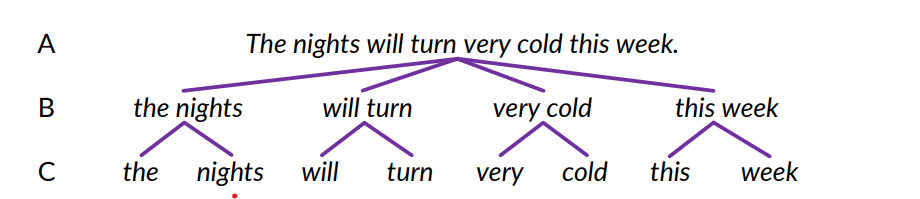
→ Elements of B and C are constituents of the sentence A, but only B are immediate constituents of A
Recognising immediate constituents:
largest unit that can be substituted by single form like pronoun
can only be moved as whole
if optional, can be omitted as whole
2.Complementation
→ Structure x and structure y require each other to form structure z of higher level
Example: this + week → this week
→ fulfills function which neither this nor week alone could
3.Modification
→ Structure x is accompanied by optional structure y that provides additional information but does not change syntactic behaviour
Example: cold → very cold
Syntax also recursive
→ Number of forms and levels in syntactic construction theoretically unlimited
Most important:
Syntactic structure is defined by functional slots which can be filled by formal realisations. In syntactic analysis vital always to keep apart what constituent is in itself (its form) and what it does (its function within larger unit).
Form vs. function → no 1-1 relation
Same syntactic function can be realised by different forms: it/the answer/… is evident
same form can fulfil different syntactic functions: Brutus I loved I Ceasar
Forms of English syntax: words
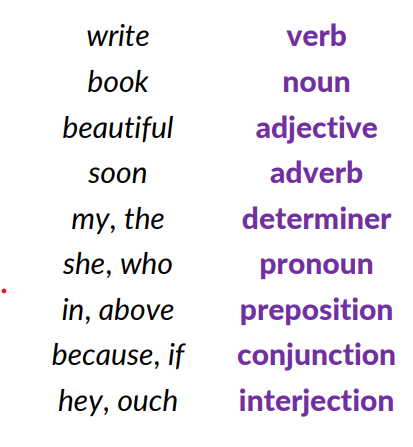
have traditionally been divided in types according to meaning → notional word classes (not satisfactory)
Structuralist approach: defined by distribution of forms over paradigmatic slots in constructions judged to be grammatical
→ can still use traditional labels for word classes (parts of speeches)
Forms of English syntax: Phrases
individual words not normally immediate constituents of clauses
at least one (often more) intermediate level at which words appear surrounded by complements and modifiers → forming phrases
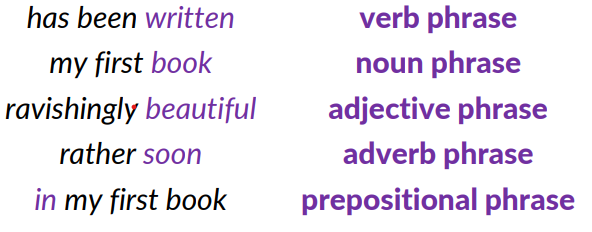
typically phrase together, sometimes discontinous e.g. the idea came up that it might be advisable to consult a lawyer
Forms of English syntax: clauses
Difference clause and sentence:
clause:
any structure that consists of verb phrase plus complement and modifiers
form of verb phrase makes claus finite/non-finite
verbless clause: verb itself may be missing with functional structure still intact
sentence:
highest ranking structure in syntax
syntactically independent consisting of at least one finite clause
theoretically unlimited number of constituents of sentence can be clauses
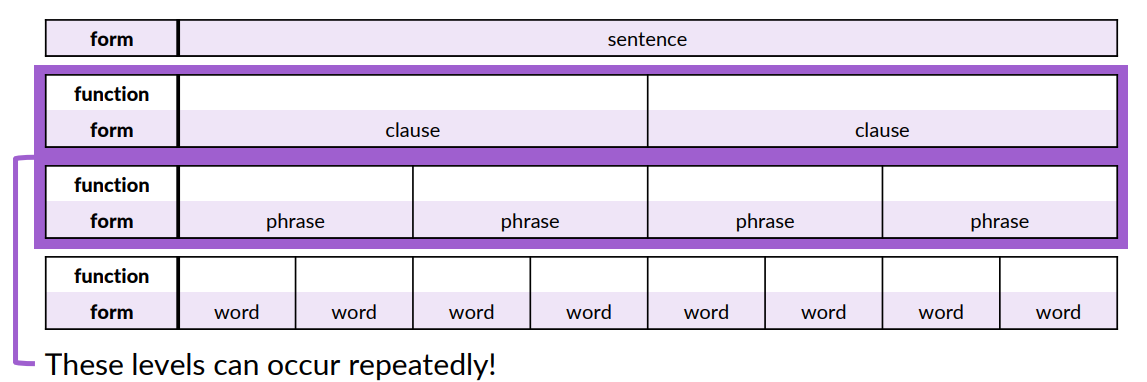
Forms of English syntax:
Highest level: the sentence
intermediate levels: clauses (of different types) / phrases of different types
lowest lewel: words (of different classes and subclasses)
Verb Phrase
Functions in verb phrase
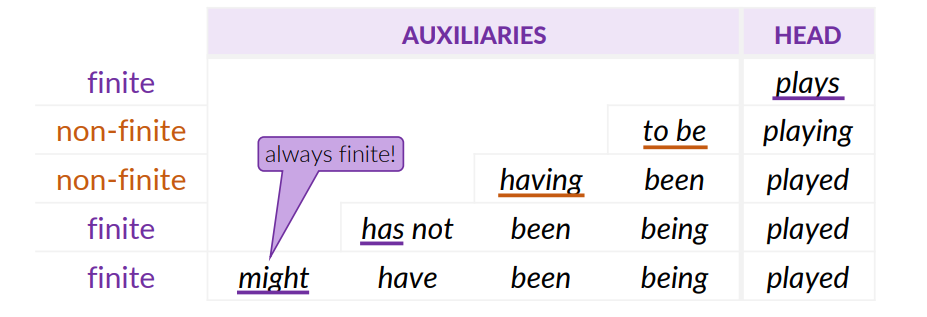
first element decides wether finite or non-finite
only other elements considered part od verb phrase are to (of infinitive) and particle “not”
Forms/sub-classes in verb phrase:
Lexical verb e.g. add, edit, .. → open class
primary verb e.g. be, have, do → closed class
modal verb e.g. can, may, must, shall, will → closed class
→ justified on distributional grounds
function: auxiliary → primary verb/modal verb
function: head → lexical verb/primary verb
→ Primary verbs both auxiliaries and heads
Noun Phrase
Functions in noun phrase
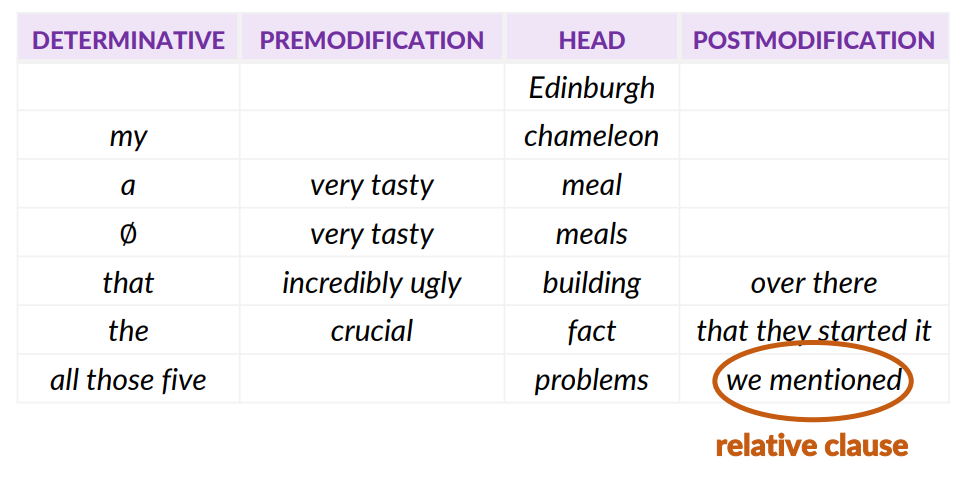
Forms/sub-classes in noun phrases
proper noun: Alice, God, April
count noun: house, idea, …
non-count noun: applause, butter, information, …
→ different types behave differently in noun phrase
determiner: the, a, an, that, my, …
pronoun: I, him, … → functionally equivalent to complete noun phrase
Proper nouns / non-count nouns can be converted into count nouns with a different meaning
Adjective Phrase
Functions in adjective phrase
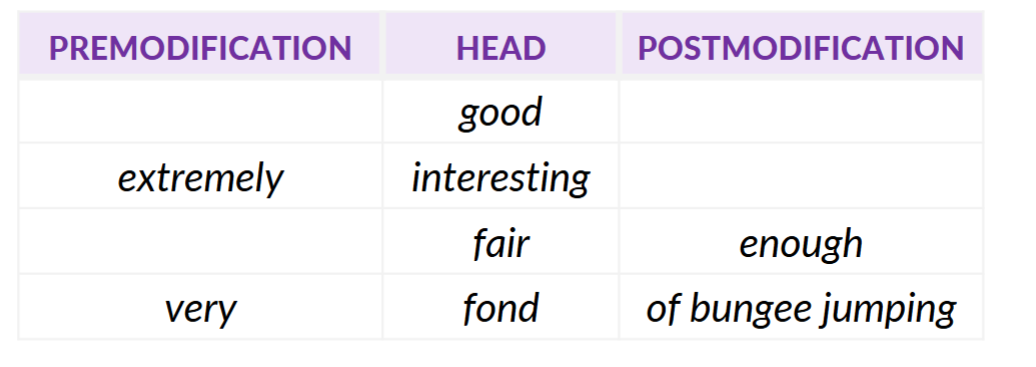
Forms:
adjective
→ even one-word phrases are phrases when occuring as immediate constituents
Adverb Phrase
Functions
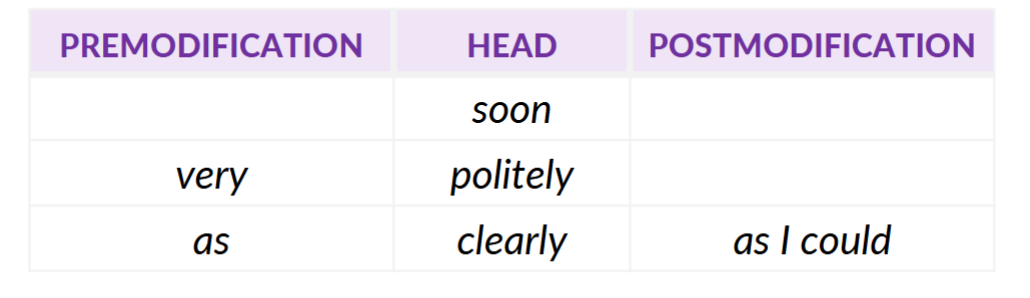
Forms:
adverb
Prepositional Phrase
Functions
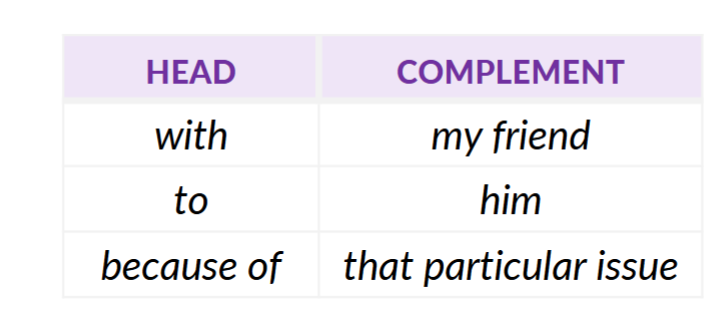
Forms:
preposition
Functions at clause level: VERB
Forms that can fulfil function verb:
verb phrase
Problem: same label for word class verb (forms) and clause function verb (what form does in clause)
But cluase function verb always realised by verb phrase → wherever verb (word class), also a verb phrase, verb (clause function) and a clause
Functions at clause level: SUBJECT
Forms that can fulfil function subject
noun phrase (including pronouns)
clause
Criteria for identification Subject
position (constituent order SV)
case
concord
behaviour under passivisation
question tag
English: finite clause usually needs overt subject, even if no semantic equivalent, empty subject required (It’s raining)
Functions at clause level: Direct Object
Forms that can fulfil function Direct Object
noun phrase (including pronouns)
clause
Criteria for identification:
position (constituent order SVO)
case
behaviour under passivisation
Functions at clause level: Indirect Object
Forms that can fulfil function:
noun phrase (including pronouns)
clause
Criteria:
position (constituent order SVOiOd
transformation into prepositional phrase
English allows passivisation for both indirect and direct objects
Functions at clause level: Subject Complement
Forms that can fulfil function:
noun phrase
adjective phrase
clause
Criteria:
reference to subject expressed by copula (linking verb) like, be, become, seem
no passivisation
Functions at clause level: Object Complement
Forms that can fulfil function
nonún phrase
adjective phrase
Criteria:
position (constituent order: SVOCo)
semantic reference to object
behaviour under passivisation
Functions at clause level: Adverbial
Forms that can fulfil function:
adverb phrase
prepositional phrase
noun phrase
clause
Criteria:
optionality
mobility
Semantically, adverbials are modifiers of:
verb phrase
entire clause
implied speech act
Functions at clause level: Obligatory Adverbial
→ Criteria of optionality/mobility doesn’t apply to certain constructions that are formally/Semantically similar to adverbials
→ with some verbs specific Adverbials act like complements
Verb complementation patterns
If stripped of all optional adverbials, clause will correspond to one of basic construction types
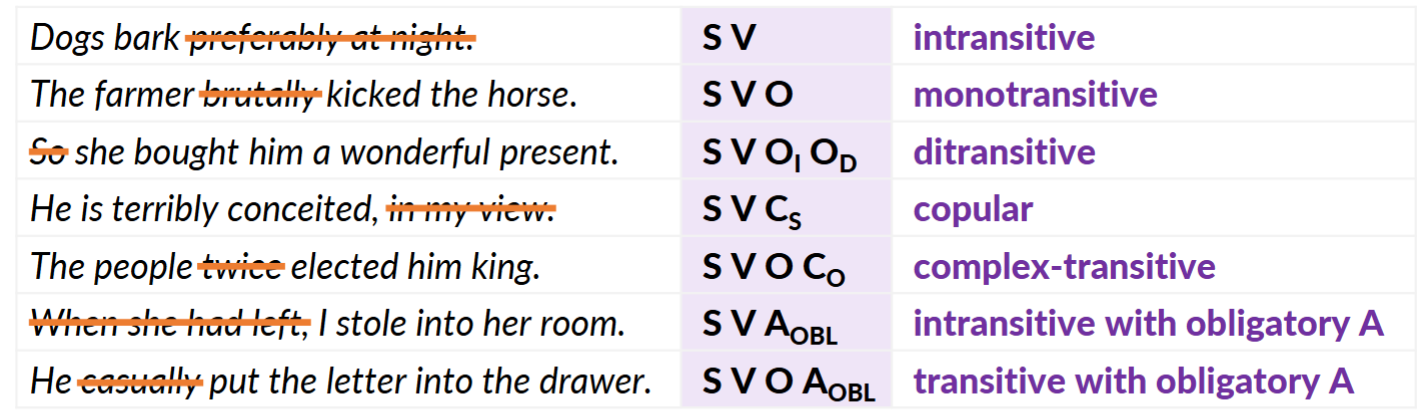
list is complete, other combinations impossible
optional adverbials can be added freely
SVO reflects most common positions but not meant to rule out other constituent order patterns
Variation:
ellipsis of subject in informal speech (“Don’t think so”)
COnstituent order SVCoO due to principle of weight
Eytraposition of long object and insertion of dummy “it”
Recipe for syntactic analysis
1. Spot highest ranking verb phrase, the verb of main clause
Criteria:
main clause is finite
not introduced by subordinating conjunction
not dependent on another constituent
→ now you have one immediate constituent of main clause
2. based on verb, determine other immediate constituents of sentence
Criteria:
each one can be substitued by single pro-form
if shiftable, shifted as whole
if omittable, omitted as wholr
→ must either be a clause or correspond to one of the five phrase types
3. Determine forms of immediate constituents
4. Assign syntactic functions to immediate constituents
5. Determine complementation pattern of highest ranking verb
2 more syntactic relations
(1. constituency, 2. complementation, 3. modification)
4.Coordination
→ Structure x and y are parallel constituents at same syntactic level but different in reference), often linked by coordinator like and, or, but (cold and cloudy)
5.Apposition
→Structures x and y are parallel constituents identical in syntactic function and reference, one of them explaind the other and either of them could be omitted (not both)
e.g. his birthday present, a book on volcanoes
Coordination and subordination
Simple sentence: one main clause
Compound sentence: two or more coordinated main clauses
Complex sentences: ine or more immediate constituents are subordinate clauses
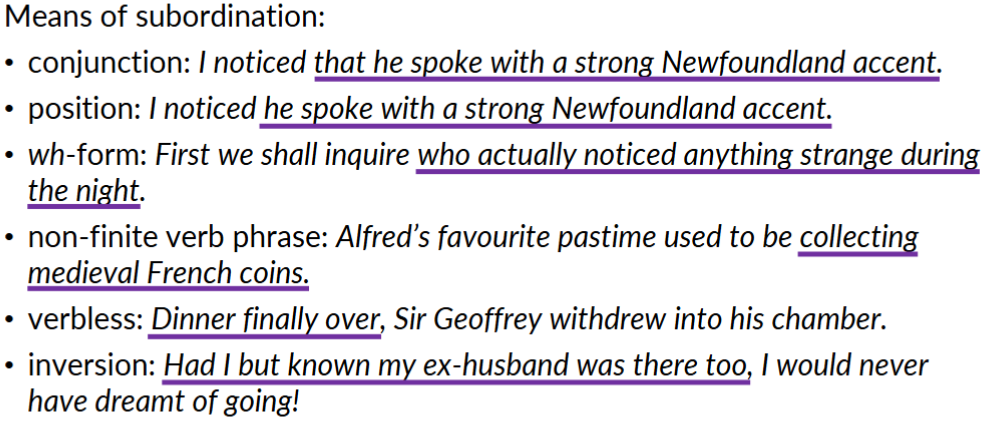
Marking constituency: Subordination
Structural ambiguity
Syntactic structures often compatible withdifferent analyses involving only subtle differences in meaning or palpable ones
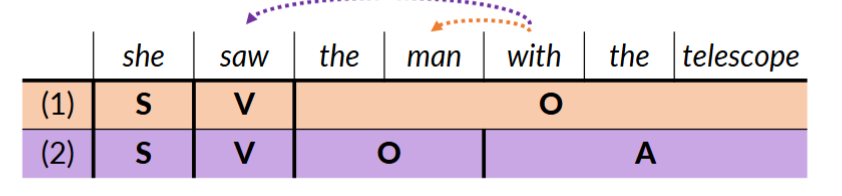
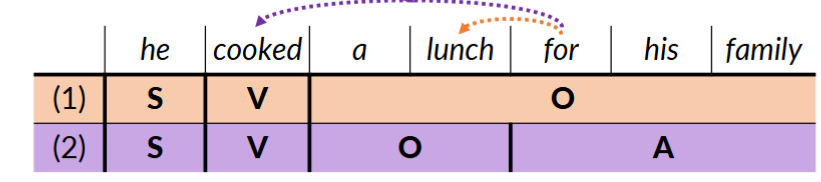
Multiple analysis
Certain sructures pose systematic problems to dscrete analysis
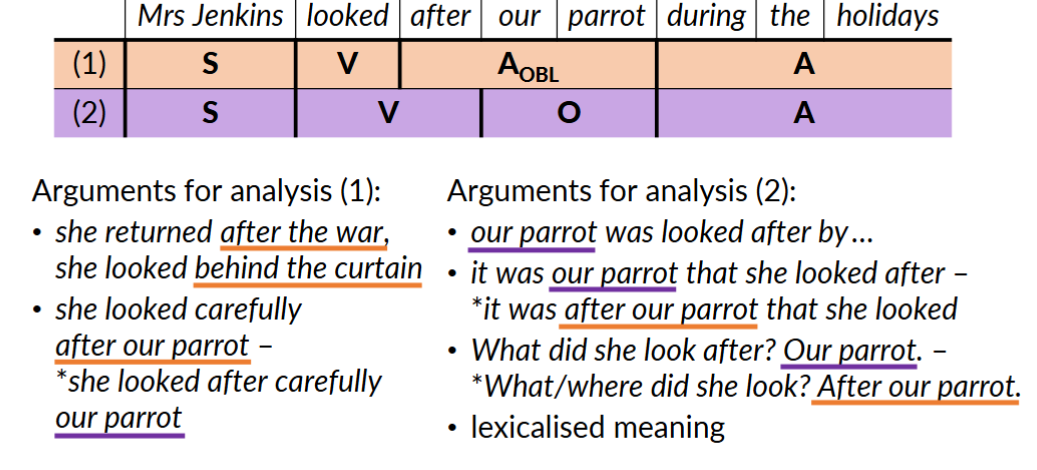
Gradience:
Realistic: syntactic categories not discrete after all
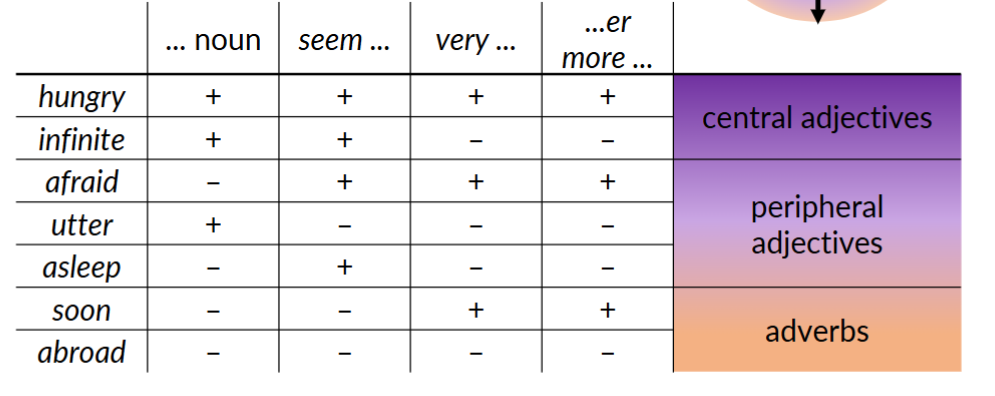
Adjectives vs adverbs